The brain's connectome -- from branch to branch
July 28, 2011 in Neuroscience
The brain's connectome -- from branch to branch

Enlarge

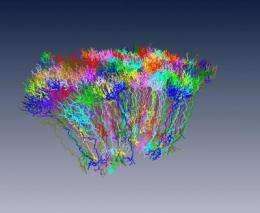
This is a reconstruction of 114 rod bipolar nerve cells from a piece of mouse retina. Each cell has a different color. The dense bundles are dendrites, and the sparser processes are axons. Credit: MPI for Medical Research

The human brain is the most complex of all organs, containing billions of neurons with their corresponding projections, all woven together in a highly complex, three-dimensional web. To date, mapping this vast network posed a practically insurmountable challenge to scientists. Now, however, a research team from the Heidelberg-based Max Planck Institute for Medical Research has developed a method for tackling the mammoth task. Using two new computer programs, KNOSSOS and RESCOP, a group of over 70 students mapped a network of more than 100 neurons – and they did so faster and more accurately than with previous methods.
The brain's connectome -- from branch to branch
Enlarge

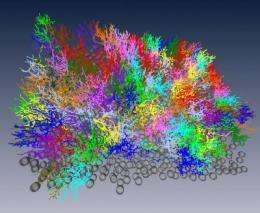
This is a reconstruction of 114 rod bipolar nerve cells from a piece of mouse retina. The dendrites form dense bundles, where the bipolar cells receive signals from the photoreceptors. The cell bodies of the bipolar cells are indicated by gray spheres. Credit: MPI for Medical Research

With some 70 billion and hundreds of thousands of kilometres of circuits, the is so complex that, for many years, it seemed impossible to reconstruct the network in detail. Each neuron is linked to about a thousand others by means of finely branched projections called dendrites and axons, and communicates with them using electrical signals. The connections between the cells are critical for brain function, so neuroscientists are keen to understand the structure of these circuits – the connectome – and to reconstruct it in a three-dimensional map. Since no computer is powerful enough yet for the task, researchers are dependent on the human eye. However, the sheer number of cellular connections contained in even the tiniest fragment of tissue makes the undertaking seem pointless – unless it is shared among a large number of people.

Moritz Helmstaedter, Kevin L. Briggman and Winfried Denk, scientists at the Institute for in Heidelberg, have now successfully tested this procedure. They developed a special software tool called RESCOP which summarises the results of several annotators to yield an overall picture. In this way, and with the support of over 70 students from Heidelberg University, they reconstructed a network of over 100 neurons from the retina in full detail.

The students used the KNOSSOS software developed by the team in Heidelberg to trace the connections between the neurons. It is no coincidence that the program is named after Crete's legendary palace, renowned for its elaborate labyrinth: "Tracing the connections in the brain is at least as hard as finding your way out of a mythological labyrinth", explains Moritz Helmstaedter.

In order to reconstruct a neural circuit, researchers start by staining the neurons of a section of tissue with heavy metals to make them visible. Using three-dimensional electron microscope images, they start at the cell body and follow the dendrites and axons, marking the branch point nodes on the screen. Then they use the computer to generate a three-dimensional image of the section. In this way, they work their way through the tangle of neurons bit by bit. It is a tedious undertaking: One person working alone with the currently available programs would take at least 30 years to reconstruct a path of 30 centimetres in length. Besides, these procedures are prone to error, since the branch points are not always easily recognised and the annotator's attentiveness decreases with time.

The KNOSSOS software considerably reduces the time required: It is about 50 times faster than other programs used up to now. In addition, the RESCOP program now makes it possible for dozens of people to work on the reconstruction at the same time. Since the method is easily learned, even non-experts can use it. Most of the students worked from home and sent their results to the scientists via e-mail. The scientists were able to establish that the error rate of the best students was no higher than that of experienced neurobiologists. Moreover, its sophisticated algorithms enable RESCOP to detect and average out inaccuracies. This means that the reconstruction is not only faster, but also more reliable than before.

"For the first time ever, these new programs could make it possible for us to unravel the complicated neural network of the brain – a task far more complex than decoding the human genome", says Winfried Denk. Next, the scientists plan to reconstruct a fragment of the mouse cerebral cortex, as this is where all the important mental processes occur.

More information: doi:10.1038/nn.2868

Provided by Max-Planck-Gesellschaft search and more info website

4.8 /5 (18 votes)  

Filter


Move the slider to adjust rank threshold, so that you can hide some of the comments.


Display comments: newest first

luke_richmond
Jul 28, 2011

Rank: not rated yet
Something tells me this isn't going to be the way the connectome is ultimately mapped. Still too time consuming.
fuviss_co_uk
Jul 28, 2011

Rank: 5 / 5 (1)
Something tells me this isn't going to be the way the connectome is ultimately mapped. Still too time consuming.


nanobots will do it, at the end of 2020's
olinhyde
Jul 28, 2011

Rank: 1 / 5 (1)
Mapping the brain might be best done using a lightweight ontology (machine driven) whereby each neural structure is mapped in n-dimensional space. There are commercial SDKs that enable this. See ai-one.com as one example.
Rank 4.8 /5 (18 votes)
Relevant PhysicsForums posts
  • A question about drug tolerance
    createdMay 23, 2012
  • Poor nutrition leading to overeating?
    createdMay 23, 2012
  • Math and dyslexia?
    createdMay 21, 2012
  • portable metabolism meter?
    createdMay 21, 2012
  • Rare medical conditions on 20/20 tonight
    createdMay 18, 2012
  • "Good" Cholesterol in Doubt
    createdMay 17, 2012
  • More from Physics Forums - Medical Sciences

More news stories

Of mice and mental models: Neuroscientific implications of risk-optimized behavior in the mouse

(Medical Xpress) -- Regardless of an organism’s biological complexity, every encephalized animal continuously makes under-informed behavioral choices that can have serious consequences. Despite its ubiquity, ...

Neuroscience created 2 hours ago | popularity not rated yet | comments 0 | with audio podcast feature

Persistent sensory experience is good for aging brain

Despite a long-held scientific belief that much of the wiring of the brain is fixed by the time of adolescence, a new study shows that changes in sensory experience can cause massive rewiring of the brain, even as one ages. ...

Neuroscience created 23 hours ago | popularity not rated yet | comments 0

Boundary stops molecule right where it needs to be

A molecule responsible for the proper formation of a key portion of the nervous system finds its way to the proper place not because it is actively recruited, but instead because it can't go anywhere else.

Neuroscience created 23 hours ago | popularity not rated yet | comments 0 | with audio podcast

Locating ground zero: How the brain's emergency workers find the disaster area

Like emergency workers rushing to a disaster scene, cells called microglia speed to places where the brain has been injured, to contain the damage by 'eating up' any cellular debris and dead or dying neurons. ...

Neuroscience created 23 hours ago | popularity 5 / 5 (2) | comments 0 | with audio podcast

Genetic 'reset switch' enables signaling pathway to induce multiple developmental outcomes for olfactory neurons

Within the nervous system, a handful of signaling pathways modulate development of a cornucopia of different neuronal subtypes. “Even small alterations in neuron differentiation pathways can disrupt subsequent ...

Neuroscience created May 24, 2012 | popularity not rated yet | comments 0


Inherited DNA change explains overactive leukemia gene

A small inherited change in DNA is largely responsible for overactivating a gene linked to poor treatment response in people with acute leukemia.

Physicians definitively links irritable bowel syndrome and bacteria in gut

An overgrowth of bacteria in the gut has been definitively linked to Irritable Bowel Syndrome in the results of a new Cedars-Sinai study which used cultures from the small intestine. This is the first study to use this "gold ...

First study to suggest that the immune system may protect against Alzheimer's changes in humans

Recent work in mice suggested that the immune system is involved in removing beta-amyloid, the main Alzheimer's-causing substance in the brain. Researchers have now shown for the first time that this may apply in humans.

Implantable pain disk may help those with cancer

An estimated 3.5 million cancer patients around the globe are in severe pain from their disease, but many get no relief.

Phone contact with nurses linked with better outcomes for women with gestational diabetes

Among women with gestational diabetes mellitus, referral to a telephone-based nurse management program was associated with lower risk of high baby birth weight and increased postpartum glucose testing, according to Kaiser ...

WHO target to cut early chronic illness deaths

The World Health Organization announced on Friday it was set to approve a new target to reduce premature deaths from chronic illnesses such as heart disease by a quarter by 2025.