New breast cancer model of mutant PI3K recapitulates features of human breast cancer
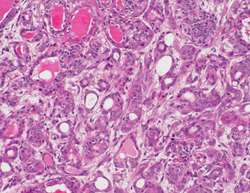
Scientists from the Friedrich Miescher Institute for Biomedical Research have shown that a mutation in the lipid kinase PI3K, which occurs in about 30% of human breast cancers, itself evokes different forms of breast cancer. While this kinase has long been associated with cancer, and is a target for anti-tumor therapy, it is now shown to be causal for multiple types of breast cancer.
Almost every sixth cancer diagnosis in women is breast cancer. Although various treatments exist for different kinds of breast cancers and although the 5-year survival rate has reached 85%, breast cancer is still the second-most common cause of cancer death after lung cancer. It is therefore vitally important to identify the molecular and cellular alterations that cause the disease.
Mohamed Bentires-Alj, his PhD student Dominique Meyer and collaborators have now published a study that addresses the role of the phosphoinositide 3-kinase (PI3K) signaling pathway in the development of breast cancer. Several proteins in this signaling cascade are known to play a role in this disease. In particular, mutations in the catalytic subunit of PI3K itself, encoded by a gene called PIK3CA, occur in approximately 30% of human breast cancers. However, it was not clear if these mutations alone can initiate the disease and what their contribution was during the development of the disease state.
These FMI scientists now show that the H1047R mutant form of PIK3CA is sufficient to cause tumors in the mammary tissue of mice. "Importantly, the mutation caused a variety of breast cancer histotypes," comments Bentires-Alj. "This indicates that the mutation has its strongest effect in precursor cells that give rise to several different cell types. Thus, our model recapitulates features of human breast tumors with the same mutation. It will be used for testing PI3K inhibitors, some of which are already in clinical trials. This type of model will allow us to predict potential resistance mechanisms to this targeted therapy." Indeed, by identifying pathways of resistance, optimal combination therapies for cancer can be designed to improve existing and future therapies.
More information: Meyer DS, et al. (2011) Luminal expression of PIK3CA mutant H1047R in the mammary gland induces heterogeneous tumors. Cancer Res 71:4344-5
Provided by Friedrich Miescher Institute for Biomedical Research
-
How to overcome resistance to one group of breast cancer drugs
Jun 08, 2010 |
not rated yet |
0
-
Genetic approach provides new insight into trastuzumab resistance in breast cancer
Oct 15, 2007 |
not rated yet |
0
-
Therapy may block expansion of breast cancer cells
Nov 05, 2008 |
not rated yet |
0
-
Hit multiple targets for maximum benefit in HER2-positive breast cancer, studies suggest
Mar 08, 2011 |
not rated yet |
0
-
Destined for disease: Breast cancer mutation regulates cell fate
Feb 03, 2011 |
not rated yet |
0
-
Motion perception revisited: High Phi effect challenges established motion perception assumptions
Apr 23, 2013 |
3 / 5 (2) |
2
-
Anything you can do I can do better: Neuromolecular foundations of the superiority illusion (Update)
Apr 02, 2013 |
4.5 / 5 (11) |
5
-
The visual system as economist: Neural resource allocation in visual adaptation
Mar 30, 2013 |
5 / 5 (2) |
9
-
Separate lives: Neuronal and organismal lifespans decoupled
Mar 27, 2013 |
4.9 / 5 (8) |
0
-
Sizing things up: The evolutionary neurobiology of scale invariance
Feb 28, 2013 |
4.8 / 5 (10) |
14
-
Why is zone 1 in liver more prone to ischemic injury?
May 23, 2013
-
How can there be villous adenoma in colon, if there are no villi there
May 22, 2013
-
How can there be a term called "intestinal metaplasia" of stomach
May 21, 2013
-
Pressure-volume curve: Elastic Recoil Pressure don't make sense
May 18, 2013
-
If you became brain-dead, would you want them to pull the plug?
May 17, 2013
-
MRI bill question
May 15, 2013
- More from Physics Forums - Medical Sciences
More news stories
New fluorescent tools for cancer diagnosis
In recent years, microRNAs (miRNAs) and other non-coding RNAs are small molecules that help control the expression of specific proteins. In recent years they have emerged as disease biomarkers. miRNA profiles have been used ...
Cancer
5 hours ago |
not rated yet |
0
Modulating the immune system to combat metastatic cancer
Cancer cells spread and grow by avoiding detection and destruction by the immune system. Stimulation of the immune system can help to eliminate cancer cells; however, there are many factors that cause the immune system to ...
Cancer
5 hours ago |
not rated yet |
0
Scientists put bowel cancer under the microscope
Researchers from London's Kingston University have begun a two-year study which could help prolong the lives of people with colorectal tumours.
Cancer
8 hours ago |
5 / 5 (1) |
0
Researcher identifies breast cancer fighting hormone
Transformative research from Western University has identified new hormones in the body which may suppress breast cancer and stimulate the regression of breast tumors.
Cancer
9 hours ago |
5 / 5 (1) |
0
Ground breaking cancer research finds immune system link
(Medical Xpress)—Curtin University researchers have found evidence that targeting specific cells in the body can reverse the effects of cancer on the immune system.
Cancer
9 hours ago |
5 / 5 (3) |
0
Researchers identify first drug targets in childhood genetic tumor disorder
Two mutations central to the development of infantile myofibromatosis (IM)—a disorder characterized by multiple tumors involving the skin, bone, and soft tissue—may provide new therapeutic targets, according to researchers ...
Engineered cytomegalovirus protects monkeys from HIV equivalent
(Medical Xpress)—A new study by researchers in the US has shown that an ancient virus can be modified to help in the fight against the simian immunodeficiency virus SIV, which is the equivalent in monkeys ...
Driving and hands-free talking lead to spike in errors, study shows
Talking on a hands-free device while behind the wheel can lead to a sharp increase in errors that could imperil other drivers on the road, according to new research from the University of Alberta.
Hormone levels may provide key to understanding psychological disorders in women
Women at a particular stage in their monthly menstrual cycle may be more vulnerable to some of the psychological side-effects associated with stressful experiences, according to a study from UCL.
Going live: Immune cell activation in multiple sclerosis
Biological processes are generally based on events at the molecular and cellular level. To understand what happens in the course of infections, diseases or normal bodily functions, scientists would need to ...
Pollen count apps for smartphones are nothing to sneeze at
Kate O'Reilly's spring allergy survival kit includes the usual stuff - nasal sprays, allergy pills and a box of tissues. This season, she's added a new weapon to her line of defense: an app on her smartphone.