Model of enigmatic Alzheimer's protein described for first time
July 18, 2011 in Medical research
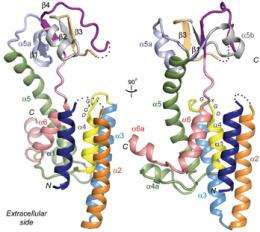
Side views of the structure of a Flak protein, a member of the same family of proteins that include presenilin, which is implicated in the onset of Alzheimer's. Understanding the structure of these proteins is an early step in the development of drugs that can combat dementia.
Yale School of Medicine researchers have described for the first time the structure of a member in an enigmatic family of proteins linked to Alzheimer's disease, a crucial early step in understanding key mechanisms of the disease and designing drugs to combat dementia.
The technical tour de force was published online July 17 in the journal Nature.
The Yale team described the crystal structure of a protease a protein that acts like molecular scissors, cutting up proteins into component parts found in membranes of an a single-celled organism. This membrane protein belongs to the GxGD membrane protease family. The most "famous" member of the family is a human protein called presenilin, which has been implicated in the production of amyloid beta, peptides that cause Alzheimer's disease. Presenilin carries more than 100 mutations that can lead to familial and early-onset Alzheimer's disease.
"Some of the key structural elements that allow the (archaea) protein to do its job are very similar to the existing structure models of human presenilin," noted Jian Hu, associate research scientist. Hu and colleague Yi Xue are lead authors of the Yale study.
The crystal structure of the protease called Flak from the archeon Methanococcus maripaludis is characterized by six transmembrane helices, the researchers found. Three of these segments form the catalytic site where the cutting of proteins is initiated. The arrangements of these three transmembrane helices are similar to those predicted in models of presenilin and therefore Flak is an ideal model system for presenilin research.
Provided by
Yale University
-
Researchers discover how mutations in presenilin gene cause early onset Alzheimer's disease
Jun 10, 2010 |
not rated yet |
0
-
Variant form of amyloid beta hinders amyloidogenesis, development of Alzheimer's disease
Mar 12, 2009 |
not rated yet |
0
-
Study suggests a second dimension to Alzheimer's disease
Sep 07, 2006 |
not rated yet |
0
-
New insight into Alzheimer's disease pathology
May 04, 2009 |
not rated yet |
0
-
Researchers find new piece in Alzheimer's puzzle
Feb 25, 2009 |
not rated yet |
0
-
Motion perception revisited: High Phi effect challenges established motion perception assumptions
Apr 23, 2013 |
3 / 5 (2) |
2
-
Anything you can do I can do better: Neuromolecular foundations of the superiority illusion (Update)
Apr 02, 2013 |
4.5 / 5 (11) |
5
-
The visual system as economist: Neural resource allocation in visual adaptation
Mar 30, 2013 |
5 / 5 (2) |
9
-
Separate lives: Neuronal and organismal lifespans decoupled
Mar 27, 2013 |
4.9 / 5 (8) |
0
-
Sizing things up: The evolutionary neurobiology of scale invariance
Feb 28, 2013 |
4.8 / 5 (10) |
14
-
Why is zone 1 in liver more prone to ischemic injury?
May 23, 2013
-
How can there be villous adenoma in colon, if there are no villi there
May 22, 2013
-
How can there be a term called "intestinal metaplasia" of stomach
May 21, 2013
-
Pressure-volume curve: Elastic Recoil Pressure don't make sense
May 18, 2013
-
If you became brain-dead, would you want them to pull the plug?
May 17, 2013
-
MRI bill question
May 15, 2013
- More from Physics Forums - Medical Sciences
More news stories
Study reveals new mechanism for estrogen suppression of liver lipid synthesis
By discovering the new mechanism by which estrogen suppresses lipid synthesis in the liver, UC Irvine endocrinologists have revealed a potential new approach toward treating certain liver diseases.
Medical research
May 23, 2013 |
5 / 5 (1) |
0
|
MRI-based measurement helps predict vascular disease in the brain
Aortic arch pulse wave velocity, a measure of arterial stiffness, is a strong independent predictor of disease of the vessels that supply blood to the brain, according to a new study published in the June issue the journal ...
Medical research
May 23, 2013 |
not rated yet |
0
Antibiotics: A new understanding of sulfonamide nervous system side effects
Since the discovery of Prontosil in 1932, sulfonamide antibiotics have been used to combat a wide spectrum of bacterial infections, from acne to chlamydia and pneumonia. However, their side effects can include serious neurological ...
Medical research
May 23, 2013 |
3 / 5 (1) |
0
|
Scientists discover molecule triggers sensation of itch
Scientists at the National Institutes of Health report they have discovered in mouse studies that a small molecule released in the spinal cord triggers a process that is later experienced in the brain as ...
Medical research
May 23, 2013 |
5 / 5 (3) |
0
|
Discarded immune cells induce the relocation of stem cells
Spanish researchers have discovered that the daily clearance of neutrophils from the body stimulates the release of hematopoietic stem cells from the bone marrow into the bloodstream, according to a report published today ...
Medical research
May 23, 2013 |
5 / 5 (2) |
0
Seniors more likely to crash when driving with pet, study finds
(HealthDay)—Animals make great companions for senior citizens, but elderly people who always drive with a pet in the car are far more likely to crash than those who never drive with a pet, researchers have ...
First drug to improve heart failure mortality in over a decade
Coenzyme Q10 decreases all cause mortality by half, according to the results of a multicentre randomised double blind trial presented today at Heart Failure 2013 congress. It is the first drug to improve heart failure mortality ...
Heart failure accelerates male 'menopause'
Heart failure accelerates the aging process and brings on early andropausal syndrome (AS), according to research presented today at the Heart Failure Congress 2013. AS, also referred to as male 'menopause', was four times ...
Death highest in heart failure patients admitted in January, on Friday, and overnight
Mortality and length of stay are highest in heart failure patients admitted in January, on Friday, and overnight, according to research presented today at the Heart Failure Congress 2013. The analysis of nearly 1 million ...
Feds fight morning-after pill age ruling in NY
(AP)—Department of Justice lawyers have again asked a federal appeals court in New York to delay lifting age restrictions and prescription requirements on an emergency contraceptive popularly known as the morning-after ...
New immune system discovered
(Medical Xpress)—A research team, led by Jeremy Barr, a biology post-doctoral fellow, unveils a new immune system that protects humans and animals from infection.