New study finds a genetic basis for muscle endurance in animal study
July 18, 2011 in Medical research
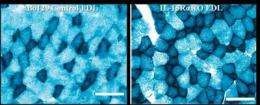
Muscles from mice lacking IL‑15R‑alpha and control mice were processed for presence of a mitochondrial marker. The mice lacking IL‑15R‑alpha show a greater number of darkly stained muscle fibers (right), indicating an increase in their mitochondrial content caused by reprogramming due to the lack of IL‑15R‑alpha. Credit: Emidio E. Pistilli, PhD, & Tejvir S. Khurana, MD, PhD, Perelman School of Medicine, University of Pennsylvania. Image is based on a Figure from Pistilli et al. 2011. Journal of Clinical Investigation.
Researchers at the Perelman School of Medicine at the University of Pennsylvania have identified a gene for endurance, or more precisely, a negative regulator of it. Not having the gene relates to greater endurance in the knockout mice that were studied. The investigators also showed that the gene is linked to Olympic-level athletes in endurance sports such as swimming compared to athletes in sprint sports such as the 100-meter dash. The study appears online this week in the Journal of Clinical Investigation. The work has implications for improving muscle performance in disease states including metabolic disorders, obesity, and aging.
"We have shown that mice lacking the gene run six times longer than control mice and that the fatigable muscles of the mouse -- the fast muscle in the front of the leg -- have been reprogrammed and are now fatigue-resistant," explains senior author Tejvir S. Khurana, MD, PhD, professor of Physiology and member of the Pennsylvania Muscle Institute. "This has wide ramifications for various aspects of muscle biology ranging from athletics to treating muscle and metabolic diseases."
The gene codes for a protein called Interleukin-15 receptor-alpha (IL-15R-alpha), which acts alone or in conjunction with the IL-15 protein. IL-15R-alpha is important in the immune response, but it also has other functions. IL-15 and IL-15R-alpha have been implicated in muscle physiology, but the exact role in muscle function has not been defined.
"We found a previously unrecognized role for IL-15R-alpha in defining muscle function, and manipulation of this gene has the potential to improve muscle performance in disease states including metabolic disorders, obesity, and aging." says lead author Emidio E. Pistilli, PhD, who was a postdoctoral researcher at Penn and is now an assistant professor in the Division of Exercise Physiology at the West Virginia School of Medicine.
Slow Vs. Fast
Slow muscles are used for endurance and fast muscles are used for speed. The champion fast muscles are the muscles moving the eye, but they are also fatigue-resistant, the only muscles like this.
In the IL-15R-alpha knockout mouse used in this study, fast muscles behave like slow muscles. These mice ran 6.3 times greater distances and had greater ambulatory activity than controls. Their fast muscles displayed fatigue-resistance and slower contractions compared to fast muscles in control mice.
They also showed that the loss of IL-15R-alpha induces a shift in how energy is burned in fast muscles, substantially increasing fatigue resistance and exercise capacity.
The molecular signature of the muscles in the knockout mice included a greater number of active transcription factors, which indicates more muscle fibers with more mitochondria, and the machinery to better process calcium since this chemical drives muscle contraction. Mitochondria are the energy storehouses of the cell.
Morphologically, the fast muscles had a greater number of muscle fibers, smaller fiber areas, and a greater number of nuclei per fiber. The alterations of physiological properties and increased resistance to fatigue in the fast muscles are consistent with a shift towards a slower, more oxidative muscle type in the knockout mice.
The study also found significant associations between the gene and elite endurance athletes and hence supports the possibility that these athletes had a genetic predisposition or advantage.
From these two lines of evidence, the researchers concluded that IL-15R-alpha plays a role in defining the function of fast skeletal muscles.
Importantly, the study demonstrates that muscles can be reprogrammed to perform much better at endurance sports and hence IL-15R-alpha manipulation is of great importance from an athletic doping standpoint as currently it is neither tested for nor do methods exist to detect its misuse by athletes. The investigators are working toward this.
This research identifies a "druggable target" that allows possible reprogramming of muscle function by increasing genes, proteins and pathways typically expressed in slow or fatigue-resistant muscle, similar to adaptations seen after endurance exercise. It is widely accepted that these types of adaptations would be beneficial or protect against obesity, diabetes and aging and may help ameliorate pathology in myopathies such as muscular dystrophy. Hence, say the researchers, the identification of this pathway should facilitate better understanding of these diseases and aid in the development of rational therapies drugs for these disorders.
From a translational research point of view the team will test the role IL-15R-alpha plays in obesity, diabetes, aging, and muscle diseases, as well as develop methods to harness the therapeutic potential of it for patients.
Provided by
University of Pennsylvania School of Medicine
-
Role of gene regulator in skeletal muscles demonstrated
Jun 02, 2011 |
not rated yet |
0
-
New insight into factors that drive muscle-building stem cells
Jan 08, 2008 |
not rated yet |
0
-
'Marathon mice' elucidate little-known muscle type
Jan 03, 2007 |
not rated yet |
0
-
Exercise may slow progression of ALS
Jun 08, 2010 |
not rated yet |
0
-
Muscle gene may provide new treatments for obesity and diabetes
Jul 27, 2010 |
not rated yet |
0
-
Limits to growth: Scientists identify key metastasis-enabling enzyme
May 22, 2012 |
5 / 5 (3) |
0
-
Seeing is as seeing does: Spatially-structured retinal input in early development of cortical maps
Apr 26, 2012 |
5 / 5 (4) |
1
-
Dreamless nights: Brain activity during nonrapid eye movement sleep
Apr 09, 2012 |
4.4 / 5 (12) |
0
-
Take your time: Neurobiology sheds light on the superiority of spaced vs. massed learning
Mar 28, 2012 |
4.5 / 5 (21) |
3
-
Your brain on 'shrooms: fMRI elucidates neural correlates of psilocybin psychedelic state
Feb 29, 2012 |
4.9 / 5 (42) |
45
-
A question about drug tolerance
May 23, 2012
-
Poor nutrition leading to overeating?
May 23, 2012
-
Math and dyslexia?
May 21, 2012
-
portable metabolism meter?
May 21, 2012
-
Rare medical conditions on 20/20 tonight
May 18, 2012
-
"Good" Cholesterol in Doubt
May 17, 2012
- More from Physics Forums - Medical Sciences
More news stories
Rockefeller scientists pioneer new method to determine mechanisms of drug action
(Medical Xpress) -- Knowing that a drug works is great. Knowing how it works is a luxury. And until now, determining a drugs mechanism of action has been a tedious and difficult process for scientists.
Medical research
13 minutes ago |
not rated yet |
0
|
Like curry? New biological role identified for compound used in ancient medicine
Scientists have just identified a new reason why some curry dishes, made with spices humans have used for thousands of years, might be good for you.
Medical research
7 hours ago |
4 / 5 (3) |
1
|
The cells' petrol pump is finally identified
The oxygen and food we consume are converted into energy by tiny organelles present in each cell, the mitochondria. These 'power plants' must be continuously supplied with fuel, to maintain all vital functions. A team led ...
Medical research
18 hours ago |
5 / 5 (1) |
0
Researchers identify protein necessary for behavioral flexibility
Researchers have identified a protein necessary to maintain behavioral flexibility, which allows us to modify our behaviors to adjust to circumstances that are similar, but not identical, to previous experiences. Their findings, ...
Medical research
20 hours ago |
5 / 5 (2) |
1
|
From stem cell to brain cell - new technique mimics the brain
A new technique that converts stem cells into brain cells has been developed by researchers at Lund University. The method is simpler, quicker and safer than previous research has shown and opens the doors to a shorter route ...
Medical research
22 hours ago |
5 / 5 (1) |
0
Routine care for Crohn's disease in children should include measurement of bone age
(Medical Xpress) -- Measuring bone age should be a standard practice of care for pediatric patients with Crohns disease, in order to properly interpret growth status and improve treatment, according to a new study from ...
Australia defiant on WTO cigarette challenge
Australia said Friday it would "vigorously defend" itself against complaints about its plan for plain cigarette packaging made by Honduras and Ukraine to the World Trade Organisation.
Chile to cover sex change operations
Chile will soon cover sex change surgeries under its public health plan in order to allow citizens of limited means to "recover their true sexual identity," Health Minister Jaime Manalich said.
Pool access for the disabled sparks controversy
(AP) -- The Obama administration is sidestepping an election-year confrontation with the hotel industry and other pool owners to give them more time to comply with access rules for the disabled.
Better response plans needed for children exposed to domestic violence
(Medical Xpress) -- Each year, millions of children are exposed to domestic violence, a traumatic experience that has been associated with cognitive, behavioral, social and emotional problems in childhood ...
Progestin treatment for polycystic ovarian syndrome may reduce pregnancy chances
(Medical Xpress) -- The hormone progestin, often given as a first step in infertility treatment for polycystic ovary syndrome (PCOS), appears to decrease the odds of conception and of giving birth, according to a study by ...