The best hospitals are run by physicians
July 6, 2011 in Health
The best hospitals are run by physicians

Enlarge

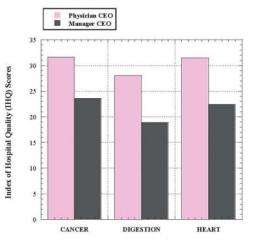
This is figure 1 from "Physician-Leaders and Hospital Performance: Is There an Association?", IZA Discussion Paper No. 5830. Credit: © IZA

Top-performing hospitals are typically ones headed by a medical doctor rather than a manager. That is the finding from a new study of what makes a good hospital.

The research, to be published in the elite journal , is the first of its kind. Its conclusions run counter to a modern trend across the western world to put generally trained managers -- not those with a medical degree -- at the helm of hospitals. This trend has been questioned, particularly by the Darzi Report, which was commissioned by the U.K. , but until now there has been no .

Amanda Goodall PhD, the author of the study, and a senior researcher at the Institute for the Study of Labor (IZA) in Bonn, Germany, constructed a detailed database on 300 of the most prominent hospitals in the United States. She then traced the professional background and of each leader. The research focused particularly on hospital performance in the fields of cancer, digestive disorders and .

The study shows that scores are approximately 25% higher in physician-run hospitals than in the average hospital.

Goodall said: "Over the last few decades there has been a growing tendency for hospital boards to appoint managers as CEOs. These findings raise some over that trend."

She said: "According to the latest data, outstanding hospitals tend to be those run by somebody with a medical degree. I was surprised by the strength of the pattern. It seems that age-old conventions about having doctors in charge -- currently an idea that is out of favor around the world -- may turn out to have been right all along."

Barry Silbaugh M.D., the CEO of American College of Physician Executives, commented: "We are watching Dr Goodall's research carefully because it seems to finally provide a real evidence-base for physician leadership. This is something we have long supported."

Goodall stressed that more research would be needed before cause-and-effect could be truly understood. The study, a cross-sectional one, uses data from 2009. "This is an intriguing pattern but these snap-shot results for a single point in time do not prove that doctors make the best heads of hospitals, although they are consistent with that claim. More research following a range of hospitals through time is urgently needed," she said.

Provided by Institute for the Study of Labor (IZA), Bonn, Germany

not rated yet  

Filter


Move the slider to adjust rank threshold, so that you can hide some of the comments.


Display comments: newest first

RobertKarlStonjek
Jul 07, 2011

Rank: not rated yet
You would expect some better performance in the area of expertise of the CEO eg medical verses financial. The better performance would be short lived if the hospital was running at a loss, for instance, and a pointless institution if it couldn't fulfill its basic purpose (treating the sick). Which approach is returning the best overall balance?
Rank not rated yet
Relevant PhysicsForums posts

More news stories

P&G to add latches to make detergent packs safer

(AP) -- Procter & Gamble says it will change the design of packaging for its miniature laundry detergent product to deter children from eating the brightly colored packets that look like candy.

Health created 9 minutes ago | popularity not rated yet | comments 0

In Spain, 70 percent of women use contraceptives during their first sexual encounter

Contraceptive use in Spain during the first sexual encounter is similar to other European countries. However, there are some geographical differences between Spanish regions: women in Murcia use contraceptives ...

Health created 1 hour ago | popularity not rated yet | comments 0

WHO target to cut early chronic illness deaths

The World Health Organization announced on Friday it was set to approve a new target to reduce premature deaths from chronic illnesses such as heart disease by a quarter by 2025.

Health created 1 hour ago | popularity not rated yet | comments 0

Better response plans needed for children exposed to domestic violence

(Medical Xpress) -- Each year, millions of children are exposed to domestic violence, a traumatic experience that has been associated with cognitive, behavioral, social and emotional problems in childhood ...

Health created 3 hours ago | popularity not rated yet | comments 0

Australia defiant on WTO cigarette challenge

Australia said Friday it would "vigorously defend" itself against complaints about its plan for plain cigarette packaging made by Honduras and Ukraine to the World Trade Organisation.

Health created 4 hours ago | popularity 5 / 5 (1) | comments 0


Cancer may require simpler genetic mutations than previously thought

Chromosomal deletions in DNA often involve just one of two gene copies inherited from either parent. But scientists haven't known how a deletion in one gene from one parent, called a "hemizygous" deletion, can contribute ...

World Health Assembly endorses new plan to increase global access to vaccines

Ministers of Health from 194 countries at the Sixty-fifth World Health Assembly today endorsed a landmark Global Vaccine Action Plan (GVAP), a roadmap to prevent millions of deaths by 2020 through more equitable access to ...

Inherited DNA change explains overactive leukemia gene

A small inherited change in DNA is largely responsible for overactivating a gene linked to poor treatment response in people with acute leukemia.

Of mice and mental models: Neuroscientific implications of risk-optimized behavior in the mouse

(Medical Xpress) -- Regardless of an organism’s biological complexity, every encephalized animal continuously makes under-informed behavioral choices that can have serious consequences. Despite its ubiquity, ...

Implantable pain disk may help those with cancer

An estimated 3.5 million cancer patients around the globe are in severe pain from their disease, but many get no relief.

First study to suggest that the immune system may protect against Alzheimer's changes in humans

Recent work in mice suggested that the immune system is involved in removing beta-amyloid, the main Alzheimer's-causing substance in the brain. Researchers have now shown for the first time that this may apply in humans.