For some, hypnosis eases pain, recovery of surgery
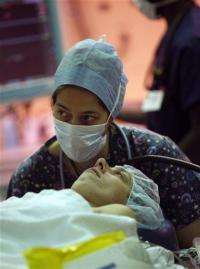
(AP) -- As the surgeons cut into her neck, Marianne Marquis was thinking of the beach.
As she heard the doctors' voices, she was imagining her toes in the sand, the water lapping.
Marquis had been hypnotized before surgery to have her thyroid removed. She's among a growing number of surgical patients at the Belgian hospital, Cliniques Universitaires St. Luc in Brussels, who choose hypnosis and a local anesthetic to avoid the groggy knockout effect of general anesthesia.
These patients are sedated but aware, and doctors say their recovery time is faster and their need for painkillers reduced. This method is feasible for only certain types of operations.
In her case, Marquis, 53, imagined herself in a field near a beach - which her anesthetist began describing by whispering into her ear about 10 minutes before surgery. She remembers hearing the doctors talk to her, but said it was as if they were far away.
"I was imagining squishing my toes in the sand and feeling water come up over them," Marquis said. She felt a little pressure on her neck with the first incision but said it wasn't painful.
Since doctors began offering hypnosis at the hospital in 2003, hundreds of patients have chosen it. At another Belgian hospital, more than 8,000 surgeries have been done this way since 1992.
Doctors say nearly any surgery usually done with a local anesthetic could work with hypnosis and less pain medicine. Proponents say hypnosis can dull patients' sense of pain and that it also cuts down on the need for anesthetic.
That means patients recover faster and hospitals save money, according to some studies. But it may require doctors to spend more time with patients beforehand to do the hypnosis and they may need more careful monitoring during surgery.
The technique has become increasingly popular in France and Belgium in recent years. Some plastic and facial surgeons in Germany also use hypnosis, as well as some British dental surgeons.
The French Society of Anesthesiologists describes hypnosis as a valid way to supplement anesthesia to reduce stress, anxiety and pain but neither the Belgian nor British anesthesiology groups offer specific hypnosis advice. Because of demand, the French Society of Anesthesiologists created a special hypnosis branch in their organization last year.
There are no figures on how widely hypnosis is used across Europe. In several of the nearly dozen French hospitals in Rennes, a northwest city of about 200,000 people, it's used in about half of all operations, says Claude Virot, a psychiatrist and director of the Institute of Research and Training in Therapeutic Communication there. Virot helps organize hypnosis training and said about 500 health professionals get it every year in France.
Dr. Fabienne Roelants, Marquis' anesthetist, described hypnosis as a modified state of consciousness. "The patient's mind goes to a pleasant place, but the body stays in the operating room." At Roelants' hospital, one-third of all surgeries to remove thyroids and one-quarter of all breast cancer surgeries, including biopsies and mastectomies, use hypnosis and local anesthetic. She and colleagues hope to expand the technique to procedures like hernias, knee arthroscopies and plastic surgeries.
Roelants said if patients feel any pain during the procedure, anesthetists immediately give them a painkiller shot.
During a recent procedure in Brussels where Christel Place, 43, had her thyroid removed, she furrowed her brow a couple of times to signal to Roelants she needed more drugs. In a green-lit room that helps relax the patients, Place pictured herself hiking in the French Alps while surgeons sliced her neck open.
The thyroid is a small gland at the bottom of the neck and makes hormones to control the body's metabolism. It is sometimes removed when it becomes enlarged, overactive or cancerous. The surgery can be done either with local or general anesthesia and is considered low-risk.
Place said waking up from the surgery was more abrupt than she'd expected. "It was like I was really in the mountains and then 'poof,' it was over," Place said, laughing.
Other experts caution that hypnosis would be impossible in major operations involving the heart or other internal organs because the pain would be unbearable.
"If hypnosis doesn't work and you've got somebody's abdomen or chest open, then you're in big trouble," said George Lewith, a professor of health research at Southampton University. "You need to be able to switch to another option immediately," he said.
Consistency is also an issue. "It's not used routinely because it's not effective in everyone and it takes a while," said Dr. Mark Warner, president of the American Society of Anesthesiologists. He said doctors would need extra time to conduct hypnosis and would need to work more closely with surgeons.
Warner said there are no guidelines on its surgical use in the U.S. He often uses music therapy or asks patients to picture a soothing scene to distract them from any discomfort. "If we could get more research on the right patient groups that would benefit from (hypnosis), that would be wonderful," he said.
Some experts said hypnosis is a hard sell because no one really profits from it.
"The problem is the money doesn't really go into anyone's hands, and the only person who really benefits from it is the patient," said Guy Montgomery, an associate professor at the Mount Sinai Medical Center in New York, who led a study published in the Journal of the National Cancer Institute in 2007.
In that research, Montgomery and colleagues randomly assigned 200 patients in the U.S. having a breast biopsy or lumpectomy to either get hypnosis or a brief session with a psychologist beforehand. They found hypnotized patients needed fewer painkillers and sedatives and required less time in surgery. On average, each hypnotized patient cost the hospital about $770 less than those who weren't hypnotized.
Marquis recommends hypnosis to patients who want to avoid anesthesia, but warned it isn't for everyone.
"You have to be in the right mental frame of mind for this, be properly prepared and trust the medical staff to take care of you," she said. "If you're very skeptical of hypnosis and freaked out about whether it's going to work, it probably won't."
©2011 The Associated Press. All rights reserved. This material may not be published, broadcast, rewritten or redistributed.


