Philippines warns against geckos as AIDS treatment
July 15, 2011 in HIV & AIDS
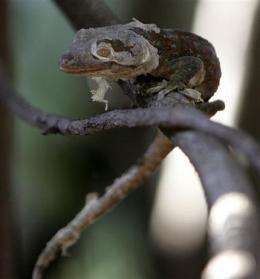
A moulting gecko clings to a twig as it is released into the sprawling compound of the Parks and Wildlife office at suburban Quezon city east of Manila, Philippines Friday July 15, 2011. Environment officials have expressed alarm about the growing illegal collection of the reptile in the Philippines with no less than the Health department warning Friday against using geckos to help treat AIDS and asthma, saying the folkloric practice that has spawned a thriving trade of Geckos in parts of Asia may put patients at risk. (AP Photo/Bullit Marquez)
(AP) -- The Philippines warned Friday against using geckos to treat AIDS and impotence, saying the folkloric practice in parts of Asia may put patients at risk.
Environmental officials have also expressed alarm about the growing trade in the wall-climbing lizards in the Philippines. An 11-ounce (300-gram) gecko reportedly sells for at least 50,000 pesos ($1,160).
Geckos are reportedly exported to Malaysia, China and South Korea, where they are used as aphrodisiacs and as traditional medicine for asthma, AIDS, cancer, tuberculosis and impotence.
Their use as medical treatments has no scientific basis and could be dangerous because patients might not seek proper treatment for their diseases, a health department statement said.
"This is likely to aggravate their overall health and put them at greater risk," it added.
Treatments for asthma are easily available and affordable, while there are antiviral drugs to control the progress of HIV, it added.
Geckos are carnivorous, nocturnal reptiles from the family Gekkonidae that are found in tropical countries. They are known for their sticky footpads that allow them to climb vertical surfaces, including glass.
Wildlife official Mundita Lim said her office has asked law enforcers to look into the possibility that scammers may have infiltrated the trade because of the exorbitant prices being quoted online by buyers demanding geckos weighing at least 400 grams (14 ounces).
She said geckos in the wild grow up to 200 grams (7 ounces). Those fattened in captivity can grow only up to 300 grams (10 ounces).
In folkloric practice, geckos are dried and pulverized to use as medicine, and there are anecdotal accounts of the saliva or internal organs being collected, according to Lim.
Environment Secretary Ramon Paje earlier warned that collecting and trading geckos without permit can be punishable by up to four years in jail and a fine of up to 300,000 pesos ($6,900).
He said a healthy population of geckos is needed to regulate pests and maintain the fragile ecosystem. Geckos feed on insects and worms. Larger species hunt small birds and rodents.
©2011 The Associated Press. All rights reserved. This material may not be published, broadcast, rewritten or redistributed.
-
Sticky gecko feet: The role of temperature and humidity
May 14, 2008 |
not rated yet |
0
-
Scientists discover four new gecko species
Jan 18, 2008 |
not rated yet |
0
-
Invasive night geckos outcompete local day geckos
Jun 07, 2011 |
not rated yet |
0
-
Angular observation of joints of geckos moving on horizontal and vertical surfaces
Nov 19, 2008 |
not rated yet |
0
-
New angle on gecko research: Scientists discover trigger that deploys geckos' amazing grip
Aug 05, 2009 |
not rated yet |
0
-
Of mice and mental models: Neuroscientific implications of risk-optimized behavior in the mouse
6 hours ago |
not rated yet |
0
-
Limits to growth: Scientists identify key metastasis-enabling enzyme
May 22, 2012 |
5 / 5 (3) |
0
-
Seeing is as seeing does: Spatially-structured retinal input in early development of cortical maps
Apr 26, 2012 |
5 / 5 (4) |
1
-
Dreamless nights: Brain activity during nonrapid eye movement sleep
Apr 09, 2012 |
4.4 / 5 (12) |
0
-
Take your time: Neurobiology sheds light on the superiority of spaced vs. massed learning
Mar 28, 2012 |
4.5 / 5 (21) |
3
-
Classical and Quantum Mechanics via Lie algebras
Apr 15, 2011
- More from Physics Forums - Independent Research
More news stories
Mortality rates decrease, chronic disease rates increase among HIV+ ICU patients
The expanded use of antiretrovirals, potent drugs used to treat retroviral infections such as human immunodeficiency virus (HIV), has been linked to significant decreases in hospital mortality rates among severely ill HIV-positive(HIV+) ...
HIV & AIDS
May 23, 2012 |
not rated yet |
0
Newly discovered breast milk antibodies help neutralize HIV
Antibodies that help to stop the HIV virus have been found in breast milk. Researchers at Duke University Medical Center isolated the antibodies from immune cells called B cells in the breast milk of infected mothers in Malawi, ...
HIV & AIDS
May 22, 2012 |
5 / 5 (3) |
1
|
Reactions to HIV drug have autoimmune cause, reports AIDS journal
Potentially severe hypersensitivity reactions to the anti-HIV drug abacavir occur through an autoimmune mechanism, resulting from the creation of drug-induced immunogens that are attacked by the body's immune system, according ...
HIV & AIDS
May 22, 2012 |
5 / 5 (1) |
0
Is the U.S. ready for home HIV tests?
At the pharmacy, you can buy anything from tea kettles to Tylenol. But what if you could buy a rapid HIV test over the counter and test yourself in the privacy of your own home?
HIV & AIDS
May 21, 2012 |
not rated yet |
0
|
Reduced glycerin formulation of tenofovir vaginal gel safe for rectal use
A change in the formulation of tenofovir gel, an anti-HIV gel developed for vaginal use, may make it safer to use in the rectum, suggests a study published online this week in the Journal of Antimicrobial Chemotherapy. In lab ...
HIV & AIDS
May 17, 2012 |
5 / 5 (1) |
0
Skp2 activates cancer-promoting, glucose-processing Akt
HER2 and its epidermal growth factor receptor cousins mobilize a specialized protein to activate a major player in cancer development and sugar metabolism, scientists report in the May 25 issue of Cell.
Early physical therapist treatment associated with reduced risk of healthcare utilization and reduced overall healthcare
A new study published in Spine shows that early treatment by a physical therapist for low back pain (LBP), as compared to delayed treatment, was associated with reduced risk of subsequent healthcare utilization and lower ...
Flesh-Eating bacteria no cause for panic, experts say
(HealthDay) -- Despite scary headlines by the score, most people don't have to fear that they'll be the next victim of the so-called flesh-eating bacteria disease, experts say.
Of mice and mental models: Neuroscientific implications of risk-optimized behavior in the mouse
(Medical Xpress) -- Regardless of an organism’s biological complexity, every encephalized animal continuously makes under-informed behavioral choices that can have serious consequences. Despite its ubiquity, ...
Cancer may require simpler genetic mutations than previously thought
Chromosomal deletions in DNA often involve just one of two gene copies inherited from either parent. But scientists haven't known how a deletion in one gene from one parent, called a "hemizygous" deletion, can contribute ...
Inherited DNA change explains overactive leukemia gene
A small inherited change in DNA is largely responsible for overactivating a gene linked to poor treatment response in people with acute leukemia.
Jul 15, 2011
Rank: not rated yet
http://medicalxpr...ion.html