Increasing the potency of HIV-battling proteins
July 29, 2011 by Kimm Fesenmaier in HIV & AIDS
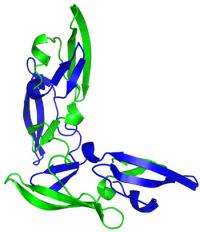
The experimentally determined structure of one of the engineered dimers (CVN2L0). One CV-N repeat is shown in green, while the other appears in blue. The polypeptide linker is not shown. Credit: Caltech/Jennifer Keeffe
If one is good, two can sometimes be better. Researchers at the California Institute of Technology (Caltech) have certainly found this to be the case when it comes to a small HIV-fighting protein.
The protein, called cyanovirin-N (CV-N), is produced by a type of blue-green algae and has gained attention for its ability to ward off several diseases caused by viruses, including HIV and influenza. Now Caltech researchers have found that a relatively simple engineering technique can boost the protein's battling prowess.
"By linking two cyanovirins, we were able to make significantly more potent HIV-fighting molecules," says Jennifer Keeffe, a staff scientist at Caltech and first author of a new paper describing the study in the Proceedings of the National Academy of Sciences (PNAS). "One of our linked molecules was 18 times more effective at preventing infection than the naturally occurring, single protein."
The team's linked pairs, or dimers, were able to neutralize all 33 subtypes of HIV that they were tested against. The researchers also found the most successful dimer to be similar or more potent than seven well-studied anti-HIV antibodies that are known to be broadly neutralizing.
CV-N binds well to certain carbohydrates, such as the kind found in high quantities connected to the proteins on the envelope that surrounds the HIV virus. Once attached, CV-N prevents a virus from infecting cells, although the mechanism by which it accomplishes this is not well understood.
What is known is that each CV-N protein has two binding sites where it can bind to a carbohydrate and that both sites are needed to neutralize HIV.
Once the Caltech researchers had linked two CV-Ns together, they wanted to know if the enhanced ability of their engineered dimers to ward off HIV was related to the availability of additional binding sites. So they engineered another version of the dimersthis time with one or more of the binding sites knocked outand tested their ability to neutralize HIV.
It turns out that the dimers' infection-fighting potency increased with each additional binding sitethree sites are better than two, and four are better than three. The advantages seemed to stop at four sites, however; the researchers did not see additional improvements when they linked three or four CV-N molecules together to create molecules with six to eight binding sites.
Although CV-N has a naturally occurring dimeric form, it isn't stable at physiological temperatures, and thus mainly exists in single-copy form. To create dimers that would be stable under such conditions, the researchers covalently bound together two CV-N molecules in a head-to-tail fashion, using flexible polypeptide linkers of varying lengths.
Interestingly, by stabilizing the dimers and locking them into a particular configuration, it seems that the group created proteins with distances between binding sites that are very similar to those between the carbohydrate binding sites in a broadly neutralizing anti-HIV antibody.
"It is possible that we have created a dimer that has its carbohydrate binding sites optimally positioned to block infection," says Stephen Mayo, Bren Professor of Biology and Chemistry, chair of the Division of Biology, and corresponding author of the new paper.
Because it is active against multiple disease-causing viruses, including multiple strains of HIV, CV-N holds unique promise for development as a drug therapy. Other research groups have already started investigating its potential application in prophylactic gels and suppositories.
"Our hope is that those who are working to make prophylactic treatments using cyanovirin will see our results and will use CVN2L0 instead of naturally occurring cyanovirin," Keeffe says. "It has higher potency and may be more protective."
The paper, entitled "Designed oligomers of cyanovirin-N show enhanced HIV neutralization," was published in the online edition of PNAS. In addition to Keeffe and Mayo, other authors on the paper include research technician Priyanthi N.P. Gnanapragasam, former biology graduate student Sarah K. Gillespie, biology graduate student John Yong, and Pamela J. Bjorkman, the Max Delbruck Professor of Biology at Caltech and a Howard Hughes Medical Institute investigator.
Provided by
California Institute of Technology
-
Neutralizing HIV
Jul 18, 2011 |
not rated yet |
0
-
Scientists show why anti-HIV antibodies are ineffective at blocking infection
Apr 22, 2009 |
not rated yet |
0
-
Scientists uncover structure of key protein in common HIV subgroup
Apr 02, 2010 |
not rated yet |
0
-
Researchers induce HIV-neutralizing antibodies that recognize HIV-1 envelope protein, lipids
Sep 01, 2009 |
not rated yet |
0
-
New strategy proposed for designing antibody-based HIV vaccine
Jun 14, 2009 |
not rated yet |
0
-
Of mice and mental models: Neuroscientific implications of risk-optimized behavior in the mouse
6 hours ago |
not rated yet |
0
-
Limits to growth: Scientists identify key metastasis-enabling enzyme
May 22, 2012 |
5 / 5 (3) |
0
-
Seeing is as seeing does: Spatially-structured retinal input in early development of cortical maps
Apr 26, 2012 |
5 / 5 (4) |
1
-
Dreamless nights: Brain activity during nonrapid eye movement sleep
Apr 09, 2012 |
4.4 / 5 (12) |
0
-
Take your time: Neurobiology sheds light on the superiority of spaced vs. massed learning
Mar 28, 2012 |
4.5 / 5 (21) |
3
-
Classical and Quantum Mechanics via Lie algebras
Apr 15, 2011
- More from Physics Forums - Independent Research
More news stories
Mortality rates decrease, chronic disease rates increase among HIV+ ICU patients
The expanded use of antiretrovirals, potent drugs used to treat retroviral infections such as human immunodeficiency virus (HIV), has been linked to significant decreases in hospital mortality rates among severely ill HIV-positive(HIV+) ...
HIV & AIDS
May 23, 2012 |
not rated yet |
0
Newly discovered breast milk antibodies help neutralize HIV
Antibodies that help to stop the HIV virus have been found in breast milk. Researchers at Duke University Medical Center isolated the antibodies from immune cells called B cells in the breast milk of infected mothers in Malawi, ...
HIV & AIDS
May 22, 2012 |
5 / 5 (3) |
1
|
Reactions to HIV drug have autoimmune cause, reports AIDS journal
Potentially severe hypersensitivity reactions to the anti-HIV drug abacavir occur through an autoimmune mechanism, resulting from the creation of drug-induced immunogens that are attacked by the body's immune system, according ...
HIV & AIDS
May 22, 2012 |
5 / 5 (1) |
0
Is the U.S. ready for home HIV tests?
At the pharmacy, you can buy anything from tea kettles to Tylenol. But what if you could buy a rapid HIV test over the counter and test yourself in the privacy of your own home?
HIV & AIDS
May 21, 2012 |
not rated yet |
0
|
Reduced glycerin formulation of tenofovir vaginal gel safe for rectal use
A change in the formulation of tenofovir gel, an anti-HIV gel developed for vaginal use, may make it safer to use in the rectum, suggests a study published online this week in the Journal of Antimicrobial Chemotherapy. In lab ...
HIV & AIDS
May 17, 2012 |
5 / 5 (1) |
0
Skp2 activates cancer-promoting, glucose-processing Akt
HER2 and its epidermal growth factor receptor cousins mobilize a specialized protein to activate a major player in cancer development and sugar metabolism, scientists report in the May 25 issue of Cell.
Early physical therapist treatment associated with reduced risk of healthcare utilization and reduced overall healthcare
A new study published in Spine shows that early treatment by a physical therapist for low back pain (LBP), as compared to delayed treatment, was associated with reduced risk of subsequent healthcare utilization and lower ...
Flesh-Eating bacteria no cause for panic, experts say
(HealthDay) -- Despite scary headlines by the score, most people don't have to fear that they'll be the next victim of the so-called flesh-eating bacteria disease, experts say.
Of mice and mental models: Neuroscientific implications of risk-optimized behavior in the mouse
(Medical Xpress) -- Regardless of an organism’s biological complexity, every encephalized animal continuously makes under-informed behavioral choices that can have serious consequences. Despite its ubiquity, ...
Cancer may require simpler genetic mutations than previously thought
Chromosomal deletions in DNA often involve just one of two gene copies inherited from either parent. But scientists haven't known how a deletion in one gene from one parent, called a "hemizygous" deletion, can contribute ...
Inherited DNA change explains overactive leukemia gene
A small inherited change in DNA is largely responsible for overactivating a gene linked to poor treatment response in people with acute leukemia.