EU bans Egypt seed imports after E. coli outbreak
(AP) -- Egyptian sprout seeds blamed for a massive and deadly E. coli outbreak are still on the market and were shipped to more European countries than was previously believed, officials said Tuesday, as the EU announced a ban on further imports.
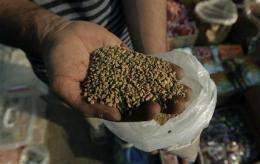
The European Food Safety Authority confirmed in a report that one lot of contaminated fenugreek seeds from Egypt was probably the source of the recent food poisoning outbreaks in Germany and France. But the number of European countries that received parts of the suspected lot is "much larger than previously known," and includes Austria, Britain and Spain, it said.
The European Union said in a statement it was banning the import of Egyptian fenugreek seeds until Oct. 31, adding that its members must destroy all seeds from "one Egyptian exporter" received between 2009 and 2011. Officials have not released the name of the exporter.
The move, however, may be largely symbolic, since tainted seeds have already been widely distributed in Europe and it's unclear officials will be able to identify them because the amount of bacteria may be too small to detect.
Fenugreek seeds from the suspect Egyptian lot - about 15,000 kilograms - were imported to one large German distributor, the agency said. Those seeds were then sold to 70 different companies, 54 of them in Germany, the center of the outbreak, and to 16 companies in 11 other European countries.
Fenugreek is a clover-shaped plant whose leaves are commonly used as an herb and also in Indian curries. The seeds are often sold dried, and if they are contaminated with E. coli, the bacteria can survive for years.
Tracing exactly where the seeds from the suspected lot were sold could take weeks, food safety officials said. In Germany, the fenugreek seeds were sold in mixed spice packages with lentil seeds.
European food safety officials could not rule out that other lots of seeds from the same exporter weren't also tainted. Last year, Europe imported about 49,000 tons of fenugreek seeds from Egypt, worth more than euro56 million ($81 million)
Officials previously believed that sales had centered primarily on Germany and France but until now had little detailed information on where the seeds were shipped.
So far, the strain has killed 51 people, including 49 deaths in Germany and one each in Sweden and the U.S.
More than 4,000 people in Germany have fallen sick since the outbreak was detected in May, including 851 who have developed a serious complication that can lead to kidney failure. The same bacteria was also responsible for a much smaller outbreak in France last month.
Scientists said it was possible only a small part of the lot were infected, which might explain why there weren't more cases given how widely they were sold. "You could have some seeds contaminated but not necessarily the whole batch," said Ian Henderson, a professor of microbial biology at the University of Birmingham.
He said it would be difficult to find the culprit bacteria on the seeds since large quantities only appear once the sprouts begin to grow. "It could be like searching for a needle in a haystack," he said.
Experts said many of the infected seeds may already have been used but that some were still in the food chain.
Some suspect there have been numerous undetected E. coli cases across Europe. "Most people who get this won't get that ill and it won't be diagnosed," said Paul Hunter, a professor of health protection at the University of East Anglia.
He said that the outbreaks were caught because there were large numbers of people getting sick at the same time, in unusual circumstances. But if people bought and ate infected sprouts on their own - like from a 50-gram (1.76-ounce) packet from a garden center, as was the case in the French outbreak - their illness would probably be missed.
Health officials warn there could be further outbreaks of the lethal E. coli strain since the tainted fenugreek seeds are still for sale. Experts say people should not grow or eat their own sprouts and that all sprouts should be thoroughly cooked before being eaten.
"If people do not eat raw sprouts, we might not see many new infections," Hunter said. "But people are very good at ignoring public health advice," he said. "I wouldn't bet against more outbreaks."
©2011 The Associated Press. All rights reserved. This material may not be published, broadcast, rewritten or redistributed.


