Transcription factor is potential target for liver cancer treatment
July 6, 2011 in Cancer
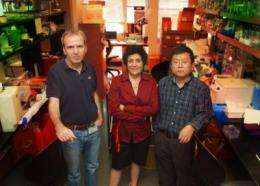
Drs. Demetrius Moskophidis (from left), Nahid Mivechi and Xiongjie Jin have evidence that altering the metabolism could be an effective treatment for liver metabolism. Credit: Phil Jones/GHSU photographer
Altering the body's metabolism could be an effective treatment for deadly liver cancer, researchers report.
The finding that inhibiting heat shock transcription factor 1, or HSF1, prevents liver cancer in mice also is another wake-up call that a low-fat, healthy diet is an effective cancer deterrent, said Dr. Demetrius Moskophidis, Cancer Virologist/Immunologist at Georgia Health Sciences University. HSF1 and its target genes are important to metabolism regulation.
"The principle that we demonstrated is that if we change the metabolism, we can interfere with tumor growth," said Moskophidis, co-corresponding author on the study published in Cell Metabolism.
GHSU scientists accomplished this by removing HSF1 from the mice; HSF1 inhibitors are under development because of their potential for treating a variety of other cancers such as breast, prostate and kidney cancers.
Liver cancer, among the top-10 cancer killers, is on the increase as obesity leads to fatty livers which predispose to liver cancer. Fat can damage the liver in much the say way as alcohol abuse or hepatitis, two major risk factors for liver cancer.
Removing HSF1 thwarts liver cancer by decreasing access to two critical elements: glucose and lipids or fats.
Tumors use glucose for energy as well as the rapid cell division essential to cancer growth, said Dr. Xiongjie Jin, GHSU Assistant Research Scientist and the study's first author. Cancer also needs more lipids to make membranes needed for new cells and so those cells can communicate, Jin said. Lipids also serve as an additional energy source.
Mice lacking HSF1 are hypersensitive to glucose, able to efficiently turn it into energy that can be used by the body so little can be diverted to cell division, said Dr. Nahid Mivechi, Director of the GHSU Center for Molecular Chaperone, Radiobiology and Cancer Virology and the study's corresponding author. As added bonuses, the mice stay slim even on a high-fat diet and avoid diabetes.
The mice also produce fewer lipids because they more easily make active protein kinase, or AMPK, which helps regulate energy levels and inhibits lipid synthesis, Moskophidis said. Lipid-hungry tumors don't like AMPK, he notes.
The studies, funded by the National Institutes of Health's National Cancer Institute, were done in genetically altered mice that were later exposed to a carcinogen known to produce cancer in 100 percent of male mice within five to seven months. Now the scientists are removing HSF1 from mice that already have cancer to see if this approach which better reflects how treatment would be used in humans works as well. They also are exploring the potential of HSF1 inhibitors in advanced breast cancer and melanoma.
They note that HSF1 levels vary normally, typically increasing after eating. In a high-metabolism, disease state such as cancer, HSF1 becomes more important, Moskophidis said. The researchers believe short-term inhibition of HSF1, as might one day be used in cancer patients, would be safe since it's one of a family of transcription factors with similar functions. However, HSF1 seems to be the family member with the biggest role in cancer.
The football-shaped liver helps the body use food and drink as energy and nutrients and helps detoxify the body. According to the American Liver Foundation, liver cancer tends to be asymptomatic until later stages of the disease. Symptoms may include fatigue, pain on the right side of the upper abdomen or around the right shoulder blade, nausea, loss of appetite, unexplained weight loss or jaundice. It may be discovered during a routine checkup if a doctor feels hard lumps in the abdomen, or incidentally by imaging studies.
Provided by Georgia Health Sciences University
-
Protein handlers should be effective treatment target for cancer and Alzheimer's
Aug 06, 2009 |
not rated yet |
0
-
Resveratrol prevents fat accumulation in livers of 'alcoholic' mice
Oct 14, 2008 |
not rated yet |
0
-
Metabolic shift may offer early cancer clue
Jul 05, 2011 |
not rated yet |
0
-
Obesity ups cancer risk, and here's how
Jan 21, 2010 |
not rated yet |
0
-
In 'spontaneous' liver cancer, researcher sees a cure
Jun 20, 2007 |
not rated yet |
0
-
Of mice and mental models: Neuroscientific implications of risk-optimized behavior in the mouse
8 hours ago |
not rated yet |
0
-
Limits to growth: Scientists identify key metastasis-enabling enzyme
May 22, 2012 |
5 / 5 (3) |
0
-
Seeing is as seeing does: Spatially-structured retinal input in early development of cortical maps
Apr 26, 2012 |
5 / 5 (4) |
1
-
Dreamless nights: Brain activity during nonrapid eye movement sleep
Apr 09, 2012 |
4.4 / 5 (12) |
0
-
Take your time: Neurobiology sheds light on the superiority of spaced vs. massed learning
Mar 28, 2012 |
4.5 / 5 (21) |
3
-
A question about drug tolerance
May 23, 2012
-
Poor nutrition leading to overeating?
May 23, 2012
-
Math and dyslexia?
May 21, 2012
-
portable metabolism meter?
May 21, 2012
-
Rare medical conditions on 20/20 tonight
May 18, 2012
-
"Good" Cholesterol in Doubt
May 17, 2012
- More from Physics Forums - Medical Sciences
More news stories
Skp2 activates cancer-promoting, glucose-processing Akt
HER2 and its epidermal growth factor receptor cousins mobilize a specialized protein to activate a major player in cancer development and sugar metabolism, scientists report in the May 25 issue of Cell.
Cancer
2 hours ago |
not rated yet |
0
|
Pancreatectomy OK without downstaging from therapy
(HealthDay) -- Pancreatectomy improves median survival in pancreatic cancer patients even when presurgical neoadjuvant therapy does not lead to radiographic downstaging of tumors, according to a study published ...
Cancer
3 hours ago |
not rated yet |
0
Common therapies for basal cell carcinoma offer similar survival
(HealthDay) -- For patients with superficial basal cell carcinoma (sBCC), treatment with imiquimod or photodynamic therapy (PDT) results in similar long-term tumor-free survival, according to a review published ...
Cancer
4 hours ago |
not rated yet |
0
Cancer may require simpler genetic mutations than previously thought
Chromosomal deletions in DNA often involve just one of two gene copies inherited from either parent. But scientists haven't known how a deletion in one gene from one parent, called a "hemizygous" deletion, can contribute ...
Cancer
6 hours ago |
not rated yet |
0
|
New prostate cancer screening guidelines face a tough sell, study suggests
(Medical Xpress) -- Recent recommendations from the U.S. Preventive Services Task Force (USPSTF) advising elimination of routine prostate-specific antigen (PSA) screening for prostate cancer in healthy men are likely to encounter ...
Cancer
9 hours ago |
not rated yet |
1
Tongue analysis software uses ancient Chinese medicine to warn of disease
For 5,000 years, the Chinese have used a system of medicine based on the flow and balance of positive and negative energies in the body. In this system, the appearance of the tongue is one of the measures used to classify ...
Most occupational injury and illness costs are paid by the government and private payers
UC Davis researchers have found that workers' compensation insurance is not used nearly as much as it should be to cover the nation's multi-billion dollar price tag for workplace illnesses and injuries. Instead, almost 80 ...
Of mice and mental models: Neuroscientific implications of risk-optimized behavior in the mouse
(Medical Xpress) -- Regardless of an organism’s biological complexity, every encephalized animal continuously makes under-informed behavioral choices that can have serious consequences. Despite its ubiquity, ...
Inherited DNA change explains overactive leukemia gene
A small inherited change in DNA is largely responsible for overactivating a gene linked to poor treatment response in people with acute leukemia.
Early physical therapist treatment associated with reduced risk of healthcare utilization and reduced overall healthcare
A new study published in Spine shows that early treatment by a physical therapist for low back pain (LBP), as compared to delayed treatment, was associated with reduced risk of subsequent healthcare utilization and lower ...
First study to suggest that the immune system may protect against Alzheimer's changes in humans
Recent work in mice suggested that the immune system is involved in removing beta-amyloid, the main Alzheimer's-causing substance in the brain. Researchers have now shown for the first time that this may apply in humans.