Tumor cells go against the flow
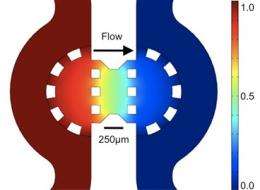
Cancer's uncontrolled spread throughout the body is what makes the disease so deadly. To shed some light on the spreading process, mechanical engineers at MIT have developed a microfluidic model to better understand how cancer cells break loose from their original tumor, make their way into the body's vascular system and travel around the body.
Using that microfluidic device, Professor Roger Kamm and mechanical engineering graduate student William Polacheck, in collaboration with Joseph Charest from the Charles Stark Draper Laboratory, have discovered that the direction in which fluid flows through bodily tissue determines how likely cancer cells are to spread, or metastasize. Armed with that information, they say, it may be possible to limit the spread of cancer.
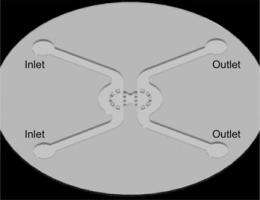
Almost as important as their discovery — described in a recent issue of Proceedings of the National Academy of Sciences — is the 3-D microfluidic system they invented that led to it. Whereas previous insights were based solely on visualizing individual cells in an artificial extracellular environment, Polacheck and Kamm's system allows them to look at the way cells interact with tissue that mimics natural breast tissue.
"There isn't a single drug currently on the market that addresses how cancer cells break loose from a primary tumor and get into the vascular system, migrate out, and form a secondary tumor. But those are processes that we can actually simulate in our microfluidic system," says Kamm, the Cecil and Ida Green Distinguished Professor of Biological and Mechanical Engineering at MIT.
It was the limitation of previous studies that fueled Polacheck, Charest and Kamm to develop this system and investigate the migration of cancer cells, with the hope of discovering additional details that were previously undetectable.
The basis of their experiments was the underlying knowledge that, due to their continual growth, tumors generate high fluid pressure in surrounding tissues. This pressure, in turn, is known to generate a fluid flow away from the tumor. A former postdoc who worked with Kamm, Melody Swartz (now a professor at École Polytechnique Fédérale de Lausanne in Switzerland), had previously discovered that due to this flow, ligands secreted by a tumor cell selectively bind to receptors on the downstream side of the cell. She found that this process ultimately results in an asymmetry that stimulates cells to migrate in the direction of the flow.
If this were the full story, it would be a discouraging result, because it would mean that when the cells start to break loose from a tumor, they will preferentially move toward the vascular system, thus spreading the cancer. But luckily, the story continues. With their new 3-D microfluidic platform — which consists of two channels separated by a region of single cells in a gel, or matrix, across which a flow can be generated — Polacheck and Kamm started experiments on breast-cancer cells. They aimed to simulate the process of migration in the body, hoping to build on Swartz's findings.
To their surprise, they found just the opposite of her result: Instead of moving with the flow, as Swartz had found, the cancer cells moved upstream. At first, they questioned their findings, but then Polacheck and Kamm realized that the cause of the discrepancy is the existence of two competing mechanisms.
One is autologous chemotaxis, which occurs in low-cell-density situations or when the CCR7 receptor becomes activated. Autologous chemotaxis produces downstream migration because the concentration of ligands is increased on the downstream side of the cell, as Swartz had found.
The other, they discovered, happens in high-cell-density situations — like around a growing tumor — or when the CCR7 receptor is blocked. This newly discovered mechanism kicks in when the pressure of a fluid flowing past a cell leads to the activation of a class of receptors called integrins, ultimately prompting upstream migration. Both mechanisms are due to asymmetry in a tumor cell's interactions with its environment.
"Acting on this might significantly improve cancer survival rates," Kamm says. "Pharmaceutical companies can use this information to focus on creating drugs that would block the CCR7 receptor to prevent migration toward the vascular system, and confine the tumors."
Because of its ability to mimic the interactions cells experience inside the body — using real human cells, in real time — Polacheck and Kamm's system could be useful in myriad other biological studies as well, such as those focused on inflammation, liver disease and liver toxicity, among others. "We're finding that the ability to visualize the interactions between different cell types is critical to learning how the cells behave," Kamm says.
"The role of interstitial flow on cell migration in 3-D environments has been considered important, but the mechanism and influence on migration and eventually metastasis has remained elusive for quite some time," says Muhammad Zaman, assistant professor of biomedical engineering and medicine at Boston University, who was not involved in this research. He adds that this study's comprehensive examination of cell migration speed and direction "will significantly advance the field of both cell migration and tumor metastasis as well as provide researchers with a robust platform to test novel hypotheses in cancer systems biology."


