UN says cholera epidemic in Somalia
August 12, 2011 By JOHN HEILPRIN , Associated Press in Diseases, Conditions, Syndromes
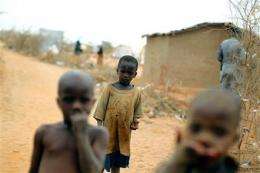
Somali boys walk in the Dagahaley refugee camp north of Dadaab, Eastern Kenya, 100 kms (60 miles) from the Somali border, Thursday Aug. 11, 2011. The United Nations warned Wednesday that the famine in East Africa hasn't peaked and hundreds of thousands of people face imminent starvation and death without a massive global response. About 1,300 new refugees arrive each day in Dadaab camps in northeastern Kenya. The new influx are running away from a famine that is getting worse in southern Somalia as an al-Qaida-linked militants in the country barred some major aid groups from operating in its areas of control, worsening the situation of the most vulnerable people. (AP Photo/Jerome Delay)
(AP) -- World Health Organization officials said Friday that famine-hit Somalia faces a cholera epidemic as dirty water and poor sanitation are leading to an increase in outbreaks of the disease.
Officials say cases of acute watery diarrhea - an important indicator of the risk of cholera - are now at 4,272 in Somalia - an 11 percent rise on last week's WHO reported figure of 3,839.
WHO public health adviser Dr. Michel Yao told reporters in Geneva on Friday that the number of cholera cases has also risen sharply this year, with officials confirming 18 cases in the 30 lab samples taken in recent days from people living in the capital, Mogadishu.
Yao said the 60 percent infection rate confirms there is a "high risk" of the disease spreading quickly - "so we can say we have an epidemic."
The random samples, which were tested in a lab in the capital, were drawn from among 4,272 samples from people who have suffered the diarrhea, he said. So far, he said, there have been 181 acute watery diarrhea-related deaths.
WHO spokeswoman Fadela Chaib said last week that a few cases of cholera have been confirmed in Somalia and the diarrhea is also on the rise. She said of the 3,839 reported cases, 77 percent afflicted children younger than 5-years old in Mogadishu.
The World Health Organization has said it is very concerned about disease outbreaks in drought-hit East Africa, due to a lack of clean water for drinking and bathing, overcrowding in camps and the low tolerance to disease of starving young children.
The United States estimates drought and famine in Somalia have killed more than 29,000 children under the age of 5. Millions face the risk of starvation amid Somalia's worst drought in 60 years.
UNICEF spokeswoman Marixie Mercado said Friday that tens of thousands of children have died and countless more are particularly at risk of cholera and other diseases because of drought and violence in East Africa.
©2011 The Associated Press. All rights reserved. This material may not be published, broadcast, rewritten or redistributed.
-
Haiti cholera toll hits 1,344: officials
Nov 22, 2010 |
not rated yet |
0
-
Cholera outbreak kills 20 in Somali capital
Mar 12, 2011 |
not rated yet |
0
-
Cholera outbreak reported in Namibia
Mar 12, 2008 |
not rated yet |
0
-
Expect 200,000 Haiti cholera cases: expert
Nov 23, 2010 |
not rated yet |
0
-
Cholera kills 41 in Central African nation of Chad
Sep 04, 2010 |
not rated yet |
0
-
Of mice and mental models: Neuroscientific implications of risk-optimized behavior in the mouse
11 hours ago |
not rated yet |
0
-
Limits to growth: Scientists identify key metastasis-enabling enzyme
May 22, 2012 |
5 / 5 (3) |
0
-
Seeing is as seeing does: Spatially-structured retinal input in early development of cortical maps
Apr 26, 2012 |
5 / 5 (4) |
1
-
Dreamless nights: Brain activity during nonrapid eye movement sleep
Apr 09, 2012 |
4.4 / 5 (12) |
0
-
Take your time: Neurobiology sheds light on the superiority of spaced vs. massed learning
Mar 28, 2012 |
4.5 / 5 (21) |
3
-
Classical and Quantum Mechanics via Lie algebras
Apr 15, 2011
- More from Physics Forums - Independent Research
More news stories
Flesh-Eating bacteria no cause for panic, experts say
(HealthDay) -- Despite scary headlines by the score, most people don't have to fear that they'll be the next victim of the so-called flesh-eating bacteria disease, experts say.
Diseases, Conditions, Syndromes
5 hours ago |
not rated yet |
0
World Health Assembly endorses new plan to increase global access to vaccines
Ministers of Health from 194 countries at the Sixty-fifth World Health Assembly today endorsed a landmark Global Vaccine Action Plan (GVAP), a roadmap to prevent millions of deaths by 2020 through more equitable access to ...
Diseases, Conditions, Syndromes
9 hours ago |
not rated yet |
0
Physicians definitively links irritable bowel syndrome and bacteria in gut
An overgrowth of bacteria in the gut has been definitively linked to Irritable Bowel Syndrome in the results of a new Cedars-Sinai study which used cultures from the small intestine. This is the first study to use this "gold ...
Diseases, Conditions, Syndromes
10 hours ago |
not rated yet |
0
|
Study provides compelling evidence for an effective new treatment for tinnitus
According to new research, a multidisciplinary approach to treating tinnitus that combines cognitive behaviour therapy with sound-based tinnitus retraining therapy is significantly more effective than currently available ...
Diseases, Conditions, Syndromes
May 24, 2012 |
not rated yet |
0
Infections may be deadly for many dialysis patients
An infection called peritonitis commonly arises in the weeks before many dialysis patients die, according to a study appearing in an upcoming issue of the Journal of the American Society of Nephrology (JASN). The findings sugges ...
Diseases, Conditions, Syndromes
May 24, 2012 |
not rated yet |
0
Tongue analysis software uses ancient Chinese medicine to warn of disease
For 5,000 years, the Chinese have used a system of medicine based on the flow and balance of positive and negative energies in the body. In this system, the appearance of the tongue is one of the measures used to classify ...
Of mice and mental models: Neuroscientific implications of risk-optimized behavior in the mouse
(Medical Xpress) -- Regardless of an organism’s biological complexity, every encephalized animal continuously makes under-informed behavioral choices that can have serious consequences. Despite its ubiquity, ...
Cancer may require simpler genetic mutations than previously thought
Chromosomal deletions in DNA often involve just one of two gene copies inherited from either parent. But scientists haven't known how a deletion in one gene from one parent, called a "hemizygous" deletion, can contribute ...
Skp2 activates cancer-promoting, glucose-processing Akt
HER2 and its epidermal growth factor receptor cousins mobilize a specialized protein to activate a major player in cancer development and sugar metabolism, scientists report in the May 25 issue of Cell.
Early physical therapist treatment associated with reduced risk of healthcare utilization and reduced overall healthcare
A new study published in Spine shows that early treatment by a physical therapist for low back pain (LBP), as compared to delayed treatment, was associated with reduced risk of subsequent healthcare utilization and lower ...
Inherited DNA change explains overactive leukemia gene
A small inherited change in DNA is largely responsible for overactivating a gene linked to poor treatment response in people with acute leukemia.