Researchers identify a target that could combat allergies of early childhood
August 14, 2011 in Medical research
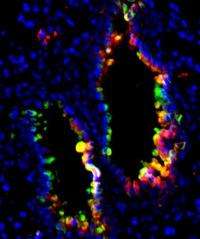
Allergic inflammation in the mouse lung. Activated airway epithelial cells (green) and alternatively activated macrophages (red) are visualized by immuno-fluorescent staining of histologic sections. Credit: Meera Nair, PhD Mark Siracusa, PhD and David Artis, PhD, Perelman School of Medicine, University of Pennsylvania
A pandemic of ailments called the "allergic march" -- the gradual acquisition of overlapping allergic diseases that commonly begins in early childhood -- has frustrated both parents and physicians. For the last three decades, an explosion of eczema, food allergies, hay fever, and asthma have afflicted children in the United States, the European Union, and many other countries.
What causes the march and how to derail it has remained elusive. Now, in this week's Nature, David Artis, PhD, an associate professor of Microbiology at the Perelman School of Medicine at the University of Pennsylvania, and a team of collaborating international scientists, identified that expression of the protein TSLP may influence susceptibility to multiple allergic diseases by regulating the maturation of basophils, an uncommon type of white blood cell. Specifically, TSLP elicits the maturation of a population of distinct basophils that promotes allergic inflammation.
"A fundamental question regarding the allergic march is if a child has eczema, for example, which is associated with TSLP production in skin cells, why would some of those children subsequently be more susceptible to other allergic diseases at different sites of the body such as the gut or the lung?" asks Artis. "Although we have known that TSLP is associated with allergic diseases for many years, how this biological messenger might influence multiple allergic diseases has been a puzzle."
The origins of the present study lie in previous reports that showed that different versions of the gene encoding TSLP, an inflammation-producing cytokine, are associated with increased susceptibility to multiple allergic disorders, and that exaggerated TSLP production is associated with asthma, eczema, and food allergies in children. Together, these studies indicate that TSLP could be a critical regulator of multiple cytokine-associated allergic inflammatory diseases.
In this new report, mice overexpressing TSLP developed allergic inflammation in their lungs, skin, and gut that was associated with very high levels of basophils. "The critical findings are that TSLP appears to activate the development and maturation of early-stage basophils in the bone marrow and that TSLP elicits a distinct type of basophil," explains first author Mark Siracusa, PhD, a Ruth L. Kirschstein National Research Service Fellow in the Artis lab. Based on these findings, the researchers speculate that this basophil maturation could promote allergic reactions at multiple tissue sites.
To translate these findings to patient populations, Artis and colleagues teamed up with a group of pediatricians at the Children's Hospital of Philadelphia to examine basophil responses in children that suffer from the food allergy-associated disease, eosinophilic esophagitis, which causes inflammation of the esophagus. Previous studies have shown that TSLP is overexpressed in food allergy patients. The team showed in the Nature paper that in children with food allergies basophils exhibited a different molecular make-up compared to non-allergy patients.
"It's promising that after more than 130 years since basophils were first discovered by Paul Ehrlich in Germany, we are still finding out new things about this cell population that could help in the design of new drugs to prevent or better fight allergic diseases," concludes Artis.
With more than 50 percent of Americans estimated to suffer from at least one allergic disease, says Artis, the team is hoping that targeting TSLP and basophils may offer new therapies for multiple allergic diseases.
Provided by
University of Pennsylvania School of Medicine
-
Food allergy-related disorder linked to master allergy gene
Mar 07, 2010 |
not rated yet |
0
-
Identified: Switch that turns on allergic disease in people
Jan 20, 2010 |
not rated yet |
0
-
Protein fuels inflammation in pancreatic and breast tumors
Feb 21, 2011 |
not rated yet |
0
-
Childhood eczema and hay fever leads to adult allergic asthma
Apr 15, 2011 |
not rated yet |
0
-
Novel study finds proton channels inhibit the release of histamine during allergic reactions
Jul 29, 2008 |
not rated yet |
0
-
Motion perception revisited: High Phi effect challenges established motion perception assumptions
Apr 23, 2013 |
3 / 5 (2) |
2
-
Anything you can do I can do better: Neuromolecular foundations of the superiority illusion (Update)
Apr 02, 2013 |
4.5 / 5 (11) |
5
-
The visual system as economist: Neural resource allocation in visual adaptation
Mar 30, 2013 |
5 / 5 (2) |
9
-
Separate lives: Neuronal and organismal lifespans decoupled
Mar 27, 2013 |
4.9 / 5 (8) |
0
-
Sizing things up: The evolutionary neurobiology of scale invariance
Feb 28, 2013 |
4.8 / 5 (10) |
14
-
Pressure-volume curve: Elastic Recoil Pressure don't make sense
May 18, 2013
-
If you became brain-dead, would you want them to pull the plug?
May 17, 2013
-
MRI bill question
May 15, 2013
-
Ratio of Hydrogen of Oxygen in Dessicated Animal Protein
May 13, 2013
-
Alcohol and acetaminophen
May 13, 2013
-
Marie Curie's leukemia
May 13, 2013
- More from Physics Forums - Medical Sciences
More news stories
Computational tool translates complex data into simplified 2-dimensional images
In their quest to learn more about the variability of cells between and within tissues, biomedical scientists have devised tools capable of simultaneously measuring dozens of characteristics of individual ...
Medical research
5 hours ago |
5 / 5 (1) |
0
|
Now we know why old scizophrenia medicine works on antibiotics-resistant bacteria
In 2008 researchers from the University of Southern Denmark showed that the drug thioridazine, which has previously been used to treat schizophrenia, is also a powerful weapon against antibiotic-resistant bacteria such as ...
Medical research
May 17, 2013 |
3.7 / 5 (3) |
0
|
SUMO wrestling cells reveal new protective mechanism target for stroke
Scientists investigating the interaction of a group of proteins in the brain responsible for protecting nerve cells from damage have identified a new target that could increase cell survival.
Medical research
May 17, 2013 |
5 / 5 (1) |
0
How serotonin receptors can shape drug effects, from LSD to migraine medication
New findings by researchers carrying out experiments at the U.S. Department of Energy Office of Science's Advanced Photon Source (APS) help explain why some drugs that interact with two kinds of human serotonin ...
Medical research
May 17, 2013 |
4 / 5 (1) |
0
|
Preventing blood poisoning
Peptide molecules derived from the body's natural immune system can help boost the body's defence against life-threatening blood poisoning, joint University research has uncovered.
Medical research
May 17, 2013 |
4 / 5 (1) |
0
|
Researchers identify a potential new risk for sleep apnea: Asthma
Researchers at the University of Wisconsin have identified a potential new risk factor for obstructive sleep apnea: asthma. Using data from the National Institutes of Health (Heart, Lung, and Blood Institute)-funded Wisconsin ...
Study finds that sleep apnea and Alzheimer's are linked
A new study looking at sleep-disordered breathing (SDB) and markers for Alzheimer's disease (AD) risk in cerebrospinal fluid (CSF) and neuroimaging adds to the growing body of research linking the two.
New theory on genesis of osteoarthritis comes with successful therapy in mice
Scientists at Johns Hopkins have turned their view of osteoarthritis (OA) inside out. Literally. Instead of seeing the painful degenerative disease as a problem primarily of the cartilage that cushions joints, ...
Ginger compounds may be effective in treating asthma symptoms
Gourmands and foodies everywhere have long recognized ginger as a great way to add a little peppery zing to both sweet and savory dishes; now, a study from researchers at Columbia University shows purified components of the ...
'Gap' for HIV vaccine efforts after latest setback
The hunt for an HIV vaccine has gobbled up $8 billion in the past decade, and the failure of the most recent efficacy trial has delivered yet another setback to 26 years of efforts.
Alzheimer's leaves bilingual victims stranded in Canada
The devastating effect of Alzheimer's disease on bilingual people has been thrown into focus in Canada, where the sudden loss of a second language can leave sufferers feeling like strangers in their own country.