Radiation in Japanese children's thyroids
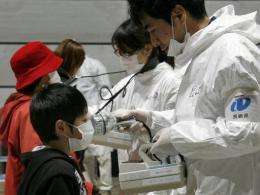
Forty-five percent of children tested in the region around Japan's stricken nuclear plant were found to have traces of radioactive elements in their thyroid glands, an official said Thursday.
The official said that the iodine concentrations -- found in tests that the government carried out about five months ago in Fukushima prefecture -- were not considered alarming in terms of their health impact.
"The government's official position is that none of the children showed radiation levels that would be problematic," he told AFP.
The government's nuclear accident taskforce tested 1,149 children aged up to 15 about two weeks after the March 11 earthquake and tsunami triggered meltdowns, blasts and fires at the Fukushima plant.
Radioactive iodine tends to gather in the thyroid glands of minors in particular, increasing the risk of developing cancer later in life.
Of the valid test results collected for 1,080 children, 482 or 44.6 percent were confirmed to have some level of radioactive contamination in their thyroid glands, the government official told AFP.
The official, who spoke on condition of anonymity, said none of the children suffered contamination beyond the equivalent of 0.2 microsieverts (mSv) per hour, the standard set by Japan's Nuclear Safety Commission.
"Only one child showed a contamination level of 0.1 mSv per hour, the highest of the group," the official said without giving the child's sex or age.
The commission recommends that children, especially young ones, whose thyroid gland is contaminated beyond the 0.2 mSv limit undergo an in-depth physical checkup, citing international standards.
The commission is considering tightening its safety standard to 0.1 mSv.
The children tested came from three municipalities -- Iwaki city, Kawamata town and Iitate village -- where especially high levels of radiation had been estimated after the accident, the official said.
The Fukushima government plans to conduct life-time medical checks for the estimated 360,000 people aged 18 or younger who were in the prefecture at the time of the nuclear accident.
The taskforce medical team began sending test results to the families of the children last week and gave a briefing on Wednesday to a group of parents and guardians in Iwaki city.
Some participants complained that the team took months to inform them of the detailed results despite the gravity of the nuclear accident, the world's worst since Chernobyl 25 years ago, the Asahi Shimbun daily reported.
The government official said the taskforce did not consider informing the families of the details results as a priority since no child had shown contamination levels beyond the safety limit.
(c) 2011 AFP
-
High radioactivity found in Japan nuclear workers
May 30, 2011 |
not rated yet |
0
-
Greenpeace warns of radioactive sea life off Japan
May 26, 2011 |
not rated yet |
0
-
Radioactive ash found in waste plants near Tokyo
Jul 12, 2011 |
not rated yet |
0
-
Questions and answers: Japan, Chernobyl disasters
Apr 12, 2011 |
not rated yet |
0
-
Factfile: Health risks from radiation
Mar 15, 2011 |
not rated yet |
0
-
Motion perception revisited: High Phi effect challenges established motion perception assumptions
Apr 23, 2013 |
3 / 5 (2) |
2
-
Anything you can do I can do better: Neuromolecular foundations of the superiority illusion (Update)
Apr 02, 2013 |
4.5 / 5 (11) |
5
-
The visual system as economist: Neural resource allocation in visual adaptation
Mar 30, 2013 |
5 / 5 (2) |
9
-
Separate lives: Neuronal and organismal lifespans decoupled
Mar 27, 2013 |
4.9 / 5 (8) |
0
-
Sizing things up: The evolutionary neurobiology of scale invariance
Feb 28, 2013 |
4.8 / 5 (10) |
14
-
Classical and Quantum Mechanics via Lie algebras
Apr 15, 2011
- More from Physics Forums - Independent Research
More news stories
Consumers largely underestimating calorie content of fast food
People eating at fast food restaurants largely underestimate the calorie content of meals, especially large ones, according to a paper published today in BMJ.
Health
16 minutes ago |
not rated yet |
0
It's not your imagination: Memory gets muddled at menopause
Don't doubt it when a woman harried by hot flashes says she's having a hard time remembering things. A new study published online in Menopause, the journal of The North American Menopause Society (NAMS), helps confirm with o ...
Health
1 hour ago |
not rated yet |
0
Farm bill: Senate rejects GMO labeling amendment
The Senate has overwhelmingly rejected an amendment allowing states to require labeling of genetically modified foods.
Health
1 hour ago |
not rated yet |
1
McDonald's can't shake criticism about nutrition
(AP)—McDonald's once again faced criticism that it's a purveyor of junk food that markets to children at its annual shareholder meeting Thursday.
Health
2 hours ago |
not rated yet |
0
Economic incentives increase blood donation without negative consequences
Can economic incentives such as gift cards, T-shirts, and time off from work motivate members of the public to increase their donations of blood?
Health
4 hours ago |
not rated yet |
0
|
Statin use is linked to increased risk of developing diabetes, warn researchers
Treatment with high potency statins (especially atorvastatin and simvastatin) may increase the risk of developing diabetes, suggests a paper published today in BMJ.
Future doctors unaware of their obesity bias
Two out of five medical students have an unconscious bias against obese people, according to a new study by researchers at Wake Forest Baptist Medical Center. The study is published online ahead of print in the Journal of ...
WHO: Scientific red tape mars efforts vs. virus
International efforts to combat a new pneumonia-like virus that has now killed 22 people are being slowed by unclear rules and competition for the potentially profitable rights to disease samples, the head ...
Dual-source cardiac CT IDs CAD in hard-to-image patients
(HealthDay)—In patients who have previously been considered difficult to image, dual-source cardiac (DSC) computed tomography (CT) can identify clinically significant coronary artery disease, according ...
Controlling mood through the motions of mitochondria
(Medical Xpress)—Regulating the distribution of power in neurons is done by a system that makes the national electric grid look simple by comparison. Each neuron has several thousand mitochondria confined ...
When oxygen is short, EGFR prevents maturation of cancer-fighting miRNAs
Even while being dragged to its destruction inside a cell, a cancer-promoting growth factor receptor fires away, sending signals that thwart the development of tumor-suppressing microRNAs (miRNAs) before it's dissolved, researchers ...