The Medical Minute: Don't overdo it, you weekend warrior
August 18, 2011 By Matthew Silvis in Health

Don't overdo it, you weekend warrior

Enlarge

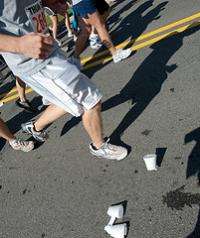
Chris Garguilo, a junior and THON 5K particpant, runs along Curtin Road past discared water cups, remnants of a water station set up by THON committee members to refresh the more than 4,000 who turned out to run through campus on Sunday, Oct. 17, in support of the Penn State Dance Marathon. Credit: Andy Colwell

There are many benefits to exercise. Exercise not only helps prevent a variety of medical disorders -- including heart disease, high blood pressure, diabetes, obesity, osteoporosis -- but it is increasingly recommended for treatment of health problems. Exercise improves and maintains muscle mass, endurance and mobility and can improve appearance and self confidence. The American College of Sports Medicine recommends that all healthy adults ages 18 to 65 years engage in moderate-intensity aerobic exercise for a minimum of 30 minutes, five days a week. Similar recommendations exist for adults older than 65 years of age with the caveat that aerobic fitness, flexibility and balance be taken into account.

Many individuals have difficulties finding the time to exercise five days a week given the demands of work and family. The term “weekend warrior” describes an individual who compresses his weekly activity into long durations on the weekend instead of exercising throughout the week. Common examples of weekend warrior activities include playing basketball for an afternoon, hiking for four hours or doing five hours of yard work.

Weekend warriors are particularly susceptible to overuse injuries. A person's musculoskeletal system changes with age. Bone mass and strength decrease, joint cartilage breaks down, discs in our spine become compressed and tendons tighten. A person with an aging musculoskeletal system trying to compress his weekly activity into long durations on a weekend (and maybe even trying to do a sporting activity that they have not done in a long time) can readily overwhelm their musculoskeletal system. This perfect storm can easily lead to an overuse injury.

For those individuals who consider themselves weekend warriors, the following tips may be useful:

1. Be realistic and respect your body’s limits. Push yourself but with the right precautions. Pain that persists into the next day may be an early indicator of a musculoskeletal injury and that you did too much. Consider adjusting your schedule to try to exercise throughout the week.

2. Cross train regularly and try to engage in nonweight-bearing exercise (swimming, cycling, elliptical) weekly. Weight lifting is encouraged to strengthen muscles and increase your bone density. Make sure to rest between weight lifting repetitions and days. At least one rest day should be taken weekly.

3. Watch diet to ensure proper nutrition for both exercise performance and for rebuilding muscle and energy stores after exercise.

4. For sport specific injury prevention and tips on proper conditioning, get good advice from a health care professional and/or personal trainer.

5. Pay close attention to and replace your equipment (old cleats, worn shoes, etc.). For example, running shoes should be changed every 4-6 months or 300-500 miles.

6. Lastly, expand your definition of success. While running a 5K in a certain amount of time or lifting a certain weight may have been your previous measure of success, remember the incredible health benefits of staying physically active.

Provided by Pennsylvania State University search and more info website

not rated yet  

Filter


Move the slider to adjust rank threshold, so that you can hide some of the comments.


Display comments: newest first

cnb
Aug 19, 2011

Rank: not rated yet
Always interesting to read advice of the sort found under 5. above.

As far as I know there has not been produced a study showing that fresh and bouncy running shoes actually prevent injuries. Nor do shoes specifically tailored to individual conditions (pronation, e.g.) seem to do much for injury prevention.

I can assume that once one actually has contracted an injury it might feel better to use all sorts of supportive equipment, but that's a different issue.
Rank not rated yet
Relevant PhysicsForums posts

More news stories

Women with severe injuries are less likely than men to be treated in a trauma center

Women are less likely than men to receive care in a trauma center after severe injury, according to a new study of almost 100,000 Canadian patients.

Health created 40 minutes ago | popularity not rated yet | comments 0

Half time warm-ups boost athletic performance

High-intensity, short duration warm up activities at half time intervals boost athletic performance, a study of soccer players has found.

Health created 2 hours ago | popularity not rated yet | comments 0

Pre-proceedings process fails to reduce length of care proceedings, but can help divert cases from court

A major new report on a procedure that aims to reduce the duration of care proceedings for children has found it made no significant difference to what happened in court, and cases lasted just as long regardless of whether ...

Health created 4 hours ago | popularity not rated yet | comments 0

Report reveals impact of public injecting

New research undertaken on the streets of Richmond and Abbotsford has revealed increasing health risks for people who inject drugs and significant community concern over the impact of injecting in public ...

Health created 4 hours ago | popularity not rated yet | comments 0

Consumer group flags high SPF ratings on sunscreen

(AP)—Sunbathers this summer will find new sunscreen labels that are designed to make the products more effective and easier to use.

Health created 7 hours ago | popularity not rated yet | comments 0


First long-term study reveals link between childhood ADHD and obesity

A new study conducted by researchers at the Child Study Center at NYU Langone Medical Center found men diagnosed as children with attention-deficit/hyperactivity disorder (ADHD) were twice as likely to be obese in a 33-year ...

Computer model predicts when viruses become infectious

A new computer model could help scientists predict when a particular strain of avian influenza might become infectious from bird to human, according to a report to be published in the International Journal Data Mining an ...

Atherosclerotic disease heredity mapped in nationwide study

Researchers at Lund University in Sweden have mapped the significance of heredity for common forms of atherosclerotic disease. No studies have previously examined whether different forms of the disease share heredity.

Germ-fighting vaccine system makes great strides in delivery

A novel vaccine study from South Dakota State University (SDSU) will headline the groundbreaking research that will be unveiled at the American Association of Pharmaceutical Scientists' (AAPS) National Biotechnology Conference ...

Diabetes drug tested in Parkinson's disease patients

Parkinson's disease (PD) is a degenerative neurological disorder marked by a progressive loss of motor control. Despite intensive research, there are currently no approved therapies that have been demonstrated to alter the ...

Impossible to predict outcome in China's bird flu outbreak, WHO says

It is impossible to predict the evolution of China's human H7N9 bird flu outbreak as researchers are still trying to understand the source of human transmission, the head of the World Health Organisation said Monday.