National survey reveals widespread mistaken beliefs about memory
August 4, 2011 in Psychology & Psychiatry
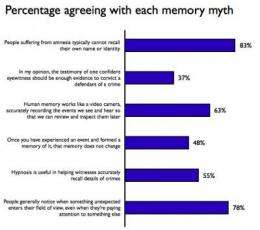
The survey evaluated the views of a representative sample of the US population. A majority of respondents agreed with six memory myths. Credit: Daniel Simons
A new survey reveals that many people in the U.S. in some cases a substantial majority think that memory is more powerful, objective and reliable than it actually is. Their ideas are at odds with decades of scientific research.
The results of the survey and a comparison to expert opinion appear in a paper in the journal PLoS ONE.
(Before reading further, test your own ideas about memory.)
This is the first large-scale, nationally representative survey of the U.S. population to measure intuitive beliefs about how memory works," said University of Illinois psychology professor Daniel Simons, who led the study with Union College psychology professor Christopher Chabris. Simons and Chabris conducted the survey during research for their book, "The Invisible Gorilla," which explores commonly held (and often incorrect) beliefs about memory and perception.
"Our book highlights ways in which our intuitions about the mind are mistaken," Simons said. "And one of the most compelling examples comes from beliefs about memory: People tend to place greater faith in the accuracy, completeness and vividness of their memories than they probably should."
The telephone survey, carried out by the opinion research company SurveyUSA, asked 1,500 respondents whether they agreed or disagreed with a series of statements about memory.
Nearly two-thirds of respondents likened human memory to a video camera that records information precisely for later review. Almost half believed that once experiences are encoded in memory, those memories do not change. Nearly 40 percent felt that the testimony of a single confident eyewitness should be enough evidence to convict someone of a crime.
These and other beliefs about memory diverge from the views of cognitive psychologists with many years of experience studying how memory works, the researchers report. While studies have shown, for example, that confident eyewitnesses are accurate more often than eyewitnesses who lack confidence, Chabris said, "even confident witnesses are wrong about 30 percent of the time."
Many studies have demonstrated the ways in which memory can be unreliable and even manipulated, Simons said.
"We've known since the 1930s that memories can become distorted in systematic ways," he said. "We've known since the 1980s that even memory for vivid, very meaningful personal events can change over time. For example, (Cornell University psychology professor) Ulric Neisser showed that personal memories for the Challenger space shuttle explosion changed over time, and (University of California professor) Elizabeth Loftus and her colleagues have managed to introduce entirely false memories that people believe and trust as if they had really happened."
"The fallibility of memory is well established in the scientific literature, but mistaken intuitions about memory persist," Chabris said. "The extent of these misbeliefs helps explain why so many people assume that politicians who may simply be remembering things wrong must be deliberately lying."
The new findings also have important implications for proceedings in legal cases, the researchers said.
"Our memories can change even if we don't realize they have changed," Simons said. "That means that if a defendant can't remember something, a jury might assume the person is lying. And misremembering one detail can impugn their credibility for other testimony, when it might just reflect the normal fallibility of memory."
Provided by
University of Illinois at Urbana-Champaign
-
Study: Kids less prone to false memories
May 02, 2007 |
not rated yet |
0
-
Study: True memories are rich with varied details
Apr 27, 2011 |
not rated yet |
0
-
Research suggests that children's memory may be more reliable than adults' in court cases
Mar 06, 2008 |
not rated yet |
0
-
Sydney study finds false memories are common
Aug 09, 2010 |
not rated yet |
0
-
Adults recall negative events less accurately than children
Jul 21, 2010 |
not rated yet |
0
-
Of mice and mental models: Neuroscientific implications of risk-optimized behavior in the mouse
15 hours ago |
not rated yet |
0
-
Limits to growth: Scientists identify key metastasis-enabling enzyme
May 22, 2012 |
5 / 5 (4) |
0
-
Seeing is as seeing does: Spatially-structured retinal input in early development of cortical maps
Apr 26, 2012 |
5 / 5 (4) |
1
-
Dreamless nights: Brain activity during nonrapid eye movement sleep
Apr 09, 2012 |
4.4 / 5 (12) |
0
-
Take your time: Neurobiology sheds light on the superiority of spaced vs. massed learning
Mar 28, 2012 |
4.5 / 5 (21) |
3
-
A question about drug tolerance
May 23, 2012
-
Poor nutrition leading to overeating?
May 23, 2012
-
Math and dyslexia?
May 21, 2012
-
portable metabolism meter?
May 21, 2012
-
Rare medical conditions on 20/20 tonight
May 18, 2012
-
"Good" Cholesterol in Doubt
May 17, 2012
- More from Physics Forums - Medical Sciences
More news stories
More mental health care urged for kids who self-harm
(HealthDay) -- Doctors have long known that some kids suffering severe emotional turmoil find relief in physical pain -- cutting or burning or sticking themselves with pins to achieve a form of release.
Psychology & Psychiatry
12 hours ago |
not rated yet |
0
Questionable research practices surprisingly common
(Medical Xpress) -- Not all scientific misconduct is flat-out fraud. Much falls into the murkier realm of questionable research practices. A new study finds that in one field, psychology, these practices are surprisingly ...
Psychology & Psychiatry
15 hours ago |
not rated yet |
0
|
Feeling strong emotions makes peoples' brains 'tick together'
Experiencing strong emotions synchronises brain activity across individuals, research team at Aalto University and Turku PET Centre in Finland has revealed.
Psychology & Psychiatry
May 24, 2012 |
5 / 5 (1) |
0
Formal recognition of PMDD will lift stigma for women
A decision to recognise premenstrual dysphoric disorder as a genuine psychiatric condition will finally provide validation for this awful and poorly understood syndrome and alleviate the stigma ...
Psychology & Psychiatry
May 24, 2012 |
2 / 5 (1) |
1
Long-term meditation leads to different brain organization
(Medical Xpress) -- People who practice mindfulness meditation learn to accept their feelings, emotions, and states of mind without judging or resisting them. They simply live in the moment.
Psychology & Psychiatry
May 24, 2012 |
5 / 5 (5) |
0
|
Of mice and mental models: Neuroscientific implications of risk-optimized behavior in the mouse
(Medical Xpress) -- Regardless of an organism’s biological complexity, every encephalized animal continuously makes under-informed behavioral choices that can have serious consequences. Despite its ubiquity, ...
Tongue analysis software uses ancient Chinese medicine to warn of disease
For 5,000 years, the Chinese have used a system of medicine based on the flow and balance of positive and negative energies in the body. In this system, the appearance of the tongue is one of the measures used to classify ...
Cancer may require simpler genetic mutations than previously thought
Chromosomal deletions in DNA often involve just one of two gene copies inherited from either parent. But scientists haven't known how a deletion in one gene from one parent, called a "hemizygous" deletion, can contribute ...
Inherited DNA change explains overactive leukemia gene
A small inherited change in DNA is largely responsible for overactivating a gene linked to poor treatment response in people with acute leukemia.
Skp2 activates cancer-promoting, glucose-processing Akt
HER2 and its epidermal growth factor receptor cousins mobilize a specialized protein to activate a major player in cancer development and sugar metabolism, scientists report in the May 25 issue of Cell.
Early physical therapist treatment associated with reduced risk of healthcare utilization and reduced overall healthcare
A new study published in Spine shows that early treatment by a physical therapist for low back pain (LBP), as compared to delayed treatment, was associated with reduced risk of subsequent healthcare utilization and lower ...