Ask 3 questions, patients urged
August 26, 2011 in Health

Ask 3 questions, patients urged

Asking three simple questions could help patients have more say and better understand their treatment options, according to University research.

Researchers from the University’s School of Medicine’s Department of Primary Care and Public Health have been working alongside doctors and nurses from Cardiff and the Vale University Health Board to develop tools to get the public more involved in deciding how they are treated.

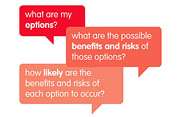
By encouraging to ask three simple questions: What are my options? What are the possible benefits and risks of those options? How likely are the benefits and risks of each option to occur? the researchers hope to improve patient knowledge and encourage engagement with health staff to develop more tailored treatment.

The work is based on research that shows shared decision making can lead to better outcomes for patients. The Making Good Decisions in Collaboration (MAGIC) programme, funded by the Health Foundation, is a joint venture between Cardiff School of Medicine, Newcastle University, Cardiff and Vale University Health Board and Newcastle-upon-Tyne Hospitals NHS Foundation Trust.

The 18-month programme, joint led by Professor Glyn Elwyn, School of Medicine, aims to explore how clinicians can engage patients in shared decision making and how it can be embedded into mainstream health services.

Keith Cass, who was diagnosed with prostate cancer, has been using the 3 Questions during his treatment and played a part in developing the tools. Mr. Cass said: "I’m really pleased with the way it is going ahead and the number of patients that have been involved. We do feel we are part of the decision making team.

"It is us that are ill and we want to have some control at least over the decisions about our and treatments. I think these tools will definitely be helpful.

"Patients are asking questions that they wouldn’t have asked before. I’ve made decisions about my treatment that have been based on my quality of life. I think the MAGIC Project helped me make those decisions. It’s helped me become I’m more aware of my illness. There’s massive benefit for patients."

Shared decision making is known to work well in situations where there is more than one reasonable course of action.

Patients are often faced with difficult decisions to make, whether it’s about choosing to have treatment or choosing between different . The best decision for the patient will depend on what matters most to them. In order to think about what’s important, they need to know about the full range of options available and the likelihood of different outcomes happening - the three can help support this.

Professor Elwyn, School of Medicine, said: "Many good decision support tools exist already, but aren’t widely used. We want to raise awareness of shared and find ways to introduce sustainable change that can be easily replicated in other areas."

More information: More information on the Ask 3 Questions campaign is available at: www.cardiffandvale… .nhs.uk/ask3

Provided by Cardiff University search and more info website

4.5 /5 (2 votes)  

Rank 4.5 /5 (2 votes)
Relevant PhysicsForums posts

More news stories

Driving and hands-free talking lead to spike in errors, study shows

Talking on a hands-free device while behind the wheel can lead to a sharp increase in errors that could imperil other drivers on the road, according to new research from the University of Alberta.

Health created 4 hours ago | popularity not rated yet | comments 0

About one in four uninsured could be excluded from ACA

(HealthDay)—More than one in four of those eligible for new premium assistance tax credits under the Affordable Care Act (ACA) do not have a checking account and will not be able to receive premiums from ...

Health created 6 hours ago | popularity not rated yet | comments 0

Audiologists recommend smart phone apps to monitor noise levels

After studying noise in one French Quarter neighborhood of New Orleans to determine whether or not noise levels exceeded municipal ordinances, Annette Hurley, PhD, Assistant Professor of Audiology at LSU Health Sciences Center ...

Health created 8 hours ago | popularity not rated yet | comments 0

Young children who miss well-child visits are more likely to be hospitalized

Young children who missed more than half of recommended well-child visits had up to twice the risk of hospitalization compared to children who attended most of their visits, according to a study published today in the American Jo ...

Health created 8 hours ago | popularity not rated yet | comments 0

Do doctors understand the individualisation of treatments?

The individualisation of drug treatments to support patients to self-manage their conditions is a concept that sits at the heart of policy, but a recent study in BMJ Open shows that there is no concrete defini ...

Health created 10 hours ago | popularity 3 / 5 (1) | comments 0


Researchers identify first drug targets in childhood genetic tumor disorder

Two mutations central to the development of infantile myofibromatosis (IM)—a disorder characterized by multiple tumors involving the skin, bone, and soft tissue—may provide new therapeutic targets, according to researchers ...

Engineered cytomegalovirus protects monkeys from HIV equivalent

(Medical Xpress)—A new study by researchers in the US has shown that an ancient virus can be modified to help in the fight against the simian immunodeficiency virus SIV, which is the equivalent in monkeys ...

Hormone levels may provide key to understanding psychological disorders in women

Women at a particular stage in their monthly menstrual cycle may be more vulnerable to some of the psychological side-effects associated with stressful experiences, according to a study from UCL.

Going live: Immune cell activation in multiple sclerosis

Biological processes are generally based on events at the molecular and cellular level. To understand what happens in the course of infections, diseases or normal bodily functions, scientists would need to ...

Pollen count apps for smartphones are nothing to sneeze at

Kate O'Reilly's spring allergy survival kit includes the usual stuff - nasal sprays, allergy pills and a box of tissues. This season, she's added a new weapon to her line of defense: an app on her smartphone.

Comorbidities common with alopecia areata

(HealthDay)—Comorbid conditions often accompany alopecia areata, according to a study published online May 22 in JAMA Dermatology.