Scientists uncover gene network responsible for repair of the central nervous system of the fruit fly
August 31, 2011 in Medical research
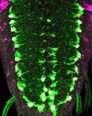
Glia that enwrap axons in the Drosophila larval ventral nerve cord. Credit: Dr Kentaro Kato, University of Birmingham
A gene network that controls repair to the central nervous system (CNS) after injury has been discovered in the fruit fly, Drosophila, by scientists at the University of Birmingham. This breakthrough may help to aid understanding of cell manipulation techniques necessary to repair damage to the human CNS, according to research published today in the journal PLoS Biology.
A natural mechanism that promotes structural robustness in animals and encourages CNS repair has been investigated using fruit flies by looking at how cells respond to injury. Axons carry impulses between nerve cells and glial cells normally surround them. After injury, glial cells are responsible for re-enwrapping axons and supporting nerve cells, encouraging recovery. In both insects and mammals, glial cell numbers increase upon injury and this response can lead to modest recovery of nerve function.
Project Director Dr Alicia Hidalgo, Senior Lecturer from the School of Biosciences at the University of Birmingham, explains:
Using fruit flies we have discovered a gene network that promotes repair to the central nervous system. We applied injury to the small nerve cord of Drosophila larvae of a range of genetic backgrounds.
We found that the gene network enables glial cells to clear up cellular debris, to divide and differentiate, and restore normal glia-axon interactions, promoting repair. By removing the genes in the network, or adding them in excess, we can shift from prevention to promotion of lesion repair in the fruit fly.
The researchers suggest that this gene network may reflect a common underlying genetic mechanism, which, if present in mammals, could help understand how to manipulate glial cells to help the human CNS self-repair.
Dr Hidalgo adds:
Finding ways to promote central nervous system regeneration is one of the key aims of medical research in neuroscience. If this fruit fly gene network was conserved evolutionarily in human glial cells, it could help us to understand the cellular events and underlying molecular mechanisms that take place after spinal cord injury and demyelinating diseases and eventually contribute to finding therapeutic solutions for these conditions.
Provided by University of Birmingham
-
Unexpected cell repairs injured spinal cord
Jul 07, 2011 |
not rated yet |
0
-
Post brain injury: New nerve cells originate from neural stem cells
Mar 11, 2008 |
not rated yet |
0
-
Cancer drug aids cell regeneration after spinal cord injury
Jan 27, 2011 |
not rated yet |
0
-
Milestone in the regeneration of brain cells
Aug 20, 2007 |
not rated yet |
0
-
Scientists discover a new line of communication between nervous system cells
Jun 26, 2007 |
not rated yet |
0
-
Motion perception revisited: High Phi effect challenges established motion perception assumptions
Apr 23, 2013 |
3 / 5 (2) |
2
-
Anything you can do I can do better: Neuromolecular foundations of the superiority illusion (Update)
Apr 02, 2013 |
4.5 / 5 (11) |
5
-
The visual system as economist: Neural resource allocation in visual adaptation
Mar 30, 2013 |
5 / 5 (2) |
9
-
Separate lives: Neuronal and organismal lifespans decoupled
Mar 27, 2013 |
4.9 / 5 (8) |
0
-
Sizing things up: The evolutionary neurobiology of scale invariance
Feb 28, 2013 |
4.8 / 5 (10) |
14
-
Why is zone 1 in liver more prone to ischemic injury?
May 23, 2013
-
How can there be villous adenoma in colon, if there are no villi there
May 22, 2013
-
How can there be a term called "intestinal metaplasia" of stomach
May 21, 2013
-
Pressure-volume curve: Elastic Recoil Pressure don't make sense
May 18, 2013
-
If you became brain-dead, would you want them to pull the plug?
May 17, 2013
-
MRI bill question
May 15, 2013
- More from Physics Forums - Medical Sciences
More news stories
Study reveals new mechanism for estrogen suppression of liver lipid synthesis
By discovering the new mechanism by which estrogen suppresses lipid synthesis in the liver, UC Irvine endocrinologists have revealed a potential new approach toward treating certain liver diseases.
Medical research
May 23, 2013 |
not rated yet |
0
|
MRI-based measurement helps predict vascular disease in the brain
Aortic arch pulse wave velocity, a measure of arterial stiffness, is a strong independent predictor of disease of the vessels that supply blood to the brain, according to a new study published in the June issue the journal ...
Medical research
May 23, 2013 |
not rated yet |
0
Antibiotics: A new understanding of sulfonamide nervous system side effects
Since the discovery of Prontosil in 1932, sulfonamide antibiotics have been used to combat a wide spectrum of bacterial infections, from acne to chlamydia and pneumonia. However, their side effects can include serious neurological ...
Medical research
May 23, 2013 |
not rated yet |
0
|
Scientists discover molecule triggers sensation of itch
Scientists at the National Institutes of Health report they have discovered in mouse studies that a small molecule released in the spinal cord triggers a process that is later experienced in the brain as ...
Medical research
May 23, 2013 |
5 / 5 (3) |
0
|
Discarded immune cells induce the relocation of stem cells
Spanish researchers have discovered that the daily clearance of neutrophils from the body stimulates the release of hematopoietic stem cells from the bone marrow into the bloodstream, according to a report published today ...
Medical research
May 23, 2013 |
5 / 5 (2) |
0
Researchers identify first drug targets in childhood genetic tumor disorder
Two mutations central to the development of infantile myofibromatosis (IM)—a disorder characterized by multiple tumors involving the skin, bone, and soft tissue—may provide new therapeutic targets, according to researchers ...
Engineered cytomegalovirus protects monkeys from HIV equivalent
(Medical Xpress)—A new study by researchers in the US has shown that an ancient virus can be modified to help in the fight against the simian immunodeficiency virus SIV, which is the equivalent in monkeys ...
Hormone levels may provide key to understanding psychological disorders in women
Women at a particular stage in their monthly menstrual cycle may be more vulnerable to some of the psychological side-effects associated with stressful experiences, according to a study from UCL.
Going live: Immune cell activation in multiple sclerosis
Biological processes are generally based on events at the molecular and cellular level. To understand what happens in the course of infections, diseases or normal bodily functions, scientists would need to ...
Driving and hands-free talking lead to spike in errors, study shows
Talking on a hands-free device while behind the wheel can lead to a sharp increase in errors that could imperil other drivers on the road, according to new research from the University of Alberta.
Pollen count apps for smartphones are nothing to sneeze at
Kate O'Reilly's spring allergy survival kit includes the usual stuff - nasal sprays, allergy pills and a box of tissues. This season, she's added a new weapon to her line of defense: an app on her smartphone.