Possible new blood test to diagnose heart attacks
September 20, 2011 in Cardiology
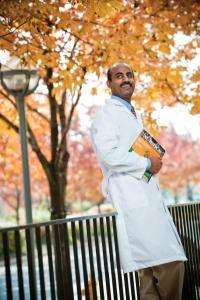
Sakthivel Sadayappan, Ph.D works at Loyola University Health System. Credit: Loyola University Health System
Loyola University Chicago Stritch School of Medicine researchers are reporting a possible new blood test to help diagnose heart attacks.
In the Journal of Molecular and Cellular Cardiology, researchers report that a large protein known as cardiac myosin binding protein-C (cMyBP-C) is released to the blood following a heart attack.
"This potentially could become the basis for a new test, used in conjunction with other blood tests, to help diagnose heart attacks," said senior author Sakthivel Sadayappan, PhD. "This is the beginning. A lot of additional studies will be necessary to establish cMyBP-C as a true biomarker for heart attacks."
Sadayappan is an assistant professor in the Department of Cell and Molecular Physiology at Loyola University Chicago Stritch School of Medicine. First author is Suresh Govindan, PhD, a postdoctoral researcher in Sadayappan's lab.
Between 60 and 70 percent of all patients who complain of chest pain do not have heart attacks. Many of these patients are admitted to the hospital, at considerable time and expense, until a heart attack is definitively ruled out.
An electrocardiogram can diagnose major heart attacks, but not minor ones. There also are blood tests for various proteins associated with heart attacks. But most of these proteins are not specific to the heart. Elevated levels could indicate a problem other than a heart attack, such as a muscle injury.
Only one protein now used in blood tests, called cardiac troponin-I, is specific to the heart. But it takes at least four to six hours for this protein to show up in the blood following a heart attack. So the search is on for another heart attack protein that is specific to the heart.
The Loyola study is the first to find that cMyBP-C is associated with heart attacks. The protein is specific to the heart. And it may be readily detectable in a blood test because of its large molecular size and relatively high concentration in the blood.
Researchers evaluated blood samples from heart attack patients. They also evaluated rats that had experienced heart attacks. They found that in both humans and rats, cMyBP-C was elevated significantly following heart attacks.
Sadayappan said cMyBP-C is a large assembly protein that stabilizes heart muscle structure and regulates cardiac function. During a heart attack, a coronary artery is blocked, and heart muscle cells begin to die due to lack of blood flow and oxygen. As heart cells die, cMyPB-C breaks into fragments and is released into the blood.
"Future studies," Sadayappan and colleagues wrote, "would determine the time course of release, peak concentrations and half life in the circulatory system."
Provided by
Loyola University Health System
-
Potential new heart attack biomarker uncovered
Dec 10, 2009 |
not rated yet |
0
-
In India, 1 in 25 people have gene that causes heart failure
Jun 08, 2010 |
not rated yet |
0
-
Cardiologists uncover new heart attack warning sign
Jan 06, 2011 |
not rated yet |
0
-
Heart attacks are more serious in the morning: study
Apr 26, 2011 |
not rated yet |
0
-
Gene predicts heart attack response and cardiac damage
Jan 30, 2008 |
not rated yet |
0
-
Motion perception revisited: High Phi effect challenges established motion perception assumptions
Apr 23, 2013 |
3 / 5 (2) |
2
-
Anything you can do I can do better: Neuromolecular foundations of the superiority illusion (Update)
Apr 02, 2013 |
4.5 / 5 (11) |
5
-
The visual system as economist: Neural resource allocation in visual adaptation
Mar 30, 2013 |
5 / 5 (2) |
9
-
Separate lives: Neuronal and organismal lifespans decoupled
Mar 27, 2013 |
4.9 / 5 (8) |
0
-
Sizing things up: The evolutionary neurobiology of scale invariance
Feb 28, 2013 |
4.8 / 5 (10) |
14
-
Magnetic field and repulsion bewteen wires
1 hour ago
-
Enthalpy of reaction
7 hours ago
-
Harmonic oscillation problem -Dancing pot
8 hours ago
-
Ultracapacitor to power electromagnet?
9 hours ago
-
Confusion in Electro Statics
9 hours ago
-
simple gravity question
10 hours ago
- More from Physics Forums - Classical Physics
More news stories
Hospitals' cardiac arrest incidence and survival rates go hand in hand
Hospitals with the highest rates of cardiac arrests tend to have the poorest survival rates for those cases, new University of Michigan Health System research shows.
Cardiology
26 minutes ago |
not rated yet |
0
Effect of fluid and sodium restrictions on weight loss among patients with heart failure
A clinical trial of 75 patients hospitalized with acute decompensated heart failure (ADHF) suggests that aggressive fluid and sodium restriction has no effect on weight loss or clinical stability at three days but was associated ...
Cardiology
26 minutes ago |
not rated yet |
0
Which women should be screened for high cholesterol?
National guidelines recommend that at-risk women be screened for elevated cholesterol levels to reduce their chances of developing cardiovascular disease. But who is 'at risk?' The results of a study by investigators ...
Cardiology
3 hours ago |
not rated yet |
0
Atherosclerotic disease heredity mapped in nationwide study
Researchers at Lund University in Sweden have mapped the significance of heredity for common forms of atherosclerotic disease. No studies have previously examined whether different forms of the disease share heredity.
Cardiology
5 hours ago |
not rated yet |
0
Study finds improved CPR quality saves lives
(Medical Xpress)—Life-saving CPR has been a foundation of emergency medicine for more than a half century. But researchers at the University of Arizona College of Medicine-Phoenix are continuing to refine the procedure, ...
Cardiology
6 hours ago |
not rated yet |
0
The compound in the Mediterranean diet that makes cancer cells 'mortal'
New research suggests that a compound abundant in the Mediterranean diet takes away cancer cells' "superpower" to escape death. By altering a very specific step in gene regulation, this compound essentially re-educates cancer ...
Study shows how bilinguals switch between languages
(Medical Xpress)—Individuals who learn two languages at an early age seem to switch back and forth between separate "sound systems" for each language, according to new research conducted at the University of Arizona.
Study suggests new source of kidneys for transplant
Nearly 20 percent of kidneys that are recovered from deceased donors in the U.S. are refused for transplant due to factors ranging from scarring in small blood vessels of the kidney's filtering units to the organ going too ...
Discovery of circadian clock in mice hair reveals period of time when damage from radiotherapy can be quickly repaired
Discovering that mouse hair has a circadian clock - a 24-hour cycle of growth followed by restorative repair - researchers suspect that hair loss in humans from toxic cancer radiotherapy and chemotherapy ...
SARS-like virus claims new life in Saudi
A Saudi man who had contracted the coronavirus has died, raising the death toll in the kingdom from the SARS-like virus to 16, the health ministry announced on Monday on its Internet website.
Gym class reduces probability of obesity, study finds for first time
Little is known about the effect of physical education (PE) on child weight, but a new study from Cornell University finds that increasing the amount of time that elementary schoolchildren spent in gym class reduces the probability ...