Cancer stem cell discovery
(Medical Xpress) -- A Cardiff team has identified a weakness in breast cancer stem cells which could help prevent the disease from spreading. The team has found a laboratory method to switch off breast cancer stem cells resistance to a particular drug. The breakthrough offers the long-term possibility of blocking the cells from creating new tumours in patients.
The finding also highlights Cardiffs strength in the increasingly important field of cancer stem cell research, having created the European Cancer Stem Cell Research Institute. This new discovery underlines just how critical cancer stem cells are in the spread and re-appearance of the disease.
Cancer stem cells make up only a small proportion of the cells in a tumour but many scientists now believe they are responsible for cancer growth, spread and relapse. They are also known to be highly drug-resistant. However, the Cardiff team, based at the School of Biosciences, has now managed to make breast cancer stem cells sensitive to the anti-cancer agent TRAIL.
TRAIL had not previously been seen as a breast cancer treatment, as it is blocked by a protein in the cells called c-FLIP. The Cardiff scientists have suppressed the effect of c-FLIP, making the cancer stem cells sensitive to TRAIL. With this method, the scientists achieved a 98 per cent reduction in secondary tumours. Importantly, they also showed that repeat treatment is equally effective in eliminating cancer stem cells if they re-appear. The Cardiff teams long-term goal is now to trial the method on breast cancer in the body.
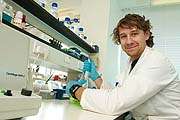
The paper on the findings has just been published in the journal Breast Cancer Research, with PhD student Luke Piggott the lead author. Luke is also familiar to ice hockey fans and has just signed a new contract with the Cardiff Devils Elite League team.
Lukes supervisor, Dr Richard Clarkson of the School of Biosciences, said: "We believe we have found a crucial Achilles heel in breast cancer stem cells. We can almost completely shut down their ability to spread the disease through the body through secondary tumours. Our success with repeat treatments is also important, offering hope that we can reduce relapse rates of the disease.
"These are very promising results but so far we have only seen this method work on cells in the laboratory. We need a lot more work to establish how best to suppress C-FLIP in patients and whether this can eliminate cancer stem cells in tumours in the breast."
Professor Alan Clarke, Director of the European Cancer Stem Cell Research Institute, added: "Lukes results highlight the key role played by cancer stem cells in the spread and relapse of breast cancer. His study is further evidence for the Institutes belief that it is vital to eliminate cancer stem cells if we are to be completely successful in treating all types of cancer."
Lukes PhD studentship is funded by the cancer charity Tenovus through a support programme for early career cancer researchers. Research Grants Officer, Dr Anita Howman said: "Tenovus funded research is continuing to further our knowledge of how cancers form and create new drugs for some of the hardest to treat cancers. We are delighted to support Lukes PhD studentship which has made an innovative discovery that will potentially benefit many people affected by breast cancer.
"One of Tenovus' proudest achievements is the early career research scientists we have helped to support and train through our PhD studentship funding programme which have benefitted close to 200 students. We now have nine active PhD studentships throughout Wales, with a further ten due to start in September. These projects not only aim to find new ways to detect and treat cancer, they also help to nurture the next generation of world class cancer researchers. "
The research was also funded by Breast Cancer Campaign. Dr Lisa Wilde, Director of Research at the charity said: "Over 12,000 people still die each year from breast cancer in the UK, mainly as a result of the disease spreading to other parts of the body. This research is an important early step in understanding the role cancer stem cells play in this process and could help us develop desperately needed new treatments to halt breast cancer spread in its tracks."
Provided by
Cardiff University
-
Herceptin targets breast cancer stem cells
Jul 09, 2008 |
not rated yet |
0
-
Therapy may block expansion of breast cancer cells
Nov 05, 2008 |
not rated yet |
0
-
Indirect path to attack breast cancer stem cells found
Jan 18, 2011 |
not rated yet |
0
-
PMH cancer researchers link ovarian hormone to breast stem cells growth
May 05, 2010 |
not rated yet |
0
-
Embryonic stem cells can kill cancer cells
Oct 11, 2005 |
not rated yet |
0
-
Motion perception revisited: High Phi effect challenges established motion perception assumptions
Apr 23, 2013 |
3 / 5 (2) |
2
-
Anything you can do I can do better: Neuromolecular foundations of the superiority illusion (Update)
Apr 02, 2013 |
4.5 / 5 (11) |
5
-
The visual system as economist: Neural resource allocation in visual adaptation
Mar 30, 2013 |
5 / 5 (2) |
9
-
Separate lives: Neuronal and organismal lifespans decoupled
Mar 27, 2013 |
4.9 / 5 (8) |
0
-
Sizing things up: The evolutionary neurobiology of scale invariance
Feb 28, 2013 |
4.8 / 5 (10) |
14
-
Pressure-volume curve: Elastic Recoil Pressure don't make sense
14 hours ago
-
If you became brain-dead, would you want them to pull the plug?
May 17, 2013
-
MRI bill question
May 15, 2013
-
Ratio of Hydrogen of Oxygen in Dessicated Animal Protein
May 13, 2013
-
Alcohol and acetaminophen
May 13, 2013
-
Marie Curie's leukemia
May 13, 2013
- More from Physics Forums - Medical Sciences
More news stories
New colonoscope provides ground-breaking view of colon
A ground-breaking advance in colonoscopy technology signals the future of colorectal care, according to research presented today at Digestive Disease Week(DDW). Additional research focuses on optimizing the minimal withdrawal ...
Cancer
7 hours ago |
5 / 5 (1) |
0
ASCO: combo antibody therapy effective for melanoma
(HealthDay)—Concurrent use of two immune checkpoint antibodies—ipilimumab and nivolumab—may be effective for the treatment of advanced melanoma, according to a proof-of-principal study presented in ...
Cancer
May 17, 2013 |
not rated yet |
0
Risk factors ID'd for poor cutaneous cell CA outcomes
(HealthDay)—The risks of metastasis and death associated with cutaneous squamous cell carcinoma (CSCC) are low, but significant, and risk factors for poor outcome include tumor diameter, invasion beyond ...
Cancer
May 17, 2013 |
not rated yet |
0
|
Physical & emotional impairments common, often untreated in people with cancer
A new review finds cancer survivors suffer a diverse and complex set of impairments, affecting virtually every organ system. Writing in CA: A Cancer Journal for Clinicians, Julie Silver, M.D., associate professor at Harvar ...
Cancer
May 17, 2013 |
not rated yet |
0
Calif. doc with 'cancer cure' gets 14 years prison (Update)
(AP)—A California doctor has been sentenced to 14 years in federal prison for bilking her patients out of more than $1 million by promising that an herbal supplement could cure late-stage cancer and other diseases.
Cancer
May 17, 2013 |
not rated yet |
0
New research identifies risks, interventions for children's GI health
An increasing number of U.S. children are experiencing gastrointestinal issues that require interventions to resolve, according to research presented at Digestive Disease Week (DDW).
US psychiatry gets makeover in new manual
The latest makeover to a massive psychiatric tome honored by some, reviled by others and even called the "Bible" of mental disorders is being released Saturday with a host of new changes.
New case of SARS-like virus in Saudi: ministry
A new case of the deadly coronavirus has been detected in Saudi Arabia where 15 people have already died after contracting it, the health ministry announced on Saturday on its Internet website.
AIDS science at 30: 'Cure' now part of lexicon
Big names in medicine are set to give an upbeat assessment of the war on AIDS on Tuesday, 30 years after French researchers identified the virus that causes the disease.
For combat veterans suffering from post-traumatic stress disorder, 'fear circuitry' in the brain never rests
Chronic trauma can inflict lasting damage to brain regions associated with fear and anxiety. Previous imaging studies of people with post-traumatic stress disorder, or PTSD, have shown that these brain regions can over-or ...
Flesh-eating disease victim gets prosthetic hands
(AP)—A woman who lost both hands, her left leg and right foot after contracting a flesh-eating disease has been fitted with prosthetic hands.