Computer-aided design used for breast tissue reconstruction
September 8, 2011 in Medical research
A technology usually reserved for designing buildings, bridges and aircraft has now been used to aid breast tissue reconstruction in cancer patients.
In a study published today, Thursday 8 September, in IOP Publishing's journal Biofabrication, researchers used computer-aided design (CAD) to create an extremely accurate mould of a breast that was used as a visual aid to surgeons in tissue reconstruction operations.
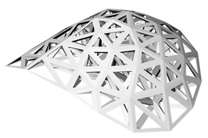
Furthermore, CAD was used to design and produce patient-specific physical scaffolds that could potentially be used in conjunction with one of the most promising areas of medicine - tissue engineering.
In theory, patients' own cells could be harnessed and grown onto the highly specific scaffold and then transferred to the affected area, avoiding the need to transfer tissue from other parts of the body which can cause large scars, result in considerable blood loss and require five to ten hours of anaesthesia.
Study co-author, Professor Dietmar Hutmacher, said, "We would take a laser scan of the healthy breast and use the CAD modeling process to design a patient-specific scaffold in silico. We would then produce a scaffold of very high porosity and load it with the patient's own cells in combination with a hydrogel. The construct would then be implanted."
CAD the use of computer technology in the process of design holds several advantages over traditional pen and paper approaches including the ability to work to full scale, examine the design from all angles and maintain absolute accuracy.
After informed consent, 3D laser scanning was performed on three female patients who suffered from breast cancer. The images were then fed into a piece of CAD-software which produced a single image representing the patient's breast and surrounding thorax region.
This image was then "printed" to form a 3D mould which was used as an operative aid for surgeons who performed autologous tissue reconstructions the transferring of tissue from another part of the patient's body on each of the patients.
After each of the operations, the surgeons observed a more perfect shape with a higher degree of symmetry between the breasts whilst, more importantly, the patients reported a higher satisfaction of the surgery outcomes than the control group, again with respect to shape and symmetry of their breasts.
The long-term aim of the study, however, was on the development of a material that could be used in tissue engineering and it showed that CAD could be an effective way of achieving this.
A function was created using the CAD software that enabled the creation of a mould for any scanned tissue with the ability to independently tailor the porosity and pore size a property that is essential to the seeding and diffusing of cells throughout the structure and something that limits modern technologies.
Professor Hutmacher continued, "The development of a clinically translatable method of engineering adipose tissue for soft tissue reconstruction requires investigation of several components.
"There must be coordination between all key aspects of the tissue engineering process, including the selection of cell source, scaffold material, cellular environment, and means of device delivery in order for the engineering of any tissue to be successful."
An Institute of Physics spokesperson said, "This advance offers hope to women who have undergone mastectomies. It's enlightening to see how a technique, first designed for the construction of buildings, bridges and aircraft, is now being used in medicine."
More information: "CAD/CAM-assisted breast reconstruction" 2011 Biofabrication 3 034114. www.iopscience.org… f/3/3/034114
Provided by
Institute of Physics
-
Tissue engineered scaffolding allows reproduction of cartilage tissue
May 09, 2007 |
not rated yet |
0
-
Researchers Use Adult Stem Cells to Create Soft Tissue
Jul 06, 2007 |
not rated yet |
0
-
3D printing for new tissues and organs
Jun 18, 2009 |
not rated yet |
0
-
Breast reconstruction advances fix distortions left by lumpectomy
Apr 23, 2008 |
not rated yet |
0
-
Extracting stem cells from fat for tissue regeneration
May 03, 2011 |
not rated yet |
0
-
Motion perception revisited: High Phi effect challenges established motion perception assumptions
Apr 23, 2013 |
3 / 5 (2) |
2
-
Anything you can do I can do better: Neuromolecular foundations of the superiority illusion (Update)
Apr 02, 2013 |
4.5 / 5 (11) |
5
-
The visual system as economist: Neural resource allocation in visual adaptation
Mar 30, 2013 |
5 / 5 (2) |
9
-
Separate lives: Neuronal and organismal lifespans decoupled
Mar 27, 2013 |
4.9 / 5 (8) |
0
-
Sizing things up: The evolutionary neurobiology of scale invariance
Feb 28, 2013 |
4.8 / 5 (10) |
14
-
Why is zone 1 in liver more prone to ischemic injury?
May 23, 2013
-
How can there be villous adenoma in colon, if there are no villi there
May 22, 2013
-
How can there be a term called "intestinal metaplasia" of stomach
May 21, 2013
-
Pressure-volume curve: Elastic Recoil Pressure don't make sense
May 18, 2013
-
If you became brain-dead, would you want them to pull the plug?
May 17, 2013
-
MRI bill question
May 15, 2013
- More from Physics Forums - Medical Sciences
More news stories
Study reveals new mechanism for estrogen suppression of liver lipid synthesis
By discovering the new mechanism by which estrogen suppresses lipid synthesis in the liver, UC Irvine endocrinologists have revealed a potential new approach toward treating certain liver diseases.
Medical research
May 23, 2013 |
5 / 5 (1) |
0
|
MRI-based measurement helps predict vascular disease in the brain
Aortic arch pulse wave velocity, a measure of arterial stiffness, is a strong independent predictor of disease of the vessels that supply blood to the brain, according to a new study published in the June issue the journal ...
Medical research
May 23, 2013 |
not rated yet |
0
Antibiotics: A new understanding of sulfonamide nervous system side effects
Since the discovery of Prontosil in 1932, sulfonamide antibiotics have been used to combat a wide spectrum of bacterial infections, from acne to chlamydia and pneumonia. However, their side effects can include serious neurological ...
Medical research
May 23, 2013 |
3 / 5 (1) |
0
|
Scientists discover molecule triggers sensation of itch
Scientists at the National Institutes of Health report they have discovered in mouse studies that a small molecule released in the spinal cord triggers a process that is later experienced in the brain as ...
Medical research
May 23, 2013 |
5 / 5 (3) |
0
|
Discarded immune cells induce the relocation of stem cells
Spanish researchers have discovered that the daily clearance of neutrophils from the body stimulates the release of hematopoietic stem cells from the bone marrow into the bloodstream, according to a report published today ...
Medical research
May 23, 2013 |
5 / 5 (2) |
0
Heart failure accelerates male 'menopause'
Heart failure accelerates the aging process and brings on early andropausal syndrome (AS), according to research presented today at the Heart Failure Congress 2013. AS, also referred to as male 'menopause', was four times ...
First drug to improve heart failure mortality in over a decade
Coenzyme Q10 decreases all cause mortality by half, according to the results of a multicentre randomised double blind trial presented today at Heart Failure 2013 congress. It is the first drug to improve heart failure mortality ...
Feds fight morning-after pill age ruling in NY
(AP)—Department of Justice lawyers have again asked a federal appeals court in New York to delay lifting age restrictions and prescription requirements on an emergency contraceptive popularly known as the morning-after ...
Death highest in heart failure patients admitted in January, on Friday, and overnight
Mortality and length of stay are highest in heart failure patients admitted in January, on Friday, and overnight, according to research presented today at the Heart Failure Congress 2013. The analysis of nearly 1 million ...
Engineered cytomegalovirus protects monkeys from HIV equivalent
(Medical Xpress)—A new study by researchers in the US has shown that an ancient virus can be modified to help in the fight against the simian immunodeficiency virus SIV, which is the equivalent in monkeys ...
Researchers identify first drug targets in childhood genetic tumor disorder
Two mutations central to the development of infantile myofibromatosis (IM)—a disorder characterized by multiple tumors involving the skin, bone, and soft tissue—may provide new therapeutic targets, according to researchers ...