Doctor experience matters in carotid artery procedures
September 27, 2011 in Cardiology
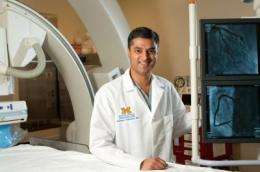
New study led by University of Michigan Health System shows receiving carotid stent from lesser-experienced physicians associated with higher risk of death. Credit: University of Michigan
Preventing a stroke by placing a stent in the carotid artery, a major artery of the head and neck, is a procedure that's skyrocketing in the United States, but the outcomes can be deadly if older patients are not in the right hands.
Older patients receiving carotid artery stenting from lesser experienced physicians had an increased risk of death 30 days after stent placement, according to a study published today in the Journal of the American Medical Association.
An analysis of Medicare data showed a higher death risk if the stent was inserted by a doctor who performed less than six procedures a year, of if the procedure was conducted early in the physician's career.
Carotid stenting is increasingly being used to treat severe carotid atherosclerosis, an important cause of ischemic stroke. Since approval of the first carotid stent system by the U.S. Food and Drug Administration in 2004, use of carotid stenting has more than doubled in Medicare beneficiaries.
Despite the promise of this procedure, its increasing use has raised potential concerns.
"Carotid stenting is a technically demanding procedure and earlier studies have demonstrated a substantial learning curve with it," says lead study author Brahmajee K. Nallamothu, M.D., M.P.H., cardiologist at the University of Michigan Cardiovascular Center.
"The total number of operators currently performing carotid stenting in routine clinical practice and their overall experiences and outcomes with the procedure remain largely unknown," he says.
Compared with patients treated by operators performing 24 or more procedures per year, those treated by operators performing less than six procedures per year were nearly twice as likely to die within 30 days of the stent placement.
Nallamothu and colleagues at the U-M Health System, Mayo Clinic, Dartmouth-Hitchcock Medical Center, and Yale University School of Medicine conducted a study to examine recent patterns of utilization and outcomes for carotid stenting in the U.S. among elderly patients.
The researchers used administrative data from fee-for-service Medicare beneficiaries ages 65 years or older who underwent carotid stenting between 2005 and 2007. Among the outcomes the researchers measured were 30-day mortality and treatment early vs. late during an operator's experience.
Analysis of the data identified 24,701 patients who underwent carotid stenting by 2,339 operators. Average age of the patients in the study was 76.2 years; 40.2 percent were women; and 4.3 percent were black.
The authors found higher 30-day mortality in patients treated early vs. late during a new operator's experience (2.3 percent vs. 1.4 percent, respectively). Compared with patients who were their operator's 12th procedure or higher, those who were among their operator's first 11 procedures had a 1.7 times higher odds of dying within 30 days of the procedure.
"In conclusion, many physicians have begun performing carotid stenting in Medicare beneficiaries during recent years, although most operators appear to have developed limited experience with the procedure over time, " study authors write. "This finding is important since adjusted outcomes following the procedure are worse among very low-volume operators and early during an operator's experience. Given limitations of these data, caution should be exerted when using our findings to set specific targets for operator experience.
"Nevertheless, collecting more detailed data about operator experience during the early dissemination of new procedures, like carotid stenting, may help optimize outcomes," the authors write.
More information: Journal of the American Medical Association, "Operator experience and carotid stenting outcomes in Medicare beneficiaries, " Vol. 306, No. 12.
Provided by
University of Michigan
-
Carotid stents associated with greater risk of stroke or death than carotid endarterectomy surgery
Oct 11, 2010 |
not rated yet |
0
-
New results in carotid artery stenosis versus endarterectomy
Dec 01, 2010 |
not rated yet |
0
-
Treatments for blocked carotid arteries vary by US region
Jul 26, 2010 |
not rated yet |
0
-
National stroke prevention study reveals surgery and stenting equally effective
Feb 26, 2010 |
not rated yet |
0
-
Study reveals embolic neuroprotection system reduces risk of cardiac events
Oct 16, 2008 |
not rated yet |
0
-
Of mice and mental models: Neuroscientific implications of risk-optimized behavior in the mouse
21 hours ago |
not rated yet |
0
-
Limits to growth: Scientists identify key metastasis-enabling enzyme
May 22, 2012 |
5 / 5 (4) |
0
-
Seeing is as seeing does: Spatially-structured retinal input in early development of cortical maps
Apr 26, 2012 |
5 / 5 (4) |
1
-
Dreamless nights: Brain activity during nonrapid eye movement sleep
Apr 09, 2012 |
4.4 / 5 (12) |
0
-
Take your time: Neurobiology sheds light on the superiority of spaced vs. massed learning
Mar 28, 2012 |
4.5 / 5 (21) |
3
-
What capacitors to use in a Tesla coil...?
15 hours ago
-
Work done by us on the spring
17 hours ago
-
Surface current density
18 hours ago
-
Work done on body moving in a circle
22 hours ago
-
Crest or Trough?
22 hours ago
-
Origin of magnetism
May 25, 2012
- More from Physics Forums - Classical Physics
More news stories
One-fifth of healthy middle-aged men have low-grade murmur
(HealthDay) -- More than one-fifth of healthy middle-aged men have a low-grade systolic heart murmur that confers a nearly five-fold higher risk of future aortic valve replacement (AVR), according to a study ...
Cardiology
16 hours ago |
not rated yet |
0
New device allows pacemaker patients to safely undergo MRIs
For many, it's a medical conundrum: The very pacemaker keeping their heart in rhythm prevents them from undergoing an MRI to diagnose other ailments, because interaction between the two devices could prove deadly.
Cardiology
17 hours ago |
not rated yet |
0
|
New study should end debate over magnesium treatment for preventing poor outcome after haemorrhagic stroke
An international randomised trial and meta-analysis published Online First in The Lancet should put an end to the debate about the use of intravenous magnesium sulphate to prevent poor outcomes after haemorrhagic stroke. The in ...
Cardiology
22 hours ago |
not rated yet |
0
Low vitamin D in diet increases stroke risk in Japanese-Americans
Japanese-American men who did not eat foods rich in vitamin D had a higher risk of stroke later in life, according to results of a 34-year study reported in Stroke, an American Heart Association journal.
Cardiology
May 24, 2012 |
not rated yet |
0
Clot buster seems to help up to 6 hours after stroke
(HealthDay) -- The largest study of its kind finds that stroke patients benefit from a clot-busting drug even six hours after a stroke, suggesting that the current recommended 4.5-hour limit could be expanded.
Cardiology
May 24, 2012 |
not rated yet |
0
Of mice and mental models: Neuroscientific implications of risk-optimized behavior in the mouse
(Medical Xpress) -- Regardless of an organism’s biological complexity, every encephalized animal continuously makes under-informed behavioral choices that can have serious consequences. Despite its ubiquity, ...
Tongue analysis software uses ancient Chinese medicine to warn of disease
For 5,000 years, the Chinese have used a system of medicine based on the flow and balance of positive and negative energies in the body. In this system, the appearance of the tongue is one of the measures used to classify ...
Cancer may require simpler genetic mutations than previously thought
Chromosomal deletions in DNA often involve just one of two gene copies inherited from either parent. But scientists haven't known how a deletion in one gene from one parent, called a "hemizygous" deletion, can contribute ...
Inherited DNA change explains overactive leukemia gene
A small inherited change in DNA is largely responsible for overactivating a gene linked to poor treatment response in people with acute leukemia.
Skp2 activates cancer-promoting, glucose-processing Akt
HER2 and its epidermal growth factor receptor cousins mobilize a specialized protein to activate a major player in cancer development and sugar metabolism, scientists report in the May 25 issue of Cell.
Early physical therapist treatment associated with reduced risk of healthcare utilization and reduced overall healthcare
A new study published in Spine shows that early treatment by a physical therapist for low back pain (LBP), as compared to delayed treatment, was associated with reduced risk of subsequent healthcare utilization and lower ...