New drug-like molecule to treat fragile X Syndrome
September 16, 2011 By Bill Snyder in Medical research
New drug-like molecule to treat fragile X Syndrome

Enlarge

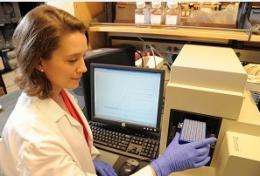
Vanderbilt research fellow Julie Field, Ph.D., prepares to assay novel compounds for activity using a high-throughput screening machine. Multi-well plate experiments allow a large number of pharmacological tests to be conducted simultaneously in a very short period of time. Credit: Dana Thomas/Vanderbilt Photography

Researchers at Vanderbilt University Medical Center, in collaboration with Seaside Therapeutics in Cambridge, Mass., have achieved a milestone in the development of a potential new treatment for fragile X syndrome, the most common genetic cause of autism.

Drug-like developed at Vanderbilt are undergoing the final pre-clinical studies required by the before entering clinical testing at Seaside Therapeutics and could be ready for human testing in early 2012, said Jeffrey Conn, Ph.D., co-director of the Vanderbilt Center for Neuroscience Drug Discovery and a member of Seaside Therapeutics’ advisory board.

Vanderbilt also is participating in clinical trials of another drug candidate developed by Seaside Therapeutics called STX209 (arbaclofen), which may decrease social withdrawal, a core symptom found in people with and autism spectrum disorders (ASD).

“Seaside Therapeutics has partnered with Vanderbilt and other leading academic institutions to translate breakthrough discoveries in neurobiology into therapeutics that we believe will address the underlying causes of these disorders and, in turn, offer the greatest potential to improve the lives of patients and their families,” said Randall Carpenter, M.D., president and chief executive officer of Seaside Therapeutics.

Fragile X syndrome, also the most common inherited form of intellectual and developmental disabilities, is relatively rare, affecting approximately 90,000 people in the United States. Major symptoms include impaired cognitive function, developmental delay, attention deficit and hyperactivity, anxiety, obsessive-compulsive and autistic behaviors.

Research conducted by the founders of Seaside Therapeutics and others suggest that excessive signaling through a receptor called mGluR5, which binds the neurotransmitter glutamate, may contribute to manifestations of fragile X syndrome.

In 2008, Seaside Therapeutics awarded Vanderbilt a $4.5 million grant to develop drug-like compounds that can improve fragile X symptoms by “tuning down” receptor activity. Last year, they began a second collaboration to discover and develop other classes of compounds that may be effective in treating the disorder. TheNational Institutes of Health also supported many of the studies that provided the groundwork for the Seaside-Vanderbilt collaboration.

Conn’s colleagues in this effort included Craig Lindsley, Ph.D., co-director in the Center for Neuroscience and Director of Medicinal Chemistry; Carrie Jones, Ph.D., the center’s director of in vivo pharmacology; Colleen Niswender , Ph.D., director of molecular pharmacology, J. Scott Daniels, director of drug metabolism and pharmacokinetics, Kyle Emmitte, Ph.D., Research Assistant Professor of Pharmacology and Medicinal Chemistry Lead, and Alice Rodriguez, Ph.D., Instructor in Pharmacology.

It can cost over a billion dollars to bring a drug to market. Cuts in health care reimbursement for medications could make it even more difficult for pharmaceutical companies to recoup that investment. Some firms already are downsizing their research operations as patent protection ends for some of their best-selling brand name products.

The rapid progress made by the Seaside Therapeutics-Vanderbilt partnership exemplifies how academic medical centers can help to fill the “drug pipeline” with new agents that potentially may improve the health of millions of patients worldwide.

Provided by Vanderbilt Medical Center

5 /5 (1 vote)  

Rank 5 /5 (1 vote)
Relevant PhysicsForums posts
  • A question about drug tolerance
    createdMay 23, 2012
  • Poor nutrition leading to overeating?
    createdMay 23, 2012
  • Math and dyslexia?
    createdMay 21, 2012
  • portable metabolism meter?
    createdMay 21, 2012
  • Rare medical conditions on 20/20 tonight
    createdMay 18, 2012
  • "Good" Cholesterol in Doubt
    createdMay 17, 2012
  • More from Physics Forums - Medical Sciences

More news stories

Implantable pain disk may help those with cancer

An estimated 3.5 million cancer patients around the globe are in severe pain from their disease, but many get no relief.

Medical research created 19 hours ago | popularity not rated yet | comments 0 | with audio podcast

Energy levels link sleep control mechanisms

Sleep, or lack of it, can determine level of cognitive performance which is linked with accidents as well as increased risk of serious health problems. Links between cell energy levels, gene transcription ...

Medical research created 21 hours ago | popularity not rated yet | comments 0

Researchers identify key brain cell in antidepressant action

(Medical Xpress) -- Antidepressant medications such as Prozac have helped improve mood and lessen anxiety in millions of people with major depression. But scientists know surprisingly little about how these drugs work.

Medical research created 21 hours ago | popularity 4.5 / 5 (2) | comments 0 | with audio podcast

Rockefeller scientists pioneer new method to determine mechanisms of drug action

(Medical Xpress) -- Knowing that a drug works is great. Knowing how it works is a luxury. And until now, determining a drug’s mechanism of action has been a tedious and difficult process for scientists.

Medical research created 22 hours ago | popularity not rated yet | comments 0 | with audio podcast

Like curry? New biological role identified for compound used in ancient medicine

Scientists have just identified a new reason why some curry dishes, made with spices humans have used for thousands of years, might be good for you.

Medical research created May 25, 2012 | popularity 4.4 / 5 (10) | comments 2 | with audio podcast


Of mice and mental models: Neuroscientific implications of risk-optimized behavior in the mouse

(Medical Xpress) -- Regardless of an organism’s biological complexity, every encephalized animal continuously makes under-informed behavioral choices that can have serious consequences. Despite its ubiquity, ...

Tongue analysis software uses ancient Chinese medicine to warn of disease

For 5,000 years, the Chinese have used a system of medicine based on the flow and balance of positive and negative energies in the body. In this system, the appearance of the tongue is one of the measures used to classify ...

Cancer may require simpler genetic mutations than previously thought

Chromosomal deletions in DNA often involve just one of two gene copies inherited from either parent. But scientists haven't known how a deletion in one gene from one parent, called a "hemizygous" deletion, can contribute ...

Inherited DNA change explains overactive leukemia gene

A small inherited change in DNA is largely responsible for overactivating a gene linked to poor treatment response in people with acute leukemia.

Skp2 activates cancer-promoting, glucose-processing Akt

HER2 and its epidermal growth factor receptor cousins mobilize a specialized protein to activate a major player in cancer development and sugar metabolism, scientists report in the May 25 issue of Cell.

Early physical therapist treatment associated with reduced risk of healthcare utilization and reduced overall healthcare

A new study published in Spine shows that early treatment by a physical therapist for low back pain (LBP), as compared to delayed treatment, was associated with reduced risk of subsequent healthcare utilization and lower ...