Electrical stimulation of brain boosts birth of new cells, may improve memory
September 20, 2011 in Neuroscience
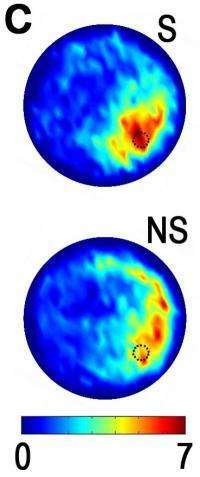
Mice who received deep brain stimulation (DBS) to a region in the brain called the entorhinal cortex showed an enhanced ability to learn how to navigate to a designated target. This image shows DBS mice (S) spent a greater amount of time (indicated in red) swimming near a submerged landing (dotted circle) compared with non-stimulated mice (NS). Credit: Reprinted with permission: Stone, et al. The Journal of Neuroscience 2011.
Stimulating a specific region of the brain leads to the production of new brain cells that enhance memory, according to an animal study in the September 21 issue of The Journal of Neuroscience. The findings show how deep brain stimulation (DBS) a clinical intervention that delivers electrical pulses to targeted areas of the brain may work to improve cognition.
"DBS has been quite effective for the treatment of movement disorders, such as Parkinson's disease, and has recently been explored for treatment of a range of neurologic and psychiatric conditions," said Paul Frankland, PhD, of The Hospital for Sick Children (SickKids), senior author of the study. "These new findings have important clinical implications as they inform potential treatments for humans with memory disorders."
Throughout life, new cells are born in parts of the hippocampus, the brain's learning and memory center. In the new study, Frankland and his colleagues found that one hour of electrical stimulation to the entorhinal cortex a region that directly communicates with the hippocampus in adult mice led to a two-fold increase in new cells in the hippocampus. Although the burst of new cells lasted for only about one week, the cells produced during this time window developed normally and made connections with other nearby brain cells.
Six weeks later, the researchers evaluated whether the newly integrated cells produced changes in memory. The authors tested how well the animals learned to navigate onto a landing submerged in a small pool of water. Compared with mice that did not receive the therapy, DBS mice spent more time swimming near the landing, suggesting that stimulation of the entorhinal cortex improved spatial learning.
"To date, the neurobiological basis for the clinical effect of DBS has not been well understood," said Daniel A. Peterson, PhD, of the Rosalind Franklin University of Medicine and Science, an expert on stem cells and brain repair who was unaffiliated with the study. "This study suggests that the stimulation of specific brain circuitry may result in the development of new functional brain cells in particular brain regions."
In a related preliminary study, researchers led by Andres Lozano, MD, PhD, of Toronto Western Hospital, recently published a Phase I clinical trial showing that DBS of the fornix, a brain region that also communicates directly with the hippocampus, slows cognitive decline in some people with dementia and other cognitive impairments. "The pro-cognitive effects of deep brain stimulation in human patients may result from the production of new neurons," Frankland said.
Provided by
Society for Neuroscience
-
Scientists identify elusive neuronal targets of deep brain stimulation
Dec 14, 2010 |
not rated yet |
0
-
Deep brain stimulation may improve memory
Jan 30, 2008 |
not rated yet |
0
-
Deep Brain Stimulation shows promise for patients with Alzheimer's
Aug 04, 2010 |
not rated yet |
0
-
Stem cells are good for the brain
Jul 15, 2008 |
not rated yet |
0
-
Shedding some light on Parkinson's treatment
Apr 16, 2009 |
not rated yet |
0
-
Motion perception revisited: High Phi effect challenges established motion perception assumptions
Apr 23, 2013 |
3 / 5 (2) |
2
-
Anything you can do I can do better: Neuromolecular foundations of the superiority illusion (Update)
Apr 02, 2013 |
4.5 / 5 (11) |
5
-
The visual system as economist: Neural resource allocation in visual adaptation
Mar 30, 2013 |
5 / 5 (2) |
9
-
Separate lives: Neuronal and organismal lifespans decoupled
Mar 27, 2013 |
4.9 / 5 (8) |
0
-
Sizing things up: The evolutionary neurobiology of scale invariance
Feb 28, 2013 |
4.8 / 5 (10) |
14
-
Why is zone 1 in liver more prone to ischemic injury?
3 hours ago
-
How can there be villous adenoma in colon, if there are no villi there
23 hours ago
-
How can there be a term called "intestinal metaplasia" of stomach
May 21, 2013
-
Pressure-volume curve: Elastic Recoil Pressure don't make sense
May 18, 2013
-
If you became brain-dead, would you want them to pull the plug?
May 17, 2013
-
MRI bill question
May 15, 2013
- More from Physics Forums - Medical Sciences
More news stories
Having both migraines, depression may mean smaller brain
(HealthDay)—Migraines and depression can each cause a great deal of suffering, but new research indicates the combination of the two may be linked to something else entirely—a smaller brain.
Neuroscience
14 hours ago |
4 / 5 (2) |
0
|
Researchers analyse hunting behaviour of fish larvae in virtual reality
Moving objects attract greater attention – a fact exploited by video screens in public spaces and animated advertising banners on the Internet. For most animal species, moving objects also play a major ...
Neuroscience
17 hours ago |
not rated yet |
0
|
Signs of motor disorders can appear years before disease manifestation
It is known that signs of neurological disorders such as Alzheimer's and Huntington's disease can appear years before the disease becomes manifest; these signs take the form of subtle changes in the brain and behavior of ...
Neuroscience
17 hours ago |
not rated yet |
0
Taming suspect gene reverses schizophrenia-like abnormalities in mice
Scientists have reversed behavioral and brain abnormalities in adult mice that resemble some features of schizophrenia by restoring normal expression to a suspect gene that is over-expressed in humans with ...
Neuroscience
19 hours ago |
5 / 5 (2) |
0
|
Scientists uncover molecular roots of cocaine addiction in the brain
Researchers at Johns Hopkins have unraveled the molecular foundations of cocaine's effects on the brain, and identified a compound that blocks cravings for the drug in cocaine-addicted mice. The compound, already proven safe ...
Neuroscience
19 hours ago |
not rated yet |
0
|
US teen birth rate drops to record low
US teen births have dropped to a record low, but the country still has one of the highest rates among developed nations, the US Centers for Disease Control and Prevention said Thursday.
Slowing the aging process—only with antibiotics
Swiss scientists reveal the mechanism responsible for aging hidden deep within mitochondria—and dramatically slow it down in worms by administering antibiotics to the young.
Researchers complete largest genetic sequencing study of human disease
Researchers from Queen Mary, University of London have led the largest sequencing study of human disease to date, investigating the genetic basis of six autoimmune diseases.
Brain can be trained in compassion, study shows
Until now, little was scientifically known about the human potential to cultivate compassion—the emotional state of caring for people who are suffering in a way that motivates altruistic behavior.
Rate of bicycle-related fatalities significantly lower in states with helmet laws
Existing research shows that bicyclists who wear helmets have an 88 percent lower risk of brain injury, but researchers at Boston Children's Hospital found that simply having bicycle helmet laws in place showed a 20 percent ...
Novel approach for influenza vaccination shows promise in early animal testing
A new approach for immunizing against influenza elicited a more potent immune response and broader protection than the currently licensed seasonal influenza vaccines when tested in mice and ferrets. The vaccine ...
Sep 20, 2011
Rank: not rated yet
Any day now, someone will discover that,"....mice that exercised generated more electrical charges in their brains and resisted dementia, depression, and anything with a 'D' better than mice that did not exercise..." Oh, "...and the exercised mice slept better..."
Honestly, we owe the mice of the world one heckuva debt!
word-to-ya-muthas
Sep 22, 2011
Rank: not rated yet