Researchers show there's more than one way to read - with implications for reading disorders
September 15, 2011 By Max McClure in Neuroscience
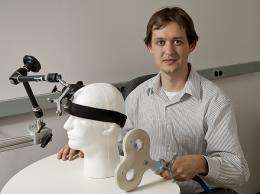
Andreas Rauschecker with the transcranial magnetic stimulation apparatus. The model's headgear is used to precisely target the procedure's disruptive currents. Credit: L.A. Cicero
(Medical Xpress) -- With specificity and precision, the brain's Visual Word Form Area, or VWFA, does exactly what its name implies. Every time we see something that looks like a word, it activates. The VWFA is so adept at packaging visual input for the brain's language centers that the task of word-recognition only takes a few tens of milliseconds.
Still, the problem of picking out words from a visual scene is strikingly complex complex enough that it is currently used to distinguish human Internet users from automated software programs. If you've ever been asked to type out a distorted word before gaining access to your email a security test known as a CAPTCHA - you've proven that you're a better reader than your computer.
In a research paper appearing in last week's Neuron, neuroscientists from the Stanford Vision Imaging Science and Technology Lab demonstrate that one key to VWFA function is its ability to recognize words through more than one visual pathway. The finding not only demonstrates the flexibility of the human visual system, but may also have implications for our understanding of dyslexia and other reading disorders.
When the VWFA was first identified in 2000, the very existence of a brain region devoted specifically to word recognition was considered surprising. Reading is an activity that has only become widespread in recent human history.
"It didn't originally evolve for reading," explained Andreas Rauschecker, the primary author of the Neuron paper and an MD/PhD candidate in Stanford's Medical Scientist Training Program. "We likely invented reading to give the VWFA what it likes to see."
Located in the ventral occipitotemporal cortex at the back of the brain, the VWFA appears to act as a relay station between the primary visual cortex and the brain regions dedicated to language recognition and production. As an individual's reading ability improves, her VWFA has been shown to expand into neighboring brain regions, including the region devoted to facial recognition.
But what does the VWFA find "appealing" about words? Traditionally, researchers have thought of words as defined by "luminance contrast" black letters on white paper, for instance. Rauschecker, however, was interested in a potential alternate pathway.
Instead of being "luminance-defined," words can be "motion-defined" distinguishable from their background not by color or contrast, but by their apparent direction of movement. Against a field of dots moving one way, words made up of dots moving in the other direction will "pop out" to most viewers, even if the word and background dots are the same shade.
"In some ways, this is an especially extreme version of a CAPTCHA," said Rauschecker.
Participants in the study were asked to read while their brains were scanned by a functional MRI (fMRI) machine. The researchers presented the participants with various types of words defined by either motion or luminance contrast and watched for activation of the VWFA (Video example of the motion-defined words viewed by study participants.)
The researchers reasoned that, if the VWFA were only looking for a basic visual feature, such as the shapes of black-on-white letters, it shouldn't activate in the presence of motion-defined words. But scans showed that the VWFA responded equally to all legible words.
The result implied that the VWFA can receive information from the human MT complex, or hMT+: a region of the visual cortex necessary for motion perception.
The fMRI scans showed that the hMT+ did activate in the presence of motion-defined words, although it was unresponsive to other types of words. This finding suggested the existence of two separate visual pathways to the VWFA.
The researchers also precisely targeted transcranial magnetic stimulation to each individual's hMT+. The technique, which applies a rapidly changing magnetic field to induce an electric current in the brain, can be used to briefly inject noise into specific brain regions, temporarily disrupting function. Stimulation dramatically reduced reading performance of motion-defined words while leaving luminance contrast-defined words unaffected.
"How exactly the information ends up in the VWFA depends on the specific visual features," Rauschecker said. "There's very flexible routing."
And the pathways seem to be partially additive. A word that is defined by both motion and color inspires a stronger VWFA response than a word defined by one or the other.
This feature offers the possibility of compensating for specific reading disabilities by designing electronic typefaces that could re-route visual information through undamaged areas of the brain. A digital font with a movement component could potentially increase legibility for some of those who have difficult reading.
The participation of hMT+ in the pathway is particularly interesting, as previous studies have shown that the region is less responsive to motion in dyslexics.
"That was something of a random finding," said Rauschecker. "There was no reason to think that, by showing people a moving stimulus, you should be able to predict their reading ability."
The research raises as many questions as it answers. Motion-defined words are an unusual stimulus, and the role of hMT+ in normal reading is still unclear. It may be involved in a reader's ability to switch rapidly from one word to the next in a sentence, though this remains only a theory.
Even the VWFA itself isn't the end of the word-recognition story. Participants also performed a decision task during their fMRIs, identifying words as either real words or nonsense words. VWFA activation was necessary for correct identification but not sufficient.
The paper's senior author was Brian Wandell, a professor of psychology at Stanford. Funding for the research was provided by the Bio-X Graduate Student Fellowship to Rauschecker and a National Institutes of Health grant to Wandell.
Provided by
Stanford University
-
'Word-vision' brain area confirmed
Apr 19, 2006 |
not rated yet |
0
-
Brain processes written words as unique 'objects'
Apr 29, 2009 |
not rated yet |
0
-
The brain as a 'task machine'
Feb 17, 2011 |
not rated yet |
0
-
Brain doesn't need vision at all in order to 'read' material
Feb 22, 2011 |
not rated yet |
0
-
Early brain activity sheds new light on the neural basis of reading
Apr 27, 2009 |
not rated yet |
0
-
Of mice and mental models: Neuroscientific implications of risk-optimized behavior in the mouse
19 hours ago |
not rated yet |
0
-
Limits to growth: Scientists identify key metastasis-enabling enzyme
May 22, 2012 |
5 / 5 (4) |
0
-
Seeing is as seeing does: Spatially-structured retinal input in early development of cortical maps
Apr 26, 2012 |
5 / 5 (4) |
1
-
Dreamless nights: Brain activity during nonrapid eye movement sleep
Apr 09, 2012 |
4.4 / 5 (12) |
0
-
Take your time: Neurobiology sheds light on the superiority of spaced vs. massed learning
Mar 28, 2012 |
4.5 / 5 (21) |
3
-
A question about drug tolerance
May 23, 2012
-
Poor nutrition leading to overeating?
May 23, 2012
-
Math and dyslexia?
May 21, 2012
-
portable metabolism meter?
May 21, 2012
-
Rare medical conditions on 20/20 tonight
May 18, 2012
-
"Good" Cholesterol in Doubt
May 17, 2012
- More from Physics Forums - Medical Sciences
More news stories
Of mice and mental models: Neuroscientific implications of risk-optimized behavior in the mouse
(Medical Xpress) -- Regardless of an organism’s biological complexity, every encephalized animal continuously makes under-informed behavioral choices that can have serious consequences. Despite its ubiquity, ...
Neuroscience
19 hours ago |
not rated yet |
0
|
Persistent sensory experience is good for aging brain
Despite a long-held scientific belief that much of the wiring of the brain is fixed by the time of adolescence, a new study shows that changes in sensory experience can cause massive rewiring of the brain, even as one ages. ...
Neuroscience
May 24, 2012 |
not rated yet |
0
Boundary stops molecule right where it needs to be
A molecule responsible for the proper formation of a key portion of the nervous system finds its way to the proper place not because it is actively recruited, but instead because it can't go anywhere else.
Neuroscience
May 24, 2012 |
not rated yet |
0
|
Locating ground zero: How the brain's emergency workers find the disaster area
Like emergency workers rushing to a disaster scene, cells called microglia speed to places where the brain has been injured, to contain the damage by 'eating up' any cellular debris and dead or dying neurons. ...
Neuroscience
May 24, 2012 |
5 / 5 (2) |
0
|
Genetic 'reset switch' enables signaling pathway to induce multiple developmental outcomes for olfactory neurons
Within the nervous system, a handful of signaling pathways modulate development of a cornucopia of different neuronal subtypes. Even small alterations in neuron differentiation pathways can disrupt subsequent ...
Neuroscience
May 24, 2012 |
not rated yet |
0
Tongue analysis software uses ancient Chinese medicine to warn of disease
For 5,000 years, the Chinese have used a system of medicine based on the flow and balance of positive and negative energies in the body. In this system, the appearance of the tongue is one of the measures used to classify ...
Cancer may require simpler genetic mutations than previously thought
Chromosomal deletions in DNA often involve just one of two gene copies inherited from either parent. But scientists haven't known how a deletion in one gene from one parent, called a "hemizygous" deletion, can contribute ...
Inherited DNA change explains overactive leukemia gene
A small inherited change in DNA is largely responsible for overactivating a gene linked to poor treatment response in people with acute leukemia.
Skp2 activates cancer-promoting, glucose-processing Akt
HER2 and its epidermal growth factor receptor cousins mobilize a specialized protein to activate a major player in cancer development and sugar metabolism, scientists report in the May 25 issue of Cell.
Early physical therapist treatment associated with reduced risk of healthcare utilization and reduced overall healthcare
A new study published in Spine shows that early treatment by a physical therapist for low back pain (LBP), as compared to delayed treatment, was associated with reduced risk of subsequent healthcare utilization and lower ...
New device allows pacemaker patients to safely undergo MRIs
For many, it's a medical conundrum: The very pacemaker keeping their heart in rhythm prevents them from undergoing an MRI to diagnose other ailments, because interaction between the two devices could prove deadly.
Sep 15, 2011
Rank: not rated yet
Sep 15, 2011
Rank: not rated yet
Sep 16, 2011
Rank: not rated yet
1. The text is moving while you hold your eyes still.
2. The text is stationary, while you are moving your eyes along the sequence of words in the line. Both have the same effect as the end product. It doesn't matter if the text is moving relative to the eyes, or the eyes are moving relative to the text. In both cases we have motion. In fact if you think about it, motion is INTEGRAL to being able to read sequential words. This goes for reading a vertically constructed list too.
Cheers, DH66
Sep 16, 2011
Rank: not rated yet
I'm just a little disappointed that they are so surprised about the presence of a separate motion activated pathway. It didn't seem to occur to them that a full word might be picked up and interpreted by the brain by using a single stationary glance, BUT this 'shortcut techique' tends to fail when you have to take in an entire sentence. Even then, you might still be 'seeing' entire words, but you then have to 'word hop' in order to take it all in. (Try it out, you'll see what I mean)Guess what fella's: motion. Without it, we wouldn't able to read very far at all... Single word post-it notes anyone?
Sep 18, 2011
Rank: 5 / 5 (1)
http://www.google...;cad=rja
Synesthesia.
No. Not the Sound of Music.
The sound of motion. :)
Sep 18, 2011
Rank: 5 / 5 (1)
This reveals what "motion" is for a brain region handling this information in the only fashion the associated pathways allow: From the perspective of sound only.
Whether this "fashion" is unique only to an individual or a universal default mode handling for everyone for identical motion expressed by sound landscape remains to be discovered.
Sep 19, 2011
Rank: 5 / 5 (1)
Cheers, DH66
Sep 20, 2011
Rank: not rated yet
Cheers, DH66
Sep 20, 2011
Rank: not rated yet
Ding-Donnnggg! (Doorbell)
A scintillating mosaic of multicoloured points rising and falling. Rising and falling in a grand quick sweep, that much resembles a very large shoal of very small fish, all darting with the current. Rising and falling, in complete harmony with that short and not unpleasant sound. Then falling away. To nothingness.
Cheers, DH66
Sep 20, 2011
Rank: 5 / 5 (1)
If motion (normally handled as a visual signal) harbors a dual potential to provide or act additionally as a signal (either provisionally or permanently) for sound as well, then ANY PHYSICAL shortcoming or malfunctioning of a hearing process can be reliable compensated for IF THERE EXISTS a dual (or more) signal potentiality for ALL signals - not just signals of motion.
Sound of motion is irrefutable evident of signals that ALWAYS have more than one "physical" 'meaning' - brains's interpretation variability for the sake of survival. Never let any signal go to waste. She's** is not a fool - there is nothing closer to the sensation of sound than motion.
This multi-signal potentiality hypothesis applies to ALL sensory signals for ALL physically perceptible sensations.
*/**Nature