Popular flu medication's neurologic side effects in children studied
September 9, 2011 in Medical research
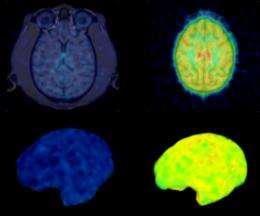
Figure 1: Positron emission tomography (PET) reveals markedly greater uptake of radioactively labeled verapamil in infant rhesus macaque brains (left) relative to adults (right). The top images represent individual scans, and the bottom images represent 3D reconstructions from those scans. Credit: 2011 Tadayuki Takashima & Kayo Onoe
Oseltamivir is the weapon of choice for preventing influenza infection from taking hold, but like any other drug, it also has the potential for adverse effects. Children in particular are susceptible to neurological symptoms, including delirium and an increased tendency for self-injury.
In partnership with University of Tokyo researcher Yuichi Sugiyama, a team led by Hirotaka Onoe at the RIKEN Center for Molecular Imaging Science, Kobe, recently discovered how age might influence the effects of oseltamivir1. We speculated that changes in drug transporter function may influence the penetration of oseltamivir and its effects in the brain, says Onoe.
The capillaries that oxygenate the brain are tightly sealed to prevent potentially toxic compounds or pathogens in the blood from penetrating the central nervous system. Specialized transporter proteins that pump toxic compounds out of the brain bolster the effectiveness of this bloodbrain barrier.
Oseltamivir and verapamil, a drug for cardiac arrhythmia, are believed to be exported by the P-glycoprotein (P-gp) transporter protein. Onoe and colleagues therefore tracked the circulation of radioactively labeled drugs in infant, adolescent and adult rhesus macaques to monitor whether or not P-gp function changes as monkeys age.
Strikingly, both drugs achieved considerably greater penetration into the brain in younger animals. For example, the maximum concentration of oseltamivir within the brain was 3.7-fold higher in infants than adults, and 2.7-fold higher in adolescents relative to their elder counterparts.
Similar results were observed with verapamil (Fig. 1). Some of this disparity could be accounted for by increased overall drug levels in the bodies of younger animals, possibly due to less efficient metabolic processing. However, even when this effect was accounted for, the researchers found clear evidence that older animals purge verapamil from the brain faster than infants and adolescents.
These results are in keeping with previous studies in rodents, which have indicated that P-gp levels increase as animals get older. The most interesting finding from this study is the significant difference in P-glycoprotein function observed among nonhuman primates of different ages, says Onoe.
The extent to which the physiology of drug clearance in nonhuman primates mirrors that of humans remains the subject of debate. Nevertheless, these findings suggest a mechanism by which oseltamivir and other drugs could provoke adverse neurological effects in younger patients. Onoe and colleagues hope to further pursue their hypothesis. Wed like to try clinical studies to assess the evidence found in this study, and understand the ontogeny of drug transporter function in humans, he says.
More information: Takashima, T., et al. Developmental changes in P-glycoprotein function in the bloodbrain barrier of nonhuman primates: PET study with R-11C-verapamil and 11C-oseltamivir. Journal of Nuclear Medicine 52, 950957 (2011).
Provided by
RIKEN
-
Genetic difference predicts antidepressant response
Jan 23, 2008 |
not rated yet |
0
-
Brain study may lead to improved epilepsy treatments
Apr 14, 2008 |
not rated yet |
0
-
Tamiflu is more effective at relieving flu symptoms than a combination of tamiflu and relenza: study
Nov 02, 2010 |
not rated yet |
0
-
Research suggests mercury linked to dementia
Nov 16, 2010 |
not rated yet |
0
-
Advances in research into Alzheimer's disease
Jul 09, 2011 |
not rated yet |
0
-
Motion perception revisited: High Phi effect challenges established motion perception assumptions
Apr 23, 2013 |
3 / 5 (2) |
2
-
Anything you can do I can do better: Neuromolecular foundations of the superiority illusion (Update)
Apr 02, 2013 |
4.5 / 5 (11) |
5
-
The visual system as economist: Neural resource allocation in visual adaptation
Mar 30, 2013 |
5 / 5 (2) |
9
-
Separate lives: Neuronal and organismal lifespans decoupled
Mar 27, 2013 |
4.9 / 5 (8) |
0
-
Sizing things up: The evolutionary neurobiology of scale invariance
Feb 28, 2013 |
4.8 / 5 (10) |
14
-
How can there be villous adenoma in colon, if there are no villi there
18 hours ago
-
How can there be a term called "intestinal metaplasia" of stomach
May 21, 2013
-
Pressure-volume curve: Elastic Recoil Pressure don't make sense
May 18, 2013
-
If you became brain-dead, would you want them to pull the plug?
May 17, 2013
-
MRI bill question
May 15, 2013
-
Ratio of Hydrogen of Oxygen in Dessicated Animal Protein
May 13, 2013
- More from Physics Forums - Medical Sciences
More news stories
Baby's life saved with groundbreaking 3-D printed device that restored his breathing
Every day, their baby stopped breathing, his collapsed bronchus blocking the crucial flow of air to his lungs. April and Bryan Gionfriddo watched helplessly, just praying that somehow the dire predictions ...
Medical research
8 hours ago |
5 / 5 (2) |
0
Research shows how immune system peacefully co-exists with 'good' bacteria
The human gut is loaded with commensal bacteria – "good" microbes that, among other functions, help the body digest food. The gastrointestinal tract contains literally trillions of such cells, and yet the ...
Medical research
12 hours ago |
5 / 5 (3) |
0
|
Slowing the aging process—only with antibiotics
Swiss scientists reveal the mechanism responsible for aging hidden deep within mitochondria—and dramatically slow it down in worms by administering antibiotics to the young.
Medical research
12 hours ago |
4.9 / 5 (7) |
0
|
How healthy are you for your age?
On May 22, JoVE will publish details of a technique to measure the health of human genetic material in relation to a patient's age. The method is demonstrated by the laboratory of Dr. Gil Atzmon at New York's Albert Einste ...
Medical research
15 hours ago |
not rated yet |
0
A molecular explanation for age-related fertility decline in women
(Medical Xpress)—Scientists supported by the National Institutes of Health have a new theory as to why a woman's fertility declines after her mid-30s. They also suggest an approach that might help slow ...
Medical research
17 hours ago |
not rated yet |
0
|
Rate of bicycle-related fatalities significantly lower in states with helmet laws
Existing research shows that bicyclists who wear helmets have an 88 percent lower risk of brain injury, but researchers at Boston Children's Hospital found that simply having bicycle helmet laws in place showed a 20 percent ...
Researchers complete largest genetic sequencing study of human disease
Researchers from Queen Mary, University of London have led the largest sequencing study of human disease to date, investigating the genetic basis of six autoimmune diseases.
Brain can be trained in compassion, study shows
Until now, little was scientifically known about the human potential to cultivate compassion—the emotional state of caring for people who are suffering in a way that motivates altruistic behavior.
Having both migraines, depression may mean smaller brain
(HealthDay)—Migraines and depression can each cause a great deal of suffering, but new research indicates the combination of the two may be linked to something else entirely—a smaller brain.
Novel approach for influenza vaccination shows promise in early animal testing
A new approach for immunizing against influenza elicited a more potent immune response and broader protection than the currently licensed seasonal influenza vaccines when tested in mice and ferrets. The vaccine ...
Calorie information in fast food restaurants used by 40 percent of 9-18 year olds when making food choices
A new study published online today (Thursday) in the Journal of Public Health has found that of young people who visited fast food or chain restaurants in the U.S. in 2010, girls and youth who were obese were more likely ...