'Promiscuous parasites' hijack host immune cells
September 20, 2011 By Carly Hodes in Medical research

'Promiscuous parasites' hijack host immune cells

Enlarge

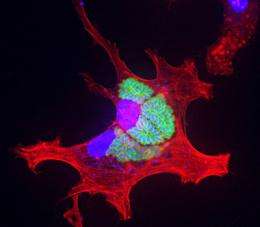
Toxoplasma gondii parasites, green, multiply inside an immune cell that lives in the brain.

Toxoplasma gondii parasites can invade your bloodstream, break into your brain and prompt behavioral changes from recklessness to neuroticism. These highly contagious protozoa infect more than half the world's population, and most people's immune systems never purge the intruders.

Cornell researchers recently discovered how T. gondii evades our defenses by hacking , making it the first known parasite to control its host's . Immunologists from the College of Veterinary Medicine published the study Sept. 8 in PLoS Pathogens, describing a forced partnership between parasite and host that challenges common conceptions of how pathogens interact with the body.

"Toxoplasma is an especially promiscuous parasite," said Eric Denkers, professor of immunology. "It infects nearly all warm-blooded species, most nucleated cell types and much of the . Although it lives in vital brain and muscle tissues, it usually causes no obvious reaction. Infection can seriously harm people with weak immune systems, yet most hosts experience no overt symptoms because Toxoplasma has found a way to coerce cooperation."

Famous for its manipulative powers, T. gondii has been shown to alter the of rodents so that they fearlessly pursue cats. Cats eat the rodents, delivering the parasites to their in feline . Similar manipulations have surfaced in human studies linking T. gondii infections to behavioral and personality shifts, schizophrenia and population variations, including and skewed sex ratios. Denkers' study maps T. gondii's newfound ability to manipulate cells in the immune system at the molecular level.
'Promiscuous parasites' hijack host immune cells
Enlarge

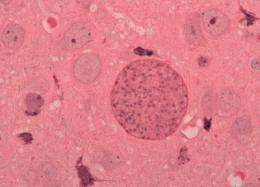
Toxoplasma parasites forming a walled cyst in a mouse brain, where they release chemicals that can affect behavior.

"We found that Toxoplasma quiets its host's alarm system by blocking immune cells from producing certain cytokines, proteins that stimulate inflammation," said Denkers. "Cytokines are double-edged swords: They summon the immune system's reinforcements, but if too many accumulate they can damage the body they're trying to defend. An unregulated immune response can kill you."

When immune cells meet intruders, they release cytokines that summon more immune cells, which produce more cytokines, rapidly causing inflammation. T. gondii must allow cytokines to trigger enough of an immune response to keep its own numbers in check and ensure host survival. But too many cytokines cause an overwhelming immune response that could damage the host or eliminate the parasites.

"Toxoplasma hijacks immune cells to enforce a mutually beneficial balance," Denkers said. "Until recently we thought it walled itself away inside cells without interacting with its environment. It's now clear that the parasite actively releases messages into cells that change cell behavior."
'Promiscuous parasites' hijack host immune cells
Enlarge

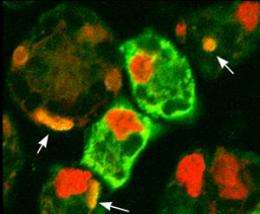
Green stain highlights cytokine production in uninfected immune cells. Cells infected with Toxoplasma parasites, orange, cannot make cytokines.

To prove this, Barbara Butcher, a senior research associate working with Denkers, exposed immune cells in the lab to bacterial factors that typically stimulate the release of inflammatory cytokines.

"Cells infected with Toxoplasma produced no messages to trigger inflammation," Denkers said. "Our colleagues at Stanford University found that Toxoplasma produces a specific protein called ROP16 to suppress inflammatory responses. Collaborating with parasitologists at Dartmouth Medical School, we found that Toxoplasma sends ROP16 to infiltrate communication channels in immune cells, causing them to lower cytokine production.

"We are excited to have found the first non-bacterial pathogen able to exert this kind of control," said Denkers. "If Toxoplasma can do this, maybe other parasites can too. This is the first case where the whole process of immune system manipulation is close to being completely mapped out at the molecular level."

That map may help steer future investigations into how pathogens interact with hosts, unveiling the inner workings of a spectrum of infectious diseases.

Provided by Cornell University search and more info website

5 /5 (8 votes)  

Filter


Move the slider to adjust rank threshold, so that you can hide some of the comments.


Display comments: newest first

nanotech_republika_pl
Sep 20, 2011

Rank: not rated yet
"Until recently we thought it walled itself away inside cells without interacting with its environment."

Yep, everybody believed it. Wherever you look, they talk about walling off inside a cell. Here goes another myth.
dogbert
Sep 21, 2011

Rank: not rated yet
I wonder about the use of ROP16 in preventing/treating sepsis. If we can synthesize it or harvest it from Toxoplasma gondii, it might save many lives every year by stopping the cytokine flood in sepsis which is often fatal.
Rank 5 /5 (8 votes)
Related Stories
Relevant PhysicsForums posts

More news stories

Now we know why old scizophrenia medicine works on antibiotics-resistant bacteria

In 2008 researchers from the University of Southern Denmark showed that the drug thioridazine, which has previously been used to treat schizophrenia, is also a powerful weapon against antibiotic-resistant bacteria such as ...

Medical research created 17 hours ago | popularity 3.7 / 5 (3) | comments 0 | with audio podcast

SUMO wrestling cells reveal new protective mechanism target for stroke

Scientists investigating the interaction of a group of proteins in the brain responsible for protecting nerve cells from damage have identified a new target that could increase cell survival.

Medical research created 22 hours ago | popularity 5 / 5 (1) | comments 0

How serotonin receptors can shape drug effects, from LSD to migraine medication

New findings by researchers carrying out experiments at the U.S. Department of Energy Office of Science's Advanced Photon Source (APS) help explain why some drugs that interact with two kinds of human serotonin ...

Medical research created May 17, 2013 | popularity not rated yet | comments 0 | with audio podcast

Preventing blood poisoning

Peptide molecules derived from the body's natural immune system can help boost the body's defence against life-threatening blood poisoning, joint University research has uncovered.

Medical research created May 17, 2013 | popularity 4 / 5 (1) | comments 0 | with audio podcast

New mechanism to prevent type 2 diabetes in obese individuals

A new Montréal study conducted by Dr. May Faraj, associate research professor at the Université de Montréal and invited scientist at the IRCM, along with her research team and medical collaborators, shows ...

Medical research created May 17, 2013 | popularity not rated yet | comments 0 | with audio podcast


AIDS science at 30: 'Cure' now part of lexicon

Big names in medicine are set to give an upbeat assessment of the war on AIDS on Tuesday, 30 years after French researchers identified the virus that causes the disease.

For combat veterans suffering from post-traumatic stress disorder, 'fear circuitry' in the brain never rests

Chronic trauma can inflict lasting damage to brain regions associated with fear and anxiety. Previous imaging studies of people with post-traumatic stress disorder, or PTSD, have shown that these brain regions can over-or ...

Melon focus headband turns to Kickstarter for rollout plans

(Medical Xpress)—What if the quality of your work depends more on your focus on the piano keys or canvas or laptop than your musical or painting or computing skills? If target users can be convinced, they ...

Temporal processing in the olfactory system

The neural machinery underlying our olfactory sense continues to be an enigma for neuroscience. A recent review in Neuron seeks to expand traditional ideas about how neurons in the olfactory bulb might encode information about ...

23 dead in initiation rites in South Africa

(AP)—Twenty-three youths have died in the past nine days at initiation ceremonies that include circumcisions and survival tests, South African police said Friday.

Individuals who drink heavily and smoke may show 'early aging' of the brain

Treatment for alcohol use disorders works best if the patient actively understands and incorporates the interventions provided in the clinic. Multiple factors can influence both the type and degree of neurocognitive abnormalities ...