Proteins could help women avoid thyroid surgery
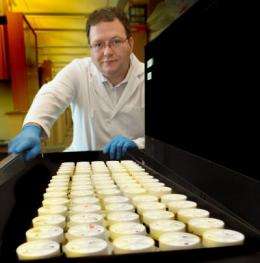
Dr. Paul Weinberger is working to identify blood-based biomarkers for thyroid cancer. Credit: Phil Jones/GHSU Photographer
Dr. Paul Weinberger wants to make thyroid cancer diagnosis as simple and accurate as checking for high cholesterol.
About 30 percent of women have a thyroid growth in their lifetime, the vast majority of which is not cancer, said Weinberger, otolaryngologist at Georgia Health Sciences University. In about 80 percent of cases, physicians can rule out cancer based on the shape of biopsied thyroid cells.
It's the remaining 20 percent that are problematic: 75 percent are benign but there is no way to be sure without surgery.
"The vast majority of patients who get this indeterminate answer end up having at least part of their thyroid gland removed," Weinberger said. "And we end up saying afterward: 'Oh, good news, this was not cancer.'"
Weinberger wants to help women avoid unnecessary surgery with the help of a Young Investigator Combined Award from the American Head and Neck Society/American Academy Otolaryngology-Head and Neck Surgery Foundation.
"That is the Holy Grail everybody is looking for: blood-based biomarkers of cancer," Weinberger said.
He's looking at two proteins, Galectin-3 and HBME-1, about which little is known other than they are found at elevated levels in thyroid cancer. While still a resident at GHSU, Weinberger was honored by the Head and Neck Society for his role in linking Galectin-3 to thyroid cancer. Three years ago GHSU and other centers started checking Galectin-3 levels as part a definitive cancer diagnosis in surgically removed thyroid tissue. More recently, HBME-1testing also was added.
But Weinberger believes those proteins could tell the tale much earlier as biomarkers in the few cells removed during a needle biopsy. Using super-sensitive mass spectrometry technology developed to detect trace amounts of drugs and other substances in forensic pathology and now used in major research centers, he'll examine the biopsied cells collected over three years from 50 patients to look at levels of both proteins. He can then correlate those with pathology findings from the surgically removed thyroid. He's tested the concept in purified proteins and some cell lines. If the relationship holds that elevated protein levels equal cancer in the patient samples, the next step would be a prospective study in current patients before seeking Food and Drug Administration approval.
He's stored the existing samples at room temperature to make sure the proteins are stable enough to be functional biomarkers so that referring physicians, for example, could one day send tissue samples to centers such as GHSU with mass spectrometry capabilities.
Weinberger noted that even benign thyroid growths sometimes necessitate surgery because of airway and/or swallowing problems. An ultrasound of the growth determines whether a biopsy is needed.
While the cause of thyroid disease is essentially unknown, the thyroid is one of the most metabolically active areas of the body; it receives as much blood flow as the brain and constantly produces hormones essential to regulating the metabolism, Weinberger said.
Provided by Georgia Health Sciences University
-
Ultrasound can help low-risk patients avoid invasive thyroid biopsy
Apr 23, 2009 |
not rated yet |
0
-
Early detection critical in treating pediatric thyroid cancer
Feb 01, 2008 |
not rated yet |
0
-
Most patients survive common thyroid cancer regardless of treatment
May 17, 2010 |
not rated yet |
0
-
Minimally invasive thyroid surgery effective in children
Apr 13, 2011 |
not rated yet |
0
-
Ethanol injection helps manage bone metastasis in thyroid cancer patients
Jun 04, 2007 |
not rated yet |
0
-
Motion perception revisited: High Phi effect challenges established motion perception assumptions
Apr 23, 2013 |
3 / 5 (2) |
2
-
Anything you can do I can do better: Neuromolecular foundations of the superiority illusion (Update)
Apr 02, 2013 |
4.5 / 5 (11) |
5
-
The visual system as economist: Neural resource allocation in visual adaptation
Mar 30, 2013 |
5 / 5 (2) |
9
-
Separate lives: Neuronal and organismal lifespans decoupled
Mar 27, 2013 |
4.9 / 5 (8) |
0
-
Sizing things up: The evolutionary neurobiology of scale invariance
Feb 28, 2013 |
4.8 / 5 (10) |
14
-
Pressure-volume curve: Elastic Recoil Pressure don't make sense
May 18, 2013
-
If you became brain-dead, would you want them to pull the plug?
May 17, 2013
-
MRI bill question
May 15, 2013
-
Ratio of Hydrogen of Oxygen in Dessicated Animal Protein
May 13, 2013
-
Alcohol and acetaminophen
May 13, 2013
-
Marie Curie's leukemia
May 13, 2013
- More from Physics Forums - Medical Sciences
More news stories
New smartphone application improves colonoscopy preparation
The use of a smartphone application significantly improves patients' preparation for a colonoscopy, according to new research presented today at Digestive Disease Week (DDW). The preparation process, which begins days in ...
Cancer
22 hours ago |
not rated yet |
0
Research examines new methods for managing digestive health
Research presented at Digestive Disease Week (DDW) explores new methods for managing digestive health through diet and lifestyle.
Cancer
23 hours ago |
not rated yet |
1
New colonoscope provides ground-breaking view of colon
A ground-breaking advance in colonoscopy technology signals the future of colorectal care, according to research presented today at Digestive Disease Week(DDW). Additional research focuses on optimizing the minimal withdrawal ...
Cancer
May 18, 2013 |
5 / 5 (2) |
0
ASCO: combo antibody therapy effective for melanoma
(HealthDay)—Concurrent use of two immune checkpoint antibodies—ipilimumab and nivolumab—may be effective for the treatment of advanced melanoma, according to a proof-of-principal study presented in ...
Cancer
May 17, 2013 |
not rated yet |
0
Risk factors ID'd for poor cutaneous cell CA outcomes
(HealthDay)—The risks of metastasis and death associated with cutaneous squamous cell carcinoma (CSCC) are low, but significant, and risk factors for poor outcome include tumor diameter, invasion beyond ...
Cancer
May 17, 2013 |
not rated yet |
0
|
Researchers identify a potential new risk for sleep apnea: Asthma
Researchers at the University of Wisconsin have identified a potential new risk factor for obstructive sleep apnea: asthma. Using data from the National Institutes of Health (Heart, Lung, and Blood Institute)-funded Wisconsin ...
New theory on genesis of osteoarthritis comes with successful therapy in mice
Scientists at Johns Hopkins have turned their view of osteoarthritis (OA) inside out. Literally. Instead of seeing the painful degenerative disease as a problem primarily of the cartilage that cushions joints, ...
Computational tool translates complex data into simplified 2-dimensional images
In their quest to learn more about the variability of cells between and within tissues, biomedical scientists have devised tools capable of simultaneously measuring dozens of characteristics of individual ...
Study finds that sleep apnea and Alzheimer's are linked
A new study looking at sleep-disordered breathing (SDB) and markers for Alzheimer's disease (AD) risk in cerebrospinal fluid (CSF) and neuroimaging adds to the growing body of research linking the two.
'Gap' for HIV vaccine efforts after latest setback
The hunt for an HIV vaccine has gobbled up $8 billion in the past decade, and the failure of the most recent efficacy trial has delivered yet another setback to 26 years of efforts.
Ginger compounds may be effective in treating asthma symptoms
Gourmands and foodies everywhere have long recognized ginger as a great way to add a little peppery zing to both sweet and savory dishes; now, a study from researchers at Columbia University shows purified components of the ...