Rewiring the brain to regain control after stroke
September 23, 2011 By Raima Larter in Neuroscience
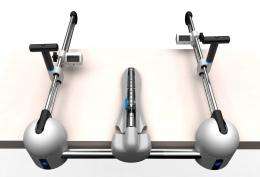
The Tailwind device, marketed by Encore Path, Inc., uses the clinically-proven BATRAC method for the treatment of partial paralysis due to stroke. Credit: Kris Appel, Encore Path, Inc.
Kris Appel was a federal employee for 17 years, working for the National Security Agency, when she realized she wanted to join the ranks of America's entrepreneurs.
Thanks to a program designed to bring scientists and engineers together with small business owners, Appel launched a new company that is now bringing hope to some of the millions of people who suffer from paralysis due to stroke.
How was Appel, a linguist by training, able to successfully navigate a major career change and become head of a medical technology company? Her first step was to resign from her job and move into high-tech industry in order to get experience in the private sector. Her second step was to enroll in the National Science Foundation (NSF)-funded ACTiVATE program offered by the University of Maryland Baltimore County.
ACTiVATE program
The ACTiVATE program seeks to bring together scientists and engineers who develop new technologies with entrepreneurs who can help commercialize these new techniques and products. Launched in 2004, it quickly attracted over a half-million dollars in federal funding from NSF's Partnerships for Innovation program. The goal of the ACTiVATE program, which helps convert discoveries made through federally funded scientific research into innovations and marketable devices that benefit the economy and society, is well aligned with the goal of the Partnerships for Innovation program to generate market-acceptable innovations.
Appel joined ACTiVATE in 2006 and was quickly matched with a group of scientists and medical doctors at the University of Maryland Medical School who developed a device to help people with stroke-induced arm paralysis. The investigators carried out controlled scientific studies that showed how their method--which used the Bilateral Arm Trainer with Rhythmic Auditory Cueing (BATRAC) device--significantly improved function in stroke patients suffering from the loss of function in one side of the body, also called hemiparesis.
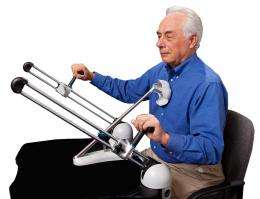
Jim White, Tailwind user, demonstrates use of the device. Credit: Kris Appel, Encore Path, Inc.
Hemiparesis is by far the most common limiting symptom resulting from a stroke, affecting 80 percent of stroke survivors. The BATRAC method is specifically aimed at the loss of function in one arm, and tackles the problem by literally retraining the brain. The BATRAC device requires the patient to use both arms to carry out the motion of reaching forward for an object and bringing it in toward the body. The movement is "cued" by a rhythmic auditory signal that apparently entrains the motor cortex of the brain.
BATRAC success
In a study published in 2000, the developers of the BATRAC method reported significant improvement in the use of the affected arm with as little as one hour of training per week for six weeks. This initial study showed improvement from 12 percent to 26 percent on two different motor improvement scales. The study subjects were also asked to assess their ability for daily use of the affected arm in everyday tasks, and this self-assessment revealed an even higher rate of improvement, up to 43 percent after training.
The BATRAC investigators conducted further studies that compared BATRAC results to a more commonly used method of physical therapy--a technique referred to as dose-matched therapeutic exercises, or DMTE.
In a report published in the Journal of the American Medical Association, functional magnetic resonance imaging scans were gathered from subjects in a study that compared BATRAC and traditional training techniques. Blood oxygenation-level dependent scans were made of the entire brain as the subjects moved the unaffected arm first, and then the paralyzed one. The scans were taken before and after training with the two methods.
The investigators noted significant changes in brain activity in most members of the BATRAC group after training, but no changes in brain activity for the DMTE group. In addition, those members of the BATRAC group whose brains showed evidence for rewiring had improved function, while the control group showed significantly less improvement.
Since beginning her collaboration with developers of the BATRAC device, Appel has launched a company, Encore Path, Inc., through which she has licensed and is marketing a device based on the BATRAC method. The device, called Tailwind, costs about $3,000 and comes with a training course; it can be used at home and is covered by some insurance plans.
Appel's research continues and she is now working with doctors on a new device to extend the treatment to paralysis in the legs, promising to help many more thousands of people who suffer from the debilitating effects of stroke.
Provided by
National Science Foundation
-
Movement Therapy May Also Improve Language Skills in Stroke Patients
Feb 24, 2010 |
not rated yet |
0
-
Stroke survivors can improve functioning of paralyzed arm years after stroke
Feb 26, 2010 |
not rated yet |
0
-
Next generation gamers: Computer games aid recovery from stroke
May 16, 2011 |
not rated yet |
0
-
Rehab robots lend stroke patients a hand
Aug 11, 2011 |
not rated yet |
0
-
Treadmill exercise retrains brain and body of stroke victims
Aug 28, 2008 |
not rated yet |
0
-
Of mice and mental models: Neuroscientific implications of risk-optimized behavior in the mouse
May 25, 2012 |
not rated yet |
0
-
Limits to growth: Scientists identify key metastasis-enabling enzyme
May 22, 2012 |
5 / 5 (4) |
0
-
Seeing is as seeing does: Spatially-structured retinal input in early development of cortical maps
Apr 26, 2012 |
5 / 5 (4) |
1
-
Dreamless nights: Brain activity during nonrapid eye movement sleep
Apr 09, 2012 |
4.4 / 5 (12) |
0
-
Take your time: Neurobiology sheds light on the superiority of spaced vs. massed learning
Mar 28, 2012 |
4.5 / 5 (21) |
3
-
Potential Breakthrough in Seizure Control
4 hours ago
-
Popping/Cracked sternum.
9 hours ago
-
Which Mental Illness Encompasses This Problem?
9 hours ago
-
A question about drug tolerance
May 23, 2012
-
Poor nutrition leading to overeating?
May 23, 2012
-
Math and dyslexia?
May 21, 2012
- More from Physics Forums - Medical Sciences
More news stories
Of mice and mental models: Neuroscientific implications of risk-optimized behavior in the mouse
(Medical Xpress) -- Regardless of an organism’s biological complexity, every encephalized animal continuously makes under-informed behavioral choices that can have serious consequences. Despite its ubiquity, ...
Neuroscience
23 hours ago |
not rated yet |
0
|
Persistent sensory experience is good for aging brain
Despite a long-held scientific belief that much of the wiring of the brain is fixed by the time of adolescence, a new study shows that changes in sensory experience can cause massive rewiring of the brain, even as one ages. ...
Neuroscience
May 24, 2012 |
not rated yet |
0
Boundary stops molecule right where it needs to be
A molecule responsible for the proper formation of a key portion of the nervous system finds its way to the proper place not because it is actively recruited, but instead because it can't go anywhere else.
Neuroscience
May 24, 2012 |
not rated yet |
0
|
Locating ground zero: How the brain's emergency workers find the disaster area
Like emergency workers rushing to a disaster scene, cells called microglia speed to places where the brain has been injured, to contain the damage by 'eating up' any cellular debris and dead or dying neurons. ...
Neuroscience
May 24, 2012 |
5 / 5 (2) |
0
|
Genetic 'reset switch' enables signaling pathway to induce multiple developmental outcomes for olfactory neurons
Within the nervous system, a handful of signaling pathways modulate development of a cornucopia of different neuronal subtypes. Even small alterations in neuron differentiation pathways can disrupt subsequent ...
Neuroscience
May 24, 2012 |
not rated yet |
0
Travel to high altitudes tied to Crohn's, colitis flare-ups
(HealthDay) -- People with inflammatory bowel disease, which includes Crohn's disease and colitis, may be at increased risk for flare-ups when they fly or travel to high altitudes for skiing or mountain climbing, ...
Transvaginal mesh op restores pelvic organ prolapse at price
(HealthDay) -- Transvaginal mesh (TVM) procedures are effective for anatomical restoration of pelvic organ prolapse (POP), but patients report a worsening of sexual function following surgery, according to ...
Cancer may require simpler genetic mutations than previously thought
Chromosomal deletions in DNA often involve just one of two gene copies inherited from either parent. But scientists haven't known how a deletion in one gene from one parent, called a "hemizygous" deletion, can contribute ...
Inherited DNA change explains overactive leukemia gene
A small inherited change in DNA is largely responsible for overactivating a gene linked to poor treatment response in people with acute leukemia.
Tongue analysis software uses ancient Chinese medicine to warn of disease
For 5,000 years, the Chinese have used a system of medicine based on the flow and balance of positive and negative energies in the body. In this system, the appearance of the tongue is one of the measures used to classify ...
Skp2 activates cancer-promoting, glucose-processing Akt
HER2 and its epidermal growth factor receptor cousins mobilize a specialized protein to activate a major player in cancer development and sugar metabolism, scientists report in the May 25 issue of Cell.

Sep 28, 2011
Rank: not rated yet