New website eases clinical research trials -- and tribulations
September 26, 2011 By Kris Newby in Other
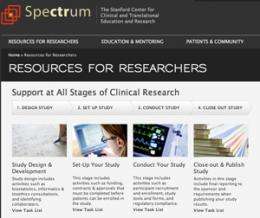
The medical school has launched a new website that guides and supports biomedical researchers through the complex process of managing translational and human-subject research studies.
Developed by Spectrum, the Stanford Center for Clinical and Translational Education and Research, this online portal is part of an ongoing effort to streamline the infrastructure that supports this type of research across the university. It represents an important milestone in the Spectrum teams mission to accelerate the flow of discoveries from university investigators to health practice. It was funded with the help of a Clinical and Translational Science Award from the National Institutes of Health.
Ripping a page from physician-scribe Atul Gawandes book, The Checklist Manifesto: How to Get Things Right, the website provides Stanford biomedical researchers with helpful to-do-lists for the four stages of running a clinical study design, set-up, management and close-out. Easy-to-follow lists provide researchers with online links to essential clinical trial resources, such as funding websites and custom online budget workbooks, saving researchers time, trouble, and paperwork.
Within the Spectrum website, researchers also can access Study Navigator 2.0, a new release of Stanfords clinical trial project tracker and collaboration tool. Since its launch in March, the development team has folded in user feedback to enhance research team workflow, especially in the area of documentation management.
I find the document storage function of Study Navigator particularly useful, said Karin Kushniruk, PhD, RN, a research nurse coordinator in maternal-fetal medicine. This allows everyone on my study team to access, from one central online location, all pertinent documents, eliminating the risk of study staff inadvertently using outdated versions.
Another popular feature of Study Navigator is the online calendaring function that enables researchers to instantly book appointments with experts in study design, biostatistics and informatics. Researchers can also request Lane Medical Library literature searches, community engagement advice and bioethics consultations from within Study Navigator.
The Spectrum website will ultimately be the front door to all of Stanfords clinical and translational resources, including a variety of training programs and pilot funding opportunities supported by Spectrum. It will help investigators focus on the research, not the administrative overhead of running a study, said Harry Greenberg, MD, Spectrums director and the senior associate dean for research.
Future releases of Study Navigator will interface with other Stanford research management systems, such as eProtocol, SeRA and OnCore. Additionally, plans are under way to further integrate it with Clinical and Translational Research Unit services, formerly called the GCRC, increasing the overall availability of these support services across the university.
This new researcher resourceis available at http://spectrum.st … .edu/.
Provided by
Stanford University Medical Center
-
Mobile devices help remove barriers to fresh food
Aug 08, 2011 |
not rated yet |
0
-
Patent agency officials discuss how to reduce application backlog
Apr 25, 2011 |
not rated yet |
0
-
Stanford creates first PhD program in stem cell science
Apr 29, 2011 |
not rated yet |
0
-
Study says there's little benefit from electronic health records from 2005 to 2007
Jan 25, 2011 |
not rated yet |
0
-
New guidelines issued for reporting of genetic risk research
Mar 28, 2011 |
not rated yet |
0
-
Of mice and mental models: Neuroscientific implications of risk-optimized behavior in the mouse
22 hours ago |
not rated yet |
0
-
Limits to growth: Scientists identify key metastasis-enabling enzyme
May 22, 2012 |
5 / 5 (4) |
0
-
Seeing is as seeing does: Spatially-structured retinal input in early development of cortical maps
Apr 26, 2012 |
5 / 5 (4) |
1
-
Dreamless nights: Brain activity during nonrapid eye movement sleep
Apr 09, 2012 |
4.4 / 5 (12) |
0
-
Take your time: Neurobiology sheds light on the superiority of spaced vs. massed learning
Mar 28, 2012 |
4.5 / 5 (21) |
3
-
Classical and Quantum Mechanics via Lie algebras
Apr 15, 2011
- More from Physics Forums - Independent Research
More news stories
Tongue analysis software uses ancient Chinese medicine to warn of disease
For 5,000 years, the Chinese have used a system of medicine based on the flow and balance of positive and negative energies in the body. In this system, the appearance of the tongue is one of the measures used to classify ...
Other
14 hours ago |
1 / 5 (1) |
0
|
Neck strength, cervical spine mobility don't predict pain
(HealthDay) -- Neither isometric neck muscle strength nor passive mobility of the cervical spine, two physical capacity parameters found to be associated with neck pain in other studies, predicts later neck ...
Other
19 hours ago |
not rated yet |
0
Pool access for the disabled sparks controversy
(AP) -- The Obama administration is sidestepping an election-year confrontation with the hotel industry and other pool owners to give them more time to comply with access rules for the disabled.
Other
23 hours ago |
not rated yet |
0
Chile to cover sex change operations
Chile will soon cover sex change surgeries under its public health plan in order to allow citizens of limited means to "recover their true sexual identity," Health Minister Jaime Manalich said.
Other
23 hours ago |
not rated yet |
0
Researcher calls for new approach to regulating probiotics
In today's Nature scientific journal Dr. Gregor Reid, Director of the Canadian R&D Centre for Probiotics at Lawson Health Research Institute and a scientist at Western University, calls for a Category Tree system to be imp ...
Other
May 24, 2012 |
not rated yet |
1
|
Of mice and mental models: Neuroscientific implications of risk-optimized behavior in the mouse
(Medical Xpress) -- Regardless of an organism’s biological complexity, every encephalized animal continuously makes under-informed behavioral choices that can have serious consequences. Despite its ubiquity, ...
Cancer may require simpler genetic mutations than previously thought
Chromosomal deletions in DNA often involve just one of two gene copies inherited from either parent. But scientists haven't known how a deletion in one gene from one parent, called a "hemizygous" deletion, can contribute ...
Inherited DNA change explains overactive leukemia gene
A small inherited change in DNA is largely responsible for overactivating a gene linked to poor treatment response in people with acute leukemia.
Skp2 activates cancer-promoting, glucose-processing Akt
HER2 and its epidermal growth factor receptor cousins mobilize a specialized protein to activate a major player in cancer development and sugar metabolism, scientists report in the May 25 issue of Cell.
Early physical therapist treatment associated with reduced risk of healthcare utilization and reduced overall healthcare
A new study published in Spine shows that early treatment by a physical therapist for low back pain (LBP), as compared to delayed treatment, was associated with reduced risk of subsequent healthcare utilization and lower ...
New device allows pacemaker patients to safely undergo MRIs
For many, it's a medical conundrum: The very pacemaker keeping their heart in rhythm prevents them from undergoing an MRI to diagnose other ailments, because interaction between the two devices could prove deadly.