Government needs to listen up on hearing aids
October 27, 2011 in Health

Government needs to listen up on hearing aids

Enlarge

Credit: Mavis http://www.flickr.com/photos/portland_mike/2993507037/

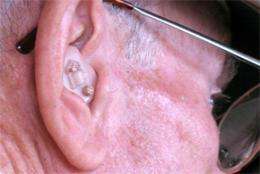
(Medical Xpress) -- Evidence is mounting of an aggressive campaign by private providers to push hearing aids onto people who are not psychologically ready for them, according to an Australian National University sociology expert.

Sociology Fellow Dr. Anthony Hogan said international research published in suggested that 40 per cent of people were dissatisfied with the they received and that almost half of people stopped using devices they were given, with similar results in Australia.

In an assessment of this year’s Commonwealth budget, Dr. Hogan said that 40 per cent of people not using their devices amounted to a waste in resources in the order of $150 million per year. 

“The Australian Government has to stop throwing more and more money at hearing devices without, at the same time, putting their support into services which help people manage their hearing problems,” he said.

“Adjusting to life with hearing loss often requires psychological support to assist with the changes which the individual and family need to make in the way they communicate. Hearing aids don’t work like glasses, where you put them on and you immediately see clearly.

“The significant community dissatisfaction with hearing aids is a direct result of the lack of consideration of the social psychology of the situation when recommending these devices.

“The Australian Government’s approach to funding private providers to deliver its hearing services has potentially created incentives which focus providers’ attention on making money rather than improving client outcomes.

“The Commonwealth has bungled its attempt to support alternate forms of hearing services by not involving people with expertise in the social psychology of living with hearing loss in the service delivery model and by underfunding hearing support services such as communication training.”

In his key note speech at today’s celebration of the Victorian Hear Services 40th anniversary, Dr. Hogan said the short fall in funding meant that quality hearing outcomes were not being achieved and resources wasted.

“Very few hearing service providers in Australia have had access to in-depth training in hearing rehabilitation, and this absence of skill is reflected in service outcome,” he said.

“The Australian community could receive far greater value for money by investing in low cost, family centred communication training programs which significantly reduce the communication problems people experience.”

Dr. Hogan called on the Government to launch an independent inquiry into hearing services in , to determine whether its existing aid program offered good value for money for the community.

“A failure rate of one in two would suggest the program does not offer good value for money to the Australian public.”

Provided by Australian National University

not rated yet  

Rank not rated yet
Related Stories
Relevant PhysicsForums posts

More news stories

New research identifies risks, interventions for children's GI health

An increasing number of U.S. children are experiencing gastrointestinal issues that require interventions to resolve, according to research presented at Digestive Disease Week (DDW).

Health created 13 hours ago | popularity not rated yet | comments 0 | with audio podcast

Youth who have their first drink during puberty have higher levels of later drinking

Research shows that the earlier the age at which youth take their first alcoholic drink, the greater the risk of developing alcohol problems. Thus, age at first drink (AFD) is generally considered a powerful predictor of ...

Health created May 17, 2013 | popularity not rated yet | comments 0

British MPs concerned about parliamentary boozing

One quarter of British lawmakers believe there is an "unhealthy" drinking culture in the Houses of Parliament, according to a survey published on Friday.

Health created May 17, 2013 | popularity not rated yet | comments 0

Patient openness to research can depend on race and sex of study personnel

Researchers at the University of Cincinnati (UC) have found that the race and sex of study personnel can influence a patient's decision on whether or not to participate in clinical research.

Health created May 17, 2013 | popularity not rated yet | comments 0

Clinical support for patient self-management is rhetoric rather than reality

The processes to allow people to self-manage their own illness are not being used appropriately by health professionals to the benefit of their patients, new research suggests.

Health created May 17, 2013 | popularity not rated yet | comments 0


US psychiatry gets makeover in new manual

The latest makeover to a massive psychiatric tome honored by some, reviled by others and even called the "Bible" of mental disorders is being released Saturday with a host of new changes.

New case of SARS-like virus in Saudi: ministry

A new case of the deadly coronavirus has been detected in Saudi Arabia where 15 people have already died after contracting it, the health ministry announced on Saturday on its Internet website.

AIDS science at 30: 'Cure' now part of lexicon

Big names in medicine are set to give an upbeat assessment of the war on AIDS on Tuesday, 30 years after French researchers identified the virus that causes the disease.

For combat veterans suffering from post-traumatic stress disorder, 'fear circuitry' in the brain never rests

Chronic trauma can inflict lasting damage to brain regions associated with fear and anxiety. Previous imaging studies of people with post-traumatic stress disorder, or PTSD, have shown that these brain regions can over-or ...

New colonoscope provides ground-breaking view of colon

A ground-breaking advance in colonoscopy technology signals the future of colorectal care, according to research presented today at Digestive Disease Week(DDW). Additional research focuses on optimizing the minimal withdrawal ...

Body clocks of depressed people altered at cell level, researchers show

Every cell in our bodies runs on a 24-hour clock, tuned to the night-day, light-dark cycles that have ruled us since the dawn of humanity. The brain acts as timekeeper, keeping the cellular clock in sync ...