Biologists create anti-HIV antibody that shows increased potency
October 27, 2011 in HIV & AIDS
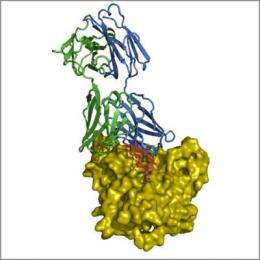
The increased potency of a new HIV antibody (green and blue), is explained by an insertion (pink) that contacts the inner domain of the HIV gp120 spike protein (yellow). Credit: Ron Diskin/California Institute of Technology
Using highly potent antibodies isolated from HIV-positive people, researchers have recently begun to identify ways to broadly neutralize the many possible subtypes of HIV. Now, a team led by biologists at the California Institute of Technology (Caltech) has built upon one of these naturally occurring antibodies to create a stronger version they believe is a better candidate for clinical applications.
Current advances in isolating antibodies from HIV-infected individuals have allowed for the discovery of a large number of new, broadly neutralizing anti-HIV antibodies directed against the host receptor (CD4) binding sitea functional site on the surface of the virus that allows for cell entry and infection. Using a technique known as structure-based rational design, the team modified one already-known and particularly potent antibodyNIH45-46so that it can target the binding site in a different and more powerful way. A study outlining their process was published in the October 27 issue of Science Express.
"NIH45-46 was already one of the most broad and potent of the known anti-HIV antibodies," says Pamela Bjorkman, Max Delbrück Professor of Biology at Caltech and senior author on the study. "Our new antibody is now arguably the best of the currently available, broadly neutralizing anti-HIV antibodies."
By conducting structural studies, the researchers were able to identify how NIH45-46 interacted with gp120a protein on the surface of the virus that's required for the successful entry of HIV into cellsto neutralize the virus. Using this information, they were able to create a new antibody (dubbed NIH45-46G54W) that is better able to grab onto and interfere with gp120. This improves the antibody's breadthor extent to which it effectively targets many subtypes of HIVand potency by an order of magnitude, according to Ron Diskin, a postdoctoral scholar in Bjorkman's lab at Caltech and the paper's lead author.
"Not only did we design an improved version of NIH45-46, our structural data are calling into question previous assumptions about how to make a vaccine in order to elicit such antibodies," says Diskin. "We hope that these observations will help to guide and improve future immunogen design."
By improving the efficacy of antibodies that can neutralize HIV, the researchers point to the possibility of clinical testing for NIH45-46G54W and other antibodies as therapeutic agents. It's also plausible that understanding effective neutralization by powerful antibodies may be useful in vaccine development.
"The results uncover the structural underpinnings of anti-HIV antibody breadth and potency, offer a new view of neutralization by CD4-binding site anti-HIV antibodies, and establish principles that may enable the creation of a new group of HIV therapeutics," says Bjorkman, who is also a Howard Hughes Medical Institute investigator.
More information: "Increasing the Potency and Breadth of an HIV Antibody by Using Structure-Based Rational Design," Science Express.
Provided by
California Institute of Technology
-
Neutralizing HIV
Jul 18, 2011 |
not rated yet |
0
-
Scientists identify broad and potent HIV antibodies that mimic CD4 binding
Jul 20, 2011 |
not rated yet |
0
-
Scientists uncover structure of key protein in common HIV subgroup
Apr 02, 2010 |
not rated yet |
0
-
New strategy proposed for designing antibody-based HIV vaccine
Jun 14, 2009 |
not rated yet |
0
-
Scientists reveal surprising picture of how powerful antibody neutralizes HIV
Oct 13, 2011 |
not rated yet |
0
-
Of mice and mental models: Neuroscientific implications of risk-optimized behavior in the mouse
23 hours ago |
not rated yet |
0
-
Limits to growth: Scientists identify key metastasis-enabling enzyme
May 22, 2012 |
5 / 5 (4) |
0
-
Seeing is as seeing does: Spatially-structured retinal input in early development of cortical maps
Apr 26, 2012 |
5 / 5 (4) |
1
-
Dreamless nights: Brain activity during nonrapid eye movement sleep
Apr 09, 2012 |
4.4 / 5 (12) |
0
-
Take your time: Neurobiology sheds light on the superiority of spaced vs. massed learning
Mar 28, 2012 |
4.5 / 5 (21) |
3
-
Classical and Quantum Mechanics via Lie algebras
Apr 15, 2011
- More from Physics Forums - Independent Research
More news stories
Mortality rates decrease, chronic disease rates increase among HIV+ ICU patients
The expanded use of antiretrovirals, potent drugs used to treat retroviral infections such as human immunodeficiency virus (HIV), has been linked to significant decreases in hospital mortality rates among severely ill HIV-positive(HIV+) ...
HIV & AIDS
May 23, 2012 |
not rated yet |
0
Newly discovered breast milk antibodies help neutralize HIV
Antibodies that help to stop the HIV virus have been found in breast milk. Researchers at Duke University Medical Center isolated the antibodies from immune cells called B cells in the breast milk of infected mothers in Malawi, ...
HIV & AIDS
May 22, 2012 |
5 / 5 (3) |
1
|
Reactions to HIV drug have autoimmune cause, reports AIDS journal
Potentially severe hypersensitivity reactions to the anti-HIV drug abacavir occur through an autoimmune mechanism, resulting from the creation of drug-induced immunogens that are attacked by the body's immune system, according ...
HIV & AIDS
May 22, 2012 |
5 / 5 (1) |
0
Is the U.S. ready for home HIV tests?
At the pharmacy, you can buy anything from tea kettles to Tylenol. But what if you could buy a rapid HIV test over the counter and test yourself in the privacy of your own home?
HIV & AIDS
May 21, 2012 |
not rated yet |
0
|
Reduced glycerin formulation of tenofovir vaginal gel safe for rectal use
A change in the formulation of tenofovir gel, an anti-HIV gel developed for vaginal use, may make it safer to use in the rectum, suggests a study published online this week in the Journal of Antimicrobial Chemotherapy. In lab ...
HIV & AIDS
May 17, 2012 |
5 / 5 (1) |
0
Of mice and mental models: Neuroscientific implications of risk-optimized behavior in the mouse
(Medical Xpress) -- Regardless of an organism’s biological complexity, every encephalized animal continuously makes under-informed behavioral choices that can have serious consequences. Despite its ubiquity, ...
Cancer may require simpler genetic mutations than previously thought
Chromosomal deletions in DNA often involve just one of two gene copies inherited from either parent. But scientists haven't known how a deletion in one gene from one parent, called a "hemizygous" deletion, can contribute ...
Inherited DNA change explains overactive leukemia gene
A small inherited change in DNA is largely responsible for overactivating a gene linked to poor treatment response in people with acute leukemia.
Tongue analysis software uses ancient Chinese medicine to warn of disease
For 5,000 years, the Chinese have used a system of medicine based on the flow and balance of positive and negative energies in the body. In this system, the appearance of the tongue is one of the measures used to classify ...
Skp2 activates cancer-promoting, glucose-processing Akt
HER2 and its epidermal growth factor receptor cousins mobilize a specialized protein to activate a major player in cancer development and sugar metabolism, scientists report in the May 25 issue of Cell.
Early physical therapist treatment associated with reduced risk of healthcare utilization and reduced overall healthcare
A new study published in Spine shows that early treatment by a physical therapist for low back pain (LBP), as compared to delayed treatment, was associated with reduced risk of subsequent healthcare utilization and lower ...