Brain scans reveal drugs' effects on attention
October 14, 2011 By Michael C. Purdy in Neuroscience
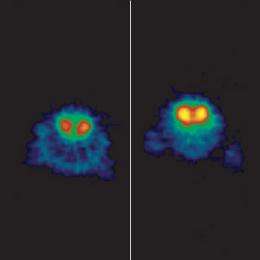
Scientists have developed a way to use PET scans to test if drugs are helping mice that have been genetically engineered to have a form of attention deficit. In the brain of the altered mouse (right), low dopamine levels result in a brighter image. (DAVID GUTMANN, MD, PHD)
(Medical Xpress) -- Scientists have developed a way to evaluate new treatments for some forms of attention deficit disorder.
Working in mice, researchers at Washington University School of Medicine in St. Louis showed that they can use brain scans to quickly test whether drugs increase levels of a brain chemical known as dopamine.
In a study published last year, the same group found that raising dopamine levels in mice alleviates attention deficits caused by neurofibromatosis type 1 (NF1), a condition that affects more than 100,000 people in the United States. Approximately 60 percent to 80 percent of children with NF1 have some type of attention deficit problem.
Many kids with NF1 really struggle in school, and finding ways to help alleviate attention problems is a high priority, says David H. Gutmann, MD, PhD, the Donald O. Schnuck Family Professor of Neurology. The technique weve refined may make it possible to match specific treatments to the patients with NF1 and attention deficit who are most likely to benefit from those treatments.
The results appear online in Experimental Neurology.
Symptoms of NF1-related attention deficits are similar to those that affect children in the general population. But its unclear whether the brain changes that underlie these problems in children with NF1 are similar to the brain changes that cause attention deficits in the general population.
This mouse model may not be a perfect model for all forms of attention deficit, but it is a terrific model for one type of attention system dysfunction, Gutmann says. Greater understanding of what goes wrong in some children with NF1 could lead to new insights into a broader variety of attention problems.
Gutmann is director of the Washington University Neurofibromatosis (NF) Center, a national referral center for patients with all forms of neurofibromatosis. The center is active in basic science research and clinical trials, with the goal of developing innovative new approaches for treating patients with NF.
Gutmann and his colleagues have developed genetically engineered mice that develop NF1-related attention problems and brain tumors.
Last year, Gutmann showed that one of these lines of mice had lower levels of dopamine in part of the brain. Following treatment with the drug Ritalin, both the brain dopamine levels and the attention deficits in these mice were restored to normal.
Prior to our study, there was no molecular basis for using Ritalin to treat children with NF1 and attention deficits, so its use depended on the pediatricians practice, the severity of the attention deficit and how comfortable the parents were with the use of medication, Gutmann says. In general, only the most severely affected kids are being treated, but that may change in the future.
For the new study, Gutmann collaborated with Robert Mach, PhD, professor of radiology, who had been working with an imaging agent, raclopride, that binds to dopamine receptors in the brain. Raclopride can be detected by positron emission tomography (PET) scans.
When Jinbin Xu, PhD, research instructor in radiology, used raclopride to test dopamine levels in untreated mice, lower levels of brain dopamine allowed for greater raclopride binding, creating a brighter PET image. Following Ritalin treatment, the raclopride binding decreased.
This finding suggested that raclopride PET imaging could be used as a platform for preclinical testing of drugs that may affect brain dopamine levels, Gutmann says. We can get an image in an hour and assess the effects of the drug on mouse behavior in a day.
Washington University scientists including David Wozniak, PhD, and Kelly Diggs-Andrews, PhD, and former Washington University researcher Jackie Brown, PhD, used the new method to test additional drugs. A compound designed to block the recycling of dopamine was successful in restoring dopamine levels. In contrast, another drug, currently in a clinical trial for learning problems in children with NF1, did not boost dopamine levels or correct the attention deficits.
Conducting similar tests in children using current PET technology involves significant radiation exposure, Gutmann says. However, a new scanner now available at Washington University that combines PET and MRI will lower the radiation exposure, making it possible to consider this method for children with NF1.
At some point, we envision a prescreening process that identifies children with reduced dopamine levels most likely to respond to Ritalin or other medications, Gutmann says. As we learn more about the different ways attention deficits arise in these children, it may be possible to use the prescreening data and preclinical drug tests in mouse models to select the best drug for each patient.
More information: Brown JA, Xu J, Diggs-Andrews KA, Wozniak DF, Mach RH, Gutmann DH. PET imaging for attention deficit preclinical drug testing in neurofibromatosis-1 mice. Experimental Neurology, online.
Provided by
Washington University School of Medicine in St. Louis
-
Brain tumor disorder impairs chemical system responsible for attention
Oct 05, 2010 |
not rated yet |
0
-
Gene's newly explained effect on height may change tumor disorder treatment
Aug 11, 2008 |
not rated yet |
0
-
ADHD appears to be associated with depressed dopamine activity in the brain
Aug 06, 2007 |
not rated yet |
0
-
Adult ADHD linked with dopamine levels
Aug 09, 2007 |
not rated yet |
0
-
Researchers discover new way to kill pediatric brain tumors
Feb 09, 2010 |
not rated yet |
0
-
Of mice and mental models: Neuroscientific implications of risk-optimized behavior in the mouse
23 hours ago |
not rated yet |
0
-
Limits to growth: Scientists identify key metastasis-enabling enzyme
May 22, 2012 |
5 / 5 (4) |
0
-
Seeing is as seeing does: Spatially-structured retinal input in early development of cortical maps
Apr 26, 2012 |
5 / 5 (4) |
1
-
Dreamless nights: Brain activity during nonrapid eye movement sleep
Apr 09, 2012 |
4.4 / 5 (12) |
0
-
Take your time: Neurobiology sheds light on the superiority of spaced vs. massed learning
Mar 28, 2012 |
4.5 / 5 (21) |
3
-
Potential Breakthrough in Seizure Control
4 hours ago
-
Popping/Cracked sternum.
9 hours ago
-
Which Mental Illness Encompasses This Problem?
9 hours ago
-
A question about drug tolerance
May 23, 2012
-
Poor nutrition leading to overeating?
May 23, 2012
-
Math and dyslexia?
May 21, 2012
- More from Physics Forums - Medical Sciences
More news stories
Of mice and mental models: Neuroscientific implications of risk-optimized behavior in the mouse
(Medical Xpress) -- Regardless of an organism’s biological complexity, every encephalized animal continuously makes under-informed behavioral choices that can have serious consequences. Despite its ubiquity, ...
Neuroscience
23 hours ago |
not rated yet |
0
|
Persistent sensory experience is good for aging brain
Despite a long-held scientific belief that much of the wiring of the brain is fixed by the time of adolescence, a new study shows that changes in sensory experience can cause massive rewiring of the brain, even as one ages. ...
Neuroscience
May 24, 2012 |
not rated yet |
0
Boundary stops molecule right where it needs to be
A molecule responsible for the proper formation of a key portion of the nervous system finds its way to the proper place not because it is actively recruited, but instead because it can't go anywhere else.
Neuroscience
May 24, 2012 |
not rated yet |
0
|
Locating ground zero: How the brain's emergency workers find the disaster area
Like emergency workers rushing to a disaster scene, cells called microglia speed to places where the brain has been injured, to contain the damage by 'eating up' any cellular debris and dead or dying neurons. ...
Neuroscience
May 24, 2012 |
5 / 5 (2) |
0
|
Genetic 'reset switch' enables signaling pathway to induce multiple developmental outcomes for olfactory neurons
Within the nervous system, a handful of signaling pathways modulate development of a cornucopia of different neuronal subtypes. Even small alterations in neuron differentiation pathways can disrupt subsequent ...
Neuroscience
May 24, 2012 |
not rated yet |
0
Travel to high altitudes tied to Crohn's, colitis flare-ups
(HealthDay) -- People with inflammatory bowel disease, which includes Crohn's disease and colitis, may be at increased risk for flare-ups when they fly or travel to high altitudes for skiing or mountain climbing, ...
Cancer may require simpler genetic mutations than previously thought
Chromosomal deletions in DNA often involve just one of two gene copies inherited from either parent. But scientists haven't known how a deletion in one gene from one parent, called a "hemizygous" deletion, can contribute ...
Inherited DNA change explains overactive leukemia gene
A small inherited change in DNA is largely responsible for overactivating a gene linked to poor treatment response in people with acute leukemia.
Tongue analysis software uses ancient Chinese medicine to warn of disease
For 5,000 years, the Chinese have used a system of medicine based on the flow and balance of positive and negative energies in the body. In this system, the appearance of the tongue is one of the measures used to classify ...
Skp2 activates cancer-promoting, glucose-processing Akt
HER2 and its epidermal growth factor receptor cousins mobilize a specialized protein to activate a major player in cancer development and sugar metabolism, scientists report in the May 25 issue of Cell.
Early physical therapist treatment associated with reduced risk of healthcare utilization and reduced overall healthcare
A new study published in Spine shows that early treatment by a physical therapist for low back pain (LBP), as compared to delayed treatment, was associated with reduced risk of subsequent healthcare utilization and lower ...