Turning up the heat to kill cancer cells: The 'Lance Armstrong effect'
October 19, 2011 in Cancer
Turning up the heat to kill cancer cells: The 'Lance Armstrong effect'

Enlarge

The "Lance Armstrong effect" could become a powerful new weapon to fight cancer cells that develop resistance to chemotherapy, radiation and other treatments, scientists say in a report in the ACS journal Molecular Pharmaceutics.

Robert Getzenberg and Donald Coffey explain that many advances have occurred in the 40 years since President Nixon declared a "War on Cancer" on December 23, 1971. However, cancer remains a leading cause of death worldwide, claiming almost 8 million lives annually. Patients with some forms of cancer respond well to treatment, while others have disease that becomes resistant to every known treatment.

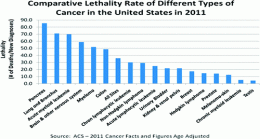
Patients with have a high survival rate — more than 70 percent — even if the cancer metastasizes, or spreads. For example, Lance Armstrong, the famous cyclist, beat metastatic testicular cancer that spread to his lungs and brain, and then went on to win the Tour de France a record seven consecutive times. But patients with pancreatic cancer have only a 25 percent survival rate in the first year and a 6 percent survival rate by the fifth year after diagnosis. Why is this?

Getzenberg and Coffey realized that the microenvironment of testicular was a little different. Testicles are usually several degrees cooler than the rest of the body, owing to their position outside the body. When cancer cells from the testicles spread to other organs, such as the lungs or brain, they encounter a warmer environment. The researchers propose that this warmth shocks the tumor cells, making them more susceptible to conventional cancer therapies, which leads to a higher survival rate among testicular cancer patients. This is the so-called "Lance Armstrong effect." The researchers describe tests now underway on nanoparticle therapies to specifically heat other types of tumors above their normal temperatures to see whether this effect holds true for non-testicular cancers.

More information: Changing the Energy Habitat of the Cancer Cell in Order To Impact Therapeutic Resistance, Mol. Pharmaceutics, Article ASAP. DOI: 10.1021/mp200310u

Abstract
Somatic cellular evolution is becoming a popular biological explanation for the common rapid development of resistance to almost every form of cancer therapy and against almost every form of advanced human solid tumors. As a result of the historical power of evolution within nature, this common biological interpretation of the failure of cancer therapy is leading to a growing despair for many investigators and a stronger turn toward prevention through lifestyle changes. The absolute explosion of molecular scientific discoveries since 1983, in the reductionist identification of specific cancer therapeutic targets, has failed to deliver the impact in the clinic that many of us would have hoped would have resulted by this time. Personalized molecular medicine may help us reclassify appropriate therapeutic subgroups, but will it significantly impact the overall specific survival times for all of the cancers combined within the organ type for the entire population? How might we approach this therapeutic dilemma by utilizing new therapeutic insights designed on proven principles of evolution? In other words, can we fight the development of therapeutic resistance in cancer cells by turning established aspects of evolution against the survival of cancer cells within the individual patient? Here we review the concepts of changing the heat habitat and microenvironment of the cancer cell to alter the higher order organization and function of DNA. We have proposed that heat may be a major factor in determining the lasting therapeutic effect on many types of far advanced metastatic tumors.

Provided by American Chemical Society search and more info website

5 /5 (2 votes)  

Filter


Move the slider to adjust rank threshold, so that you can hide some of the comments.


Display comments: newest first

PPihkala
Oct 20, 2011

Rank: not rated yet
Alternative medicine has long known this effect that cancer cells are more vulnerable to heating than normal cells. There are therefore certain treatments where the temperature of the cancer or whole body is elevated by technical means. Previously that could be done by fever causing pathogen also. Combined with other treatments like chemotherapy there has been reported good results.
Rank 5 /5 (2 votes)
Relevant PhysicsForums posts
  • Potential Breakthrough in Seizure Control
    created5 hours ago
  • Popping/Cracked sternum.
    created10 hours ago
  • Which Mental Illness Encompasses This Problem?
    created10 hours ago
  • A question about drug tolerance
    createdMay 23, 2012
  • Poor nutrition leading to overeating?
    createdMay 23, 2012
  • Math and dyslexia?
    createdMay 21, 2012
  • More from Physics Forums - Medical Sciences

More news stories

Skp2 activates cancer-promoting, glucose-processing Akt

HER2 and its epidermal growth factor receptor cousins mobilize a specialized protein to activate a major player in cancer development and sugar metabolism, scientists report in the May 25 issue of Cell.

Cancer created 18 hours ago | popularity not rated yet | comments 0 | with audio podcast

Pancreatectomy OK without downstaging from therapy

(HealthDay) -- Pancreatectomy improves median survival in pancreatic cancer patients even when presurgical neoadjuvant therapy does not lead to radiographic downstaging of tumors, according to a study published ...

Cancer created 19 hours ago | popularity not rated yet | comments 0

Common therapies for basal cell carcinoma offer similar survival

(HealthDay) -- For patients with superficial basal cell carcinoma (sBCC), treatment with imiquimod or photodynamic therapy (PDT) results in similar long-term tumor-free survival, according to a review published ...

Cancer created 20 hours ago | popularity not rated yet | comments 0

Cancer may require simpler genetic mutations than previously thought

Chromosomal deletions in DNA often involve just one of two gene copies inherited from either parent. But scientists haven't known how a deletion in one gene from one parent, called a "hemizygous" deletion, can contribute ...

Cancer created 22 hours ago | popularity not rated yet | comments 0 | with audio podcast

New prostate cancer screening guidelines face a tough sell, study suggests

(Medical Xpress) -- Recent recommendations from the U.S. Preventive Services Task Force (USPSTF) advising elimination of routine prostate-specific antigen (PSA) screening for prostate cancer in healthy men are likely to encounter ...

Cancer created May 25, 2012 | popularity not rated yet | comments 1


Family history of Alzheimer's affects functional connectivity

(HealthDay) -- Cognitively normal individuals with a family history of late-onset Alzheimer's disease (AD) may display lower resting state functional connectivity in the default mode network (DMN) of the brain, ...

Travel to high altitudes tied to Crohn's, colitis flare-ups

(HealthDay) -- People with inflammatory bowel disease, which includes Crohn's disease and colitis, may be at increased risk for flare-ups when they fly or travel to high altitudes for skiing or mountain climbing, ...

Transvaginal mesh op restores pelvic organ prolapse at price

(HealthDay) -- Transvaginal mesh (TVM) procedures are effective for anatomical restoration of pelvic organ prolapse (POP), but patients report a worsening of sexual function following surgery, according to ...

Inherited DNA change explains overactive leukemia gene

A small inherited change in DNA is largely responsible for overactivating a gene linked to poor treatment response in people with acute leukemia.

Tongue analysis software uses ancient Chinese medicine to warn of disease

For 5,000 years, the Chinese have used a system of medicine based on the flow and balance of positive and negative energies in the body. In this system, the appearance of the tongue is one of the measures used to classify ...

Early physical therapist treatment associated with reduced risk of healthcare utilization and reduced overall healthcare

A new study published in Spine shows that early treatment by a physical therapist for low back pain (LBP), as compared to delayed treatment, was associated with reduced risk of subsequent healthcare utilization and lower ...