Monitoring how T cells respond to HIV
October 14, 2011 by Anne Trafton in HIV & AIDS
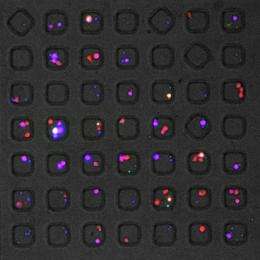
Inside these squares, single T cells taken from HIV-infected patients interact with infected cells. This technology, developed by MIT chemical engineers, offers the first way to study how effectively individual T cells respond to HIV-infected cells. Image: Navin Varadarajan
One of the obstacles to developing an effective AIDS vaccine is the difficulty in measuring how well a potential vaccine primes the body to defend itself against HIV.
Ideally, scientists would like their vaccines to provoke T cells, a critical component of the immune response, to recognize and kill HIV-infected cells. Unfortunately, there is no fast and easy way to monitor whether T cells are actually doing that. Instead, researchers measure the amount of a protein called interferon gamma that T cells secrete when they encounter an infected cell. Studies have shown, however, that this surrogate measurement doesnt necessarily predict a T cells ability to kill HIV-infected cells.
In an advance that could overcome that obstacle, a team of researchers at MIT has developed a new technology that can measure multiple aspects of individual T cells responses to HIV-infected cells, including their ability to kill them. The technology could make it easier to monitor and design vaccines against HIV, says J. Christopher Love, the Latham Family Career Development Associate Professor of Chemical Engineering and leader of the research team.
The technology, described in a paper published in the Oct. 3 online edition of the Journal of Clinical Investigation, involves two steps. First, the researchers place single T cells taken from HIV-infected patients into tiny wells on a plate, where they are exposed to HIV-infected cells. The researchers can detect whether the T cells kill the infected cells with probes that glow when the dying cells nuclei become compromised.
Watch T cells attack HIV-infected cells:
This video is not supported by your browser at this time.
Next, the researchers measure interferon gamma production with a microengraving technique they developed in 2008. Secretions from each cell are imprinted on a glass slide, which can then be tested for the presence of specific proteins. Because each cell has its own address on the slide, the secretions can be traced back to individual cells, and their interferon gamma production can be correlated directly to their cell-killing ability.
The same technology could be adapted to measure cells output of any other immune system protein.
In this study, the researchers found that while the percentage of T cells that secrete interferon gamma is similar to the percentage of those that kill infected cells, the populations are not identical. In future studies, the researchers hope to find markers that do correlate with cell-killing ability, making it easier to evaluate a potential vaccines effectiveness.
Now that we have a tool to look directly at a variety of different functional activities, you can go in and start to evaluate other markers that may be better predictors of killing. Those then become what you would want to monitor in vaccine trials, says Love, who is also a member of the Ragon Institute of MGH, MIT and Harvard and the David H. Koch Institute for Integrative Cancer Research at MIT.
The appeal of this technology is that it can help us understand more about whats going on in single cells, says Alan Landay, professor of immunology and microbiology at Rush Medical College. It helps us rethink what we understand about immunology and immune function.
More research will be needed to develop the technology to the point where it can be used routinely in vaccine trials for large-scale studies of patient samples.
This story is republished courtesy of MIT News (web.mit.edu/newsoffice/), a popular site that covers news about MIT research, innovation and teaching.
Provided by
Massachusetts Institute of Technology
-
Well-armed immune cells help long-term non-progressors contain HIV
Dec 04, 2008 |
not rated yet |
0
-
Nano-sized vaccines
Feb 22, 2011 |
not rated yet |
0
-
Extraordinary immune cells may hold the key to managing HIV
Dec 04, 2008 |
not rated yet |
0
-
Elite controllers block integration of HIV DNA into host genome
Sep 19, 2011 |
not rated yet |
0
-
Exhausted B cells hamper immune response to HIV
Jul 14, 2008 |
not rated yet |
0
-
Motion perception revisited: High Phi effect challenges established motion perception assumptions
Apr 23, 2013 |
3 / 5 (2) |
2
-
Anything you can do I can do better: Neuromolecular foundations of the superiority illusion (Update)
Apr 02, 2013 |
4.5 / 5 (11) |
5
-
The visual system as economist: Neural resource allocation in visual adaptation
Mar 30, 2013 |
5 / 5 (2) |
9
-
Separate lives: Neuronal and organismal lifespans decoupled
Mar 27, 2013 |
4.9 / 5 (8) |
0
-
Sizing things up: The evolutionary neurobiology of scale invariance
Feb 28, 2013 |
4.8 / 5 (10) |
14
-
Classical and Quantum Mechanics via Lie algebras
Apr 15, 2011
- More from Physics Forums - Independent Research
More news stories
Engineered cytomegalovirus protects monkeys from HIV equivalent
(Medical Xpress)—A new study by researchers in the US has shown that an ancient virus can be modified to help in the fight against the simian immunodeficiency virus SIV, which is the equivalent in monkeys ...
HIV & AIDS
6 hours ago |
5 / 5 (3) |
0
|
New microsphere-based methods for detecting HIV antibodies
Detection of HIV antibodies is used to diagnose HIV infection and monitor trials of experimental HIV/AIDS vaccines. New, more sensitive detection systems being developed use microspheres to capture HIV antibodies ...
HIV & AIDS
22 hours ago |
5 / 5 (1) |
0
Fecal microbiota tx feasible for recurrent C. difficile in HIV
(HealthDay)—For HIV-infected individuals with recurrent Clostridium difficile infection, fecal microbiota therapy is feasible, according to a letter published in the May 21 issue of the Annals of Intern ...
HIV & AIDS
May 22, 2013 |
not rated yet |
0
Canada lifts ban on gay men donating blood
Canadian health authorities lifted Wednesday what was effectively a ban on gay men giving blood, announcing new rules making men who have not had sex with men in the past five years eligible.
HIV & AIDS
May 22, 2013 |
not rated yet |
1
AIDS scientists optimistic of AIDS cure, for some
Top AIDS scientists were optimistic Wednesday of finding a cure for the disease that has claimed 30 million lives—but said it might not work for all people.
HIV & AIDS
May 22, 2013 |
not rated yet |
0
Researchers identify first drug targets in childhood genetic tumor disorder
Two mutations central to the development of infantile myofibromatosis (IM)—a disorder characterized by multiple tumors involving the skin, bone, and soft tissue—may provide new therapeutic targets, according to researchers ...
Driving and hands-free talking lead to spike in errors, study shows
Talking on a hands-free device while behind the wheel can lead to a sharp increase in errors that could imperil other drivers on the road, according to new research from the University of Alberta.
FDA warns of infections tied to Tennessee pharmacy
(AP)—Government health officials are investigating several health problems reported with potentially contaminated medications made by a Tennessee specialty pharmacy.
Hormone levels may provide key to understanding psychological disorders in women
Women at a particular stage in their monthly menstrual cycle may be more vulnerable to some of the psychological side-effects associated with stressful experiences, according to a study from UCL.
Going live: Immune cell activation in multiple sclerosis
Biological processes are generally based on events at the molecular and cellular level. To understand what happens in the course of infections, diseases or normal bodily functions, scientists would need to ...
Pollen count apps for smartphones are nothing to sneeze at
Kate O'Reilly's spring allergy survival kit includes the usual stuff - nasal sprays, allergy pills and a box of tissues. This season, she's added a new weapon to her line of defense: an app on her smartphone.