A global push to unlock the genome
A global push to unlock the genome
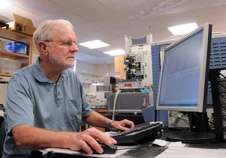
Prof. Bill Hancock is the Bradstreet Chair and a professor of chemistry and chemical biology.

A Northeastern chemistry professor is a leader in the international effort to advance the understanding of human genetics and genomics by assigning each of the 23 pairs of human chromosomes for in-depth study by research groups in different countries.

William Hancock, the Bradstreet Chair in Bioanalytical Chemistry at Northeastern’s Barnett Institute of Chemical and Biological Analysis, is on the executive committee of the Human Proteome Organization (HUPO) and a key player in the project assigned to the United States team: to analyze the role of proteins in chromosome 17, which includes the gene that makes people susceptible to breast cancer.

The project is a daunting one: the human has 22,000 genes and probably about 500,000 proteins, which each serve a different role and have been shaped by millennia of human evolution. The project is specifically looking at a chromosome’s proteomes, which produce proteins as directed by RNA — an effort so large that it quickly became clear the work needed to be conducted on a global scale.

The project is similar to previous work to sequence the human genome, which gave scientists a far deeper understanding of genetics. This project will help scientists better understand the role myriad proteins play in human chromosomes, which can improve the monitoring of disease and the development of more effective drug treatments in the next decade.

“There are gaps in our knowledge, and this project will help us to fill in those gaps,” said Hancock, editor-in-chief of the Journal of Proteome Research.

Barnett’s team at Northeastern, which includes two research professors in the Barnett Institute, Billy Wu and Marina Hincapie, and a group of PhD students, is working with researchers from the University of Michigan Medical School, Stanford University and the University of Vancouver to map out the role of each in the chromosome to better understand what each does and how modern medicine could treat diseases that some genes cause.

The project began in September and will take 10 years to complete. In the first year, HUPO will work to organize the 14 countries that have already signed on and recruit more to study all 23 pairs of chromosomes. 

Barnett’s team includes five chemistry PhD students — Emma Zhang, Suli Li, Julia Yan, Fateme Tousi and Fan Zhang — who will focus on areas including stem cells and the proteins in chromosome 17 that affect breast, gastric, renal and other forms of cancer.

“The impact is straightforward, really,” Hancock said. “Our hypothesis is if we know a lot about the missing parts of chromosomes and proteomes, we can do a lot better at diagnosing disease and treating disease through therapies that specifically target the genes that cause disease.”

add to favorites email to friend print save as pdf

Related Stories

Lund adopts chromosome 19

Feb 03, 2011

The genes that make up the human genome were mapped by HUGO, the Human Genome Organisation, and published in 2001. Now the project is expanding into the HUPO, the Human Proteome Organisation. Within the framework of this ...

Human chromosome 3 is sequenced

Apr 27, 2006

The sequencing of human chromosome 3 at Baylor College represents the final stage of a multi-year project to sequence the human genome.

New lung cancer gene found

Jul 19, 2011

A major challenge for cancer biologists is figuring out which among the hundreds of genetic mutations found in a cancer cell are most important for driving the cancer’s spread.

Chromosome number changes in yeast

Jul 21, 2011

Researchers from Trinity College Dublin have uncovered the evolutionary mechanisms that have caused increases or decreases in the numbers of chromosomes in a group of yeast species during the last 100-150 million years. The ...

Recommended for you

The secret of DNA methylation

12 hours ago

Methylation refers to a chemical modification of DNA and this modification can occur in millions of positions in the DNA sequence. Until now, scientists believed that this epigenetic phenomenon actively reduced the expression ...

Aspirin may fight cancer by slowing DNA damage

15 hours ago

Aspirin is known to lower risk for some cancers, and a new study led by a UC San Francisco scientist points to a possible explanation, with the discovery that aspirin slows the accumulation of DNA mutations in abnormal cells ...

Study identifies protein essential for normal heart function

Jun 17, 2013

A study by researchers at Skaggs School of Pharmacy and Pharmaceutical Sciences and the Department of Pharmacology at the University of California, San Diego, shows that a protein called MCL-1, which promotes cell survival, ...

Scouring the genome of adenoid cystic carcinoma

Jun 17, 2013

Adenoid cystic carcinoma (ACC) is a slow-growing and often fatal malignancy that can occur at multiple organ site, but is most frequently found in the salivary glands. The primary treatment is surgical removal; however, the ...

Gene variants may play role in obesity

Jun 17, 2013

(HealthDay)—Two new studies offer some solace to those who can't control their weight despite diet and exercise by providing more evidence that genetics may play a role in obesity.

Decoding Rett syndrome: New pieces to the puzzle

Jun 17, 2013

(Medical Xpress)—Rett Syndrome is a neurological disorder that affects about 1 in 10,000 girls. Back in 1992, University of Edinburgh researcher Adrian Bird discovered that the protein, MeCP2, plays a major ...

User comments

More news stories

Study suggests new approach to fight lung cancer

Recent research has shown that cancer cells have a much different – and more complex – metabolism than normal cells. Now, scientists at The University of Texas at Dallas have found that exploiting these differences might ...

Getting enough sleep could help prevent type 2 diabetes

Men who lose sleep during the work week may be able to lower their risk of developing Type 2 diabetes by getting more hours of sleep, according to Los Angeles Biomedical Research Institute (LA BioMed) research findings presented ...