Healthy mouth bacteria provide ideal conditions for gum disease
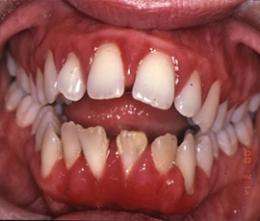
Gum disease leads to painful gums and the loosening of teeth
Normal bacteria which live in our mouths provide the catalyst for the development of gum disease, a debilitating condition which leads to painful gums and the loosening of teeth, new research from Queen Mary, University of London has found.
The unexpected finding could pave the way for the development of preventative measures in tackling gum, or periodontal disease*, by manipulating the normal bacteria in the same way that probiotic yoghurt works to protect the intestine.
Researchers at Queen Mary's Blizard Institute, including Medical Research Council Clinical Research Training Fellow Mark Payne, worked with scientists in the US; they published their findings in the journal Cell Host and Microbe today (Oct. 27).
The scientists introduced the oral bacterium Porphyromonas gingivalis to mice living in two different test conditions. The mice with normal bacteria in their mouths developed periodontal bone loss but the mice raised under germ-free conditions, in the absence of any normal bacteria, remained disease-free.
Professor Mike Curtis, Director of the Blizard Institute and co-author on the paper, said when the oral bacterium P. gingivalis was introduced under normal conditions "it stimulated the growth of normal bugs leading to a large increase in the number of those organisms already there".
"P. gingivalis was introduced at very low levels yet it had a major affect on both the immune system and the inflammatory system," he said.
"This oral bacterium only appears in small numbers but appears to have a major influence on the overall ecology. It has a keystone effect in a community working in the same way that starfish, which have relatively small numbers, control the shell fish communities in the sea.
Professor Curtis said although the findings were encouraging in terms of understanding the way gum disease develops, there was still "some way to go" before there was a similar product on the market for gum disease as a probiotic yoghurt is available for the intestine.
"Now we know that periodontal disease only develops through P. gingivalis interacting with the existing bacteria in our mouths, we need to understand the role played by our normal bacteria in both the development of disease and protection from it," he said.
"This may then provide the means to develop preventative measures for the disease."
Professor Farida Fortune, Dean for Dentistry at Queen Mary said the research was encouraging for people who suffer from gum disease which results in bleeding gums and ultimately loose teeth which cause difficulty in both speaking and eating.
"The public still need to be mindful of the way they look after their teeth and gums," she said.
"People need to pay more attention to their oral hygiene. Their local hygienist, dental therapist and dentist can all assist in teaching them effective cleaning techniques. Just these simple preventative measures, as well as not smoking, will go some way to helping them avoid developing gum disease."
Provided by
Queen Mary, University of London
-
Smoking is a major cause of gum disease: study
Apr 30, 2008 |
not rated yet |
0
-
Healthy gums may lead to healthy lungs
Jan 18, 2011 |
not rated yet |
0
-
Scientists find link between inflamed gums and heart disease
Dec 15, 2008 |
not rated yet |
0
-
Presence of certain antibodies signals healthier teeth and gums
Apr 23, 2008 |
not rated yet |
0
-
Researchers find evidence of periodontal disease leading to gestational diabetes
Mar 24, 2008 |
not rated yet |
0
-
Motion perception revisited: High Phi effect challenges established motion perception assumptions
Apr 23, 2013 |
3 / 5 (2) |
2
-
Anything you can do I can do better: Neuromolecular foundations of the superiority illusion (Update)
Apr 02, 2013 |
4.5 / 5 (11) |
5
-
The visual system as economist: Neural resource allocation in visual adaptation
Mar 30, 2013 |
5 / 5 (2) |
9
-
Separate lives: Neuronal and organismal lifespans decoupled
Mar 27, 2013 |
4.9 / 5 (8) |
0
-
Sizing things up: The evolutionary neurobiology of scale invariance
Feb 28, 2013 |
4.8 / 5 (10) |
14
-
The Durability of Bone: Long Falls
7 hours ago
-
Is energy convertible to matter?
8 hours ago
-
Rotating electron as a dipole is this right?
11 hours ago
-
Dipole term in multipole expansion
15 hours ago
-
Bubbles in a Pre-Boiling/Boiling pot of water
16 hours ago
-
Assumptions of Griffith's fracture theory
May 21, 2013
- More from Physics Forums - Classical Physics
More news stories
Primary care docs should play role in kids' dental health, experts say
(HealthDay)—When it comes to the care of your children's teeth, dentists aren't the only experts who can help.
Dentistry
21 hours ago |
not rated yet |
0
Guidelines issued to prevent infection with dental work
(HealthDay)—Practitioners might consider discontinuing prophylactic antibiotics for patients with prosthetic implants undergoing dental procedures, and these patients should be encouraged to maintain appropriate ...
Dentistry
May 14, 2013 |
not rated yet |
0
First analysis of dental therapists finds increase in access for children, low-income adults
A new report assessing the economic viability of services provided by practicing midlevel dental providers in the U.S. shows that they are expanding preventive dental care to people who need it most: children and those who ...
Dentistry
May 14, 2013 |
not rated yet |
0
Excessive soda can mimic illicit drug use effects on teeth
(HealthDay)—Manifestation of dental erosion caused by illicit drug use or excessive soda consumption needs to be distinguished from dental caries, according to case studies published in the March/April ...
Dentistry
May 13, 2013 |
5 / 5 (1) |
0
Common habits that harm your teeth
Are you wrecking your teeth without even knowing it? For instance, chewing on ice or opening stuff with your teeth may be convenient but using your teeth as tools can cause them to crack or chip.
Dentistry
May 03, 2013 |
3 / 5 (1) |
1
Study says empathy plays a key role in moral judgments
Is it permissible to harm one to save many? Those who tend to say "yes" when faced with this classic dilemma are likely to be deficient in a specific kind of empathy, according to a report published in the scientific journal ...
Phthalates: Study links chemicals widely found in plastics, processed food to elevated blood pressure in children, teens
Plastic additives known as phthalates (pronounced THAL-ates) are odorless, colorless and just about everywhere: They turn up in flooring, plastic cups, beach balls, plastic wrap, intravenous tubing and—according to the ...
If you can remember it, you can remember it wrong
(Medical Xpress)—Native peoples in regions where cameras are uncommon sometimes react with caution when their picture is taken. The fear that something must have been stolen from them to create the photo ...
B vitamins could delay dementia
(Medical Xpress)—Despite spending billions of dollars on research and development, drug companies have been unable to come up with effective treatments for dementia and Alzheimer's Disease (AD). Now, A. ...
Insight into the dazzling impact of insulin in cells
Australian scientists have charted the path of insulin action in cells in precise detail like never before. This provides a comprehensive blueprint for understanding what goes wrong in diabetes.
New sleeping pill poised to hit US markets
An experimental sleeping pill from US drug company Merck is effective at helping people fall and stay asleep, according to reviewers at the US Food and Drug Administration, which could soon approve the new drug.
Oct 28, 2011
Rank: not rated yet