iPad research promising for children with cortical visual impairment
October 6, 2011 in Health
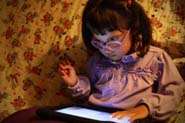
Moxie is working with Muriel Saunders, an assistant research professor at KU's Life Span Institute.
(Medical Xpress) -- A researcher at the University of Kansas believes the iPad could vastly improve the lives and prospects of children living with cortical visual impairment, a severe neurological disorder resulting from brain damage that prevents children from interpreting visual information.
"We tested 15 children and were absolutely shocked," said Muriel Saunders, assistant research professor at KU's Life Span Institute. "Every single child was enthralled with the iPad. Children that typically didn't look at people, didn't respond with objects or responded in a very repetitious fashion, were absolutely glued to the iPad. It was an amazing experience."
Saunders, who works with children with CVI to help them develop language skills, said that traditionally such children work with therapists and parents using a light box, akin to the light box a doctor uses to see an X-ray. This is because children with CVI have an easier time seeing lights and objects in high contrast.
"Someone with a severe CVI will spend a lot of time looking at lights," Saunders said. "They might just sit and look at a light inside the house, or typically they look out the window into the bright sunlight. They might look briefly at something passing by, but they don't look at faces, and they don't look at objects. So they appear to be blind."
With its bright screen, the iPad replicates a light box -- but its interactivity, sound and color are a great deal more engaging to the children with CVI.
After a research assistant working with Saunders asked to use an iPad with the children as a possible light-box substitute, Saunders saw the powerful draw the device had for the children.
"We were using some very simple infant applications," said Saunders. "One was called 'Baby Finger,' where you just touch the screen, and sounds and images and colored shapes appear on the white background. So, in many ways, it was similar to a light box except for instead of black and white, there were bright colors. We also looked at a Dr. Seuss book."
Parents of children with CVI had been the first to notice the iPad's potential as a therapy tool for their kids. Word of the device's promise has begun to spread on Internet chat rooms and social media. But no formal research documenting the iPad's power to help children with CVI has been conducted yet.
Saunders hopes to change that and now is writing a grant proposal to the National Institutes of Health to conduct a thorough study.
"Using the iPad, not only can they interact with a screen, but we can teach them through a series of steps to control things on that screen," the KU researcher said. "There are so many apps already available; we don't have to go out and make our own apps. There are apps available to make a communication board. There are apps available that have different levels of difficulty. Parents of children with CVI are already learning that the iPad works well. There are blogs that say, 'Look at this one' or, 'Look at that one! My child is responding to this app.'"
Early intervention in the lives of children living with CVI is not just crucial to their development; it also could help them to gain better vision as they grow. Saunders said the iPad could be a crucial part of this life-changing therapy.
"With the proper intervention techniques, the amazing thing is that the child's brain grows the brain cells needed in the cerebral cortex," she said. "It grows the brain cells necessary to begin understanding what their eye is seeing. So they develop the ability to interpret images, sometimes just partially, sometimes fully."
Saunders is conducting the initial tests of the iPad in cooperation with the Junior Blind of America in Los Angeles.
Provided by University of Kansas
-
Using touch screens and apps to treat autism
Jul 22, 2011 |
not rated yet |
0
-
Scottish doc calls for kindergarten sex ed
Dec 31, 2007 |
not rated yet |
0
-
Scientist designs language development toy for autistic children
Feb 27, 2007 |
not rated yet |
0
-
Experts and parents are unsure of new touch-screen tablet, marketed for very young children
Sep 22, 2011 |
not rated yet |
0
-
iPad neat, but I'm waiting for ver. 2.0
Jan 30, 2010 |
not rated yet |
0
-
Of mice and mental models: Neuroscientific implications of risk-optimized behavior in the mouse
May 25, 2012 |
not rated yet |
0
-
Limits to growth: Scientists identify key metastasis-enabling enzyme
May 22, 2012 |
5 / 5 (4) |
0
-
Seeing is as seeing does: Spatially-structured retinal input in early development of cortical maps
Apr 26, 2012 |
5 / 5 (4) |
1
-
Dreamless nights: Brain activity during nonrapid eye movement sleep
Apr 09, 2012 |
4.4 / 5 (12) |
0
-
Take your time: Neurobiology sheds light on the superiority of spaced vs. massed learning
Mar 28, 2012 |
4.5 / 5 (21) |
3
-
Classical and Quantum Mechanics via Lie algebras
Apr 15, 2011
- More from Physics Forums - Independent Research
More news stories
Most occupational injury and illness costs are paid by the government and private payers
UC Davis researchers have found that workers' compensation insurance is not used nearly as much as it should be to cover the nation's multi-billion dollar price tag for workplace illnesses and injuries. Instead, almost 80 ...
Health
17 hours ago |
not rated yet |
0
Early physical therapist treatment associated with reduced risk of healthcare utilization and reduced overall healthcare
A new study published in Spine shows that early treatment by a physical therapist for low back pain (LBP), as compared to delayed treatment, was associated with reduced risk of subsequent healthcare utilization and lower ...
Health
20 hours ago |
not rated yet |
0
|
Cancer patients share web info with docs for insight, advice
(HealthDay) -- Cancer patients' primary goal in talking with their doctors about information they've found on the Internet is to get more insight and advice on the online information, new research indicates.
Health
22 hours ago |
not rated yet |
0
P&G to add latches to make detergent packs safer
(AP) -- Procter & Gamble says it will change the design of packaging for its miniature laundry detergent product to deter children from eating the brightly colored packets that look like candy.
Health
23 hours ago |
not rated yet |
0
In Spain, 70 percent of women use contraceptives during their first sexual encounter
Contraceptive use in Spain during the first sexual encounter is similar to other European countries. However, there are some geographical differences between Spanish regions: women in Murcia use contraceptives ...
Health
May 25, 2012 |
not rated yet |
0
Travel to high altitudes tied to Crohn's, colitis flare-ups
(HealthDay) -- People with inflammatory bowel disease, which includes Crohn's disease and colitis, may be at increased risk for flare-ups when they fly or travel to high altitudes for skiing or mountain climbing, ...
Family history of Alzheimer's affects functional connectivity
(HealthDay) -- Cognitively normal individuals with a family history of late-onset Alzheimer's disease (AD) may display lower resting state functional connectivity in the default mode network (DMN) of the brain, ...
Transvaginal mesh op restores pelvic organ prolapse at price
(HealthDay) -- Transvaginal mesh (TVM) procedures are effective for anatomical restoration of pelvic organ prolapse (POP), but patients report a worsening of sexual function following surgery, according to ...
Cancer may require simpler genetic mutations than previously thought
Chromosomal deletions in DNA often involve just one of two gene copies inherited from either parent. But scientists haven't known how a deletion in one gene from one parent, called a "hemizygous" deletion, can contribute ...
Skp2 activates cancer-promoting, glucose-processing Akt
HER2 and its epidermal growth factor receptor cousins mobilize a specialized protein to activate a major player in cancer development and sugar metabolism, scientists report in the May 25 issue of Cell.
Tongue analysis software uses ancient Chinese medicine to warn of disease
For 5,000 years, the Chinese have used a system of medicine based on the flow and balance of positive and negative energies in the body. In this system, the appearance of the tongue is one of the measures used to classify ...