Research links water disinfection byproducts to adverse health effects
October 24, 2011 in Health
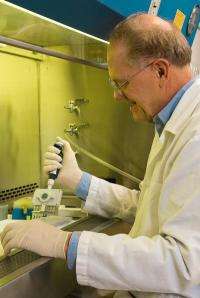
Michael Plewa, lead scientist and professor of genetics in the U of I Department of Crop Sciences, reports the first identification of a cellular mechanism linked to the toxicity of a major class of drinking water disinfection byproducts. This study, published in Environmental Science & Technology, suggests a possible connection to adverse health effects, including neurological diseases such as Alzheimer’s. Credit: David Riecks, University of Illinois ITCS
University of Illinois scientists report the first identification of a cellular mechanism linked to the toxicity of a major class of drinking water disinfection byproducts. This study, published in Environmental Science & Technology, suggests a possible connection to adverse health effects, including neurological diseases such as Alzheimer's.
"I'm not implying that drinking disinfected water will give you Alzheimer's," said Michael Plewa, lead scientist and professor of genetics in the U of I Department of Crop Sciences. "Certainly, the disinfection of drinking water was one of the most significant public health achievements of the 20th century. But the adverse effects of disinfection byproducts (DBPs) that are unintentionally formed during this process are causing concerns as researchers unveil their toxicity."
More than 600 DBPs have been discovered. Although researchers know some DBPs are toxic, little biological information is available on the majority of these water contaminants. The Environmental Protection Agency regulates only 11 of these DBPs, he said.
Plewa's laboratory investigated the biological mechanism, or the cellular target that leads to toxicity, in the second-most prevalent DBP class generated in disinfected water haloacetic acids (HAAs).
"The EPA has regulated HAAs for nearly 15 years. However, we did not know how they caused toxicity before this study," he said. "Now that we've uncovered the mechanism for HAAs, we can make sense of past data that can lead to new studies relating to adverse pregnancy outcomes, different types of cancer, and neurological dysfunction."
Plewa believes this will assist the EPA in establishing regulations based on science. Their research will also help the water treatment community develop new methods to prevent the generation of the most toxic DBPs.
"It's fairly simple," Plewa said. "To increase the health benefits of disinfected water, we must reduce the most toxic DBPs. If we understand their biological mechanisms, we can come up with more rational ways to disinfect drinking water without generating toxic DBPs."
In this study, researchers focused on three HAAs iodoacetic acid, bromoacetic acid and chloroacetic acid. After they rejected their first hypothesis that the HAAs directly damaged DNA, they looked at research in a different area neuroscience. Plewa's graduate student, Justin Pals, discovered an amazing connection, Plewa said.
In neurotoxicology, iodoacetic acid reduces the availability of nutrients or oxygen in neurons by inhibiting glyceraldehyde-3-phosphate dehydrogenase (GAPDH).
"Researchers are interested in understanding how to prevent damage after a stroke or other neurological damage," Plewa said. "Iodoacetic acid kills these cells. One of the targets they found was that iodoacetic acid inhibited GAPDH."
Plewa's lab conducted quantitative GAPDH enzyme kinetics and discovered that the data were highly correlated with a diversity of adverse health markers.
"All the pieces of the puzzle fell into place in an instant," Plewa said. "We had discovered our cellular target GAPDH. Never before had this type of research been done with this level of precision and associated with a large body of adverse biological impacts."
They discovered that the HAA disinfection byproducts were toxic because the cells cannot make ATP, and this causes oxidative stress.
"Cells treated with HAAs experience DNA damage," Plewa said. "So they start expressing DNA repair systems. HAAs are not directly damaging DNA, rather they are inhibiting GAPDH, which is involved in increasing the oxidative stress that we are observing."
A growing body of information has shown that GAPDH is associated with the onset of neurological diseases.
"If you carry a natural mutation for GAPDH and are exposed to high levels of these disinfection byproducts, you could be more susceptible to adverse health effects such as Alzheimer's," he said.
More research is needed to study iodinated disinfection byproducts because they are the most reactive in inhibiting GAPDH function and are currently not regulated by the EPA, Plewa said.
"We replaced the standard working model of direct DNA damage with a new working model based on a cellular target molecule," he said. "This discovery is a fundamental contribution to the field of drinking water science."
More information: This research, "Biological Mechanism for the Toxicity of Haloacetic Acid Drinking Water Disinfection Byproducts," was published in Environmental Science & Technology.
Provided by
University of Illinois at Urbana-Champaign
-
What's in your water?: Disinfectants create toxic by-products
Mar 31, 2009 |
not rated yet |
0
-
Research links recreational pool disinfectants to health problems
Jul 21, 2010 |
not rated yet |
0
-
First measurements of HAAs in urine of swimmers and pool workers
Jul 27, 2011 |
not rated yet |
0
-
Using an activated-carbon filtering pitcher significantly reduces chemicals in tap water
Nov 02, 2006 |
not rated yet |
0
-
Researcher identifies cell mechanism leading to diabetic blindness
Feb 01, 2010 |
not rated yet |
0
-
Of mice and mental models: Neuroscientific implications of risk-optimized behavior in the mouse
May 25, 2012 |
not rated yet |
0
-
Limits to growth: Scientists identify key metastasis-enabling enzyme
May 22, 2012 |
5 / 5 (4) |
0
-
Seeing is as seeing does: Spatially-structured retinal input in early development of cortical maps
Apr 26, 2012 |
5 / 5 (4) |
1
-
Dreamless nights: Brain activity during nonrapid eye movement sleep
Apr 09, 2012 |
4.4 / 5 (12) |
0
-
Take your time: Neurobiology sheds light on the superiority of spaced vs. massed learning
Mar 28, 2012 |
4.5 / 5 (21) |
3
-
Classical and Quantum Mechanics via Lie algebras
Apr 15, 2011
- More from Physics Forums - Independent Research
More news stories
Most occupational injury and illness costs are paid by the government and private payers
UC Davis researchers have found that workers' compensation insurance is not used nearly as much as it should be to cover the nation's multi-billion dollar price tag for workplace illnesses and injuries. Instead, almost 80 ...
Health
18 hours ago |
not rated yet |
0
Early physical therapist treatment associated with reduced risk of healthcare utilization and reduced overall healthcare
A new study published in Spine shows that early treatment by a physical therapist for low back pain (LBP), as compared to delayed treatment, was associated with reduced risk of subsequent healthcare utilization and lower ...
Health
20 hours ago |
not rated yet |
0
|
Cancer patients share web info with docs for insight, advice
(HealthDay) -- Cancer patients' primary goal in talking with their doctors about information they've found on the Internet is to get more insight and advice on the online information, new research indicates.
Health
23 hours ago |
not rated yet |
0
P&G to add latches to make detergent packs safer
(AP) -- Procter & Gamble says it will change the design of packaging for its miniature laundry detergent product to deter children from eating the brightly colored packets that look like candy.
Health
23 hours ago |
not rated yet |
0
In Spain, 70 percent of women use contraceptives during their first sexual encounter
Contraceptive use in Spain during the first sexual encounter is similar to other European countries. However, there are some geographical differences between Spanish regions: women in Murcia use contraceptives ...
Health
May 25, 2012 |
not rated yet |
0
Travel to high altitudes tied to Crohn's, colitis flare-ups
(HealthDay) -- People with inflammatory bowel disease, which includes Crohn's disease and colitis, may be at increased risk for flare-ups when they fly or travel to high altitudes for skiing or mountain climbing, ...
Family history of Alzheimer's affects functional connectivity
(HealthDay) -- Cognitively normal individuals with a family history of late-onset Alzheimer's disease (AD) may display lower resting state functional connectivity in the default mode network (DMN) of the brain, ...
Transvaginal mesh op restores pelvic organ prolapse at price
(HealthDay) -- Transvaginal mesh (TVM) procedures are effective for anatomical restoration of pelvic organ prolapse (POP), but patients report a worsening of sexual function following surgery, according to ...
Skp2 activates cancer-promoting, glucose-processing Akt
HER2 and its epidermal growth factor receptor cousins mobilize a specialized protein to activate a major player in cancer development and sugar metabolism, scientists report in the May 25 issue of Cell.
Tongue analysis software uses ancient Chinese medicine to warn of disease
For 5,000 years, the Chinese have used a system of medicine based on the flow and balance of positive and negative energies in the body. In this system, the appearance of the tongue is one of the measures used to classify ...
New device allows pacemaker patients to safely undergo MRIs
For many, it's a medical conundrum: The very pacemaker keeping their heart in rhythm prevents them from undergoing an MRI to diagnose other ailments, because interaction between the two devices could prove deadly.