Study links pollutants to a 450 percent increase in risk of birth defects
October 19, 2011 in Health
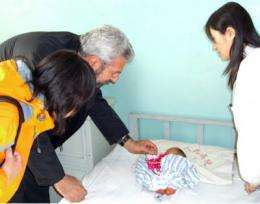
Richard Finnell checks on a newborn in Shanxi Province. Credit: Image courtesy of Richard Finnell
Pesticides and pollutants are related to an alarming 450 percent increase in the risk of spina bifida and anencephaly in rural China, according to scientists at The University of Texas at Austin and Peking University.
Two of the pesticides found in high concentrations in the placentas of affected newborns and stillborn fetuses were endosulfan and lindane. Endosulfan is only now being phased out in the United States for treatment of cotton, potatoes, tomatoes and apples. Lindane was only recently banned in the United States for treatment of barley, corn, oats, rye, sorghum and wheat seeds.
Strong associations were also found between spina bifida and anencephaly and high concentrations of polycyclic aromatic hydrocarbons (PAHs), which are byproducts of burning fossil fuels such as oil and coal. Spina bifida is a defect in which the backbone and spinal canal do not close before birth. Anencephaly is the absence of a large part of the brain and skull.
"Our advanced industrialized societies have unleashed upon us a lot of pollutants," says Richard Finnell, professor of nutritional sciences and director of genomic research at the Dell Children's Medical Center of Central Texas. "We've suspected for a while that some of these pollutants are related to an increase in birth defects, but we haven't always had the evidence to show it. Here we quite clearly showed that the concentration of compounds from pesticides and coal-burning are much higher in the placentas of cases with neural tube defects than in controls."
The study, which was published in August in the Proceedings of the National Academy of Sciences, is the result of a more than decadelong collaboration between Finnell and a team of researchers in Shanxi, a province in northern China.
Finnell sought collaborators in China because the prevalence of neural tube defects is much greater there than it is in the United States. Also, because of its population policies, China is good at tracking births.
"It's an extraordinary natural experiment," says Finnell, who was recently recruited to the university to help anchor the Dell Pediatric Research Institute. "It would be much harder to do this study in the United States, where neural tube defects are more rare. It's also an opportunity to assist the Chinese government in their efforts to lower their birth defect rates."
Working with public health officials in four rural counties in Shanxi, researchers collected placentas from 80 newborn or stillborn fetuses that suffered from spina bifida or anencephaly. Once a fetus or a newborn with such defects was identified as a case, the placenta of a healthy newborn with no congenital malformations born in the same hospital was selected as a control.
Finnell and his colleagues screened these placentas for the presence of a class of substances known as persistent organic pollutants (POPs). Common POPs include agricultural pesticides, industrial solvents and the byproducts of burning fuels such as oil and coal.
They found strong associations between the birth defects and high levels of a number of compounds present in commonly used pesticides. They also found elevated placental concentrations of PAHs.
"This is a region where they mine and burn a lot of coal," says Finnell. "Many people cook with coal in their homes. The air is often black. You don't need to be a rocket scientist to say that maybe there's something in there that isn't good for babies."
Finnell says although the environmental conditions in Shanxi are dramatically worse than they are in most areas of the United States, they are comparable to what the United States was like a century ago, and the neural tube defects are not solely a Chinese problem.
Every year approximately 3,000 pregnancies in the United States are complicated by neural tube defects. Many other congenital conditions, including autism, may one day prove to be related to environmental pollutants.
"Ultimately you need enough cells to make a proper, healthy baby," says Finnell, "and these are the types of compounds that cause cell death. At the most basic level, we're learning that environmental things kill cells, and if that occurs in a critical progenitor population at a crucial time, you're going to have problems."
Provided by
University of Texas at Austin
-
Birth defects linked to coal and pesticides
Jul 20, 2011 |
not rated yet |
0
-
Some neural tube defects in mice linked to enzyme deficiency
May 25, 2009 |
not rated yet |
0
-
Immigrant women may be at higher risk of having a baby with a birth defect
Apr 16, 2009 |
not rated yet |
0
-
New findings may shed light on brain and spinal cord birth defects
Jan 19, 2010 |
not rated yet |
0
-
Gene causing birth defects in mice discovered
Mar 16, 2011 |
not rated yet |
0
-
Of mice and mental models: Neuroscientific implications of risk-optimized behavior in the mouse
May 25, 2012 |
not rated yet |
0
-
Limits to growth: Scientists identify key metastasis-enabling enzyme
May 22, 2012 |
5 / 5 (4) |
0
-
Seeing is as seeing does: Spatially-structured retinal input in early development of cortical maps
Apr 26, 2012 |
5 / 5 (4) |
1
-
Dreamless nights: Brain activity during nonrapid eye movement sleep
Apr 09, 2012 |
4.4 / 5 (12) |
0
-
Take your time: Neurobiology sheds light on the superiority of spaced vs. massed learning
Mar 28, 2012 |
4.5 / 5 (21) |
3
-
Classical and Quantum Mechanics via Lie algebras
Apr 15, 2011
- More from Physics Forums - Independent Research
More news stories
Most occupational injury and illness costs are paid by the government and private payers
UC Davis researchers have found that workers' compensation insurance is not used nearly as much as it should be to cover the nation's multi-billion dollar price tag for workplace illnesses and injuries. Instead, almost 80 ...
Health
18 hours ago |
not rated yet |
0
Early physical therapist treatment associated with reduced risk of healthcare utilization and reduced overall healthcare
A new study published in Spine shows that early treatment by a physical therapist for low back pain (LBP), as compared to delayed treatment, was associated with reduced risk of subsequent healthcare utilization and lower ...
Health
20 hours ago |
not rated yet |
0
|
Cancer patients share web info with docs for insight, advice
(HealthDay) -- Cancer patients' primary goal in talking with their doctors about information they've found on the Internet is to get more insight and advice on the online information, new research indicates.
Health
23 hours ago |
not rated yet |
0
P&G to add latches to make detergent packs safer
(AP) -- Procter & Gamble says it will change the design of packaging for its miniature laundry detergent product to deter children from eating the brightly colored packets that look like candy.
Health
23 hours ago |
not rated yet |
0
In Spain, 70 percent of women use contraceptives during their first sexual encounter
Contraceptive use in Spain during the first sexual encounter is similar to other European countries. However, there are some geographical differences between Spanish regions: women in Murcia use contraceptives ...
Health
May 25, 2012 |
not rated yet |
0
Travel to high altitudes tied to Crohn's, colitis flare-ups
(HealthDay) -- People with inflammatory bowel disease, which includes Crohn's disease and colitis, may be at increased risk for flare-ups when they fly or travel to high altitudes for skiing or mountain climbing, ...
Family history of Alzheimer's affects functional connectivity
(HealthDay) -- Cognitively normal individuals with a family history of late-onset Alzheimer's disease (AD) may display lower resting state functional connectivity in the default mode network (DMN) of the brain, ...
Transvaginal mesh op restores pelvic organ prolapse at price
(HealthDay) -- Transvaginal mesh (TVM) procedures are effective for anatomical restoration of pelvic organ prolapse (POP), but patients report a worsening of sexual function following surgery, according to ...
Skp2 activates cancer-promoting, glucose-processing Akt
HER2 and its epidermal growth factor receptor cousins mobilize a specialized protein to activate a major player in cancer development and sugar metabolism, scientists report in the May 25 issue of Cell.
Tongue analysis software uses ancient Chinese medicine to warn of disease
For 5,000 years, the Chinese have used a system of medicine based on the flow and balance of positive and negative energies in the body. In this system, the appearance of the tongue is one of the measures used to classify ...
New device allows pacemaker patients to safely undergo MRIs
For many, it's a medical conundrum: The very pacemaker keeping their heart in rhythm prevents them from undergoing an MRI to diagnose other ailments, because interaction between the two devices could prove deadly.