Mechanical stress can help or hinder wound healing depending on time of application
October 24, 2011 in Medical research

Mechanical stress can help or hinder wound healing depending on time of application

Enlarge

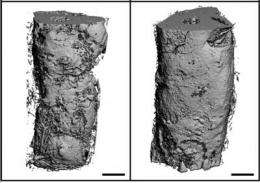
Micro-computed tomography reconstructions of bone formation (left) when the injury site experienced no mechanical force for seven weeks and (right) when mechanical forces were exerted on the injury site beginning after four weeks for a duration of three weeks. Study results showed that bone formation improved by 20 percent with delayed loading compared to when no force was applied, and strong tissue biomaterial integration was evident. Credit: Georgia Tech/Joel Boerckel

A new study demonstrates that mechanical forces affect the growth and remodeling of blood vessels during tissue regeneration and wound healing. The forces diminish or enhance the vascularization process and tissue regeneration depending on when they are applied during the healing process.

The study found that applying mechanical forces to an injury site immediately after healing began disrupted vascular growth into the site and prevented bone healing. However, applying mechanical forces later in the healing process enhanced functional bone regeneration. The study's findings could influence treatment of tissue injuries and recommendations for rehabilitation.

"Our finding that mechanical stresses caused by movement can disrupt the initial formation and growth of new supports the advice doctors have been giving their patients for years to limit activity early in the healing process," Robert Guldberg, a professor in the George W. Woodruff School of Mechanical Engineering at the Georgia Institute of Technology. "However, our findings also suggest applying mechanical stresses to the wound later on can significantly improve healing through a process called adaptive remodeling."

The study was published last month in the journal . The research was supported by the National Institutes of Health, the Armed Forces Institute of Regenerative Medicine and the U.S. Department of Defense.

Because is required for the regeneration of many different tissues, including bone, Guldberg and former Georgia Tech graduate student Joel Boerckel used healing of a bone defect in rats for their study. Following removal of eight millimeters of femur bone, they treated the gap with a seeded with a growth factor called recombinant morphogenetic protein-2 (rhBMP-2), a potent inducer of . The scaffold was designed in collaboration with Nathaniel Huebsch and David Mooney from Harvard University.
Mechanical stress can help or hinder wound healing depending on time of application
Enlarge

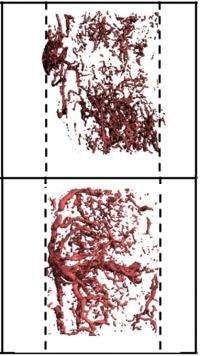
Micro-computed angiography reconstructions of blood vessel formation in the area of the defect (top) when it experienced no mechanical force for seven weeks and (bottom) when mechanical forces were exerted on the injury site beginning after four weeks for a duration of three weeks. With delayed loading, the researchers observed a reduction in quantity and connectivity of blood vessels, but the average vessel thickness increased. Credit: Georgia Tech/Joel Boerckel

In one group of animals, plates screwed onto the bones to maintain limb stability prevented mechanical forces from being applied to the affected bone. In another group, plates allowed compressive loads along the bone axis to be transferred, but prevented twisting and bending of the limbs. The researchers used contrast-enhanced micro-computed tomography imaging and histology to quantify new bone and blood vessel formation.

The experiments showed that exerting on the injury site immediately after healing began significantly inhibited vascular growth into the bone defect region. The volume of blood vessels and their connectivity were reduced by 66 and 91 percent, respectively, compared to the group for which no force was applied. The lack of vascular growth into the defect produced a 75 percent reduction in bone formation and failure to heal the defect.

But the study found that the same mechanical force that hindered repair early in the healing process became helpful later on.

When the injury site experienced no mechanical force until four weeks after the injury, blood vessels grew into the defect and vascular remodeling began. With delayed loading, the researchers observed a reduction in quantity and connectivity of blood vessels, but the average vessel thickness increased. In addition, formation improved by 20 percent compared to when no force was applied, and strong tissue biomaterial integration was evident.

"We found that having a very stable environment initially is very important because applied early on disrupted very small vessels that were forming," said Guldberg, who is also the director of the Petit Institute for Bioengineering and Bioscience at Georgia Tech. "If you wait until those vessels have grown in and they're a little more mature, applying a mechanical stimulus then induces remodeling so that you end up with a more robust vascular network."

The study's results may help researchers optimize the mechanical properties of tissue regeneration scaffolds in the future.

"Our study shows that one might want to implant a material that is stiff at the very beginning to stabilize the injury site but becomes more compliant with time, to improve vascularization and ," added Guldberg.

Provided by Georgia Institute of Technology search and more info website

5 /5 (1 vote)  

Rank 5 /5 (1 vote)
Relevant PhysicsForums posts

More news stories

Computational tool translates complex data into simplified 2-dimensional images

In their quest to learn more about the variability of cells between and within tissues, biomedical scientists have devised tools capable of simultaneously measuring dozens of characteristics of individual ...

Medical research created 11 hours ago | popularity 5 / 5 (2) | comments 0 | with audio podcast

Now we know why old scizophrenia medicine works on antibiotics-resistant bacteria

In 2008 researchers from the University of Southern Denmark showed that the drug thioridazine, which has previously been used to treat schizophrenia, is also a powerful weapon against antibiotic-resistant bacteria such as ...

Medical research created May 17, 2013 | popularity 4 / 5 (4) | comments 0 | with audio podcast

SUMO wrestling cells reveal new protective mechanism target for stroke

Scientists investigating the interaction of a group of proteins in the brain responsible for protecting nerve cells from damage have identified a new target that could increase cell survival.

Medical research created May 17, 2013 | popularity 5 / 5 (1) | comments 0

How serotonin receptors can shape drug effects, from LSD to migraine medication

New findings by researchers carrying out experiments at the U.S. Department of Energy Office of Science's Advanced Photon Source (APS) help explain why some drugs that interact with two kinds of human serotonin ...

Medical research created May 17, 2013 | popularity 4 / 5 (1) | comments 0 | with audio podcast

Preventing blood poisoning

Peptide molecules derived from the body's natural immune system can help boost the body's defence against life-threatening blood poisoning, joint University research has uncovered.

Medical research created May 17, 2013 | popularity 4 / 5 (1) | comments 0 | with audio podcast


Researchers identify a potential new risk for sleep apnea: Asthma

Researchers at the University of Wisconsin have identified a potential new risk factor for obstructive sleep apnea: asthma. Using data from the National Institutes of Health (Heart, Lung, and Blood Institute)-funded Wisconsin ...

New theory on genesis of osteoarthritis comes with successful therapy in mice

Scientists at Johns Hopkins have turned their view of osteoarthritis (OA) inside out. Literally. Instead of seeing the painful degenerative disease as a problem primarily of the cartilage that cushions joints, ...

Study finds that sleep apnea and Alzheimer's are linked

A new study looking at sleep-disordered breathing (SDB) and markers for Alzheimer's disease (AD) risk in cerebrospinal fluid (CSF) and neuroimaging adds to the growing body of research linking the two.

'Gap' for HIV vaccine efforts after latest setback

The hunt for an HIV vaccine has gobbled up $8 billion in the past decade, and the failure of the most recent efficacy trial has delivered yet another setback to 26 years of efforts.

Ginger compounds may be effective in treating asthma symptoms

Gourmands and foodies everywhere have long recognized ginger as a great way to add a little peppery zing to both sweet and savory dishes; now, a study from researchers at Columbia University shows purified components of the ...

Ketamine shows significant therapeutic benefit in people with treatment-resistant depression

Patients with treatment-resistant major depression saw dramatic improvement in their illness after treatment with ketamine, an anesthetic, according to the largest ketamine clinical trial to-date led by researchers from the ...