Organic medical imaging system to detect disease and track medication
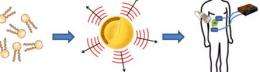
(Medical Xpress) -- Scientists at The University of Nottingham are developing microscopic organic medical imaging systems to support a new generation of breakthrough treatments for currently incurable diseases and chronic life-threatening illnesses.
The nano-transducers, made from fat found in the membrane of naturally occurring biological cells, could have a whole range of medical applications, including the potential to detect tumours earlier, monitoring electrical activity in the brain and tracking individual cells as they move around the human body.
The work is being led by Dr. Melissa Mather, who said: “This research is very exciting as it paves the way for the development of tiny transducers that could be used in the human body without any risk of toxicity.
“There is a growing need for sophisticated new imaging systems capable of studying cells and tissues in the body to support the development of emerging treatments that use human cells to treat conditions such as Parkinson’s disease and spinal injury, as well as chronic conditions such as diabetes or heart disease.
“The hope is that by introducing new healthy cells into the body they will help to restore the function of injured or diseased cells but to ensure these therapies have a positive effect, it is important that the location and behaviour of introduced cells are tracked once in the body. This is a challenging problem which current technologies are struggling to address.”
To support the work, Dr. Mather, based in the University’s Institute of Biophysics, Imaging and Optical Sciences, has received a Career Acceleration Fellowship from the Engineering and Physical Sciences Research Council that will provide funding of more than £730,000 over the next five years.
Transducers are devices, traditionally made from single crystals such as quartz or ceramics, which can convert energy, such as electrical to mechanical. They are used as a method of testing in a wide range of applications, from locating cracks in metal structures to diagnosing diseases in humans.
Scientists have recently discovered that a wider range of materials can be used to make transducers than previously thought if they are miniaturised down to the nanoscale. In fact, it has been shown that the natural electrical activity of the body can be harnessed in biological membranes and converted into mechanical energy.
Dr. Mather’s fellowship is centred on the design and manufacture of nano-sized transducers made from phospholipids, the main type of fat found in the membrane of biological cells. A key part of this will be forming the phospholipids into bubbles called liposomes to take advantage of their acoustic properties — a crucial element for using transducers as a means for testing. The research will look at different ways of increasing the power of the acoustic signal produced by modifying the composition, shape and size of the liposome.
These transducers will be used to develop a biological micro imaging system that will be able to produce diagnostic images of the body. By tagging the lipsomes with specific biological molecules, the transducers will also be able to target certain cell types, enabling them to act as beacons to locate cells in the body.
The final part of the research will focus on testing the capabilities of the new imaging system on tissue phantoms that mimic the human body, particularly in detecting tumours, monitoring electrical activity in the brain and tracking cells used in therapies. The aim is to have a working prototype of the system by 2016.
Dr. Mather added: “The success of this work could hail a new type of organic medical imaging technology that could easily be used in a clinical setting at the point of care. This would have a significant impact in healthcare and enable new therapies to become available for clinical use and contribute to the health and wealth of society.”
Dr. Mather is also a co-investigator at the EPSRC Centre for Innovative Manufacturing in Regenerative Medicine, a partnership between the universities of Loughborough, Nottingham and Keele.


