Pausing to make memories
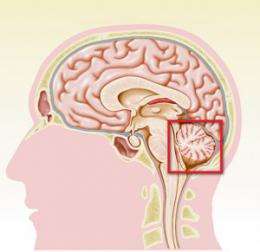
Before the effects of training become hard-wired, the neural imprint of a newly learned motor skill is initially encoded in a temporary ‘holding area’ for memory, after which the memory ‘trace’ is transferred to a different region of the brain for long-term retention. The basis for this learning process has proven challenging to untangle, but new research from a group led by Soichi Nagao of the RIKEN Brain Science Institute in Wako, Japan, has revealed some of the key steps involved.
Several years ago, Nagao and his colleagues studied the acquisition of the horizontal optokinetic response (HOKR), the mechanism by which the eye compensates for sideways movement of the visual field, such as scenery passing by the window of a moving car. HOKR offers a simple and broadly relevant model for understanding motor learning. “This behavior exists throughout most animal species ranging from fish to humans, and even works in invertebrates,” says Nagao.
The researchers examined activity in the cerebellum, the brain region responsible for motor function. They found that they could detect the shift in HOKR-related activity from a cerebellar region called the flocculus to another population of cells called the vestibular nuclei after three to four days of training sessions, in which the researchers tracked eye movement as the animals viewed an oscillating screen on a computer screen.
However, Nagao and colleagues wondered whether there might be a more efficient way to study this shift. “Three or four days is a very long time to maintain constant experimental conditions,” says Nagao. “If the same phenomenon could be observed within three or four hours, we could use drugs or surgical treatments to study the underlying mechanisms.”
The solution turned out to be an alternative approach to training based on what is known as the spacing effect. Neuroscientists have recognized this effect since the 19th century, but it remains poorly understood. “Very little has been revealed about its underlying neural mechanisms by biological experiments,” explains Nagao, “and in particular, there have been very few studies in mammals.”
Nevertheless, he and his colleagues observed clear benefits when they trained their mice with a series of spaced intervals rather than long individual ‘massed training’ sessions. Twenty-four hours after the completion of the training, all animals on spaced training protocols retained their gains in HOKR adaptation, while the mass trained animals lost approximately half of the gains they had obtained by the end of training.
Damage inflicted surgically to the flocculus prior to training impaired the acquisition of HOKR via either regimen, indicating that early learning is acquired via a common mechanism in both approaches. In subsequent experiments, the researchers used infusions of the anesthetic drug lidocaine to suppress neural activity within the flocculus an hour after the completion of training. Although this treatment suppressed the adaptation gains from massed training, the researchers were surprised to find that it had virtually no effect on animals receiving spaced training.
This suggests that the span of the spaced training regimen was itself sufficient to see the memory trace transferred from the flocculus to the vestibular nuclei, indicating a considerably rate of long-term memory retention. “The transfer of the memory trace occurred within two and half hours after the start of training,” Nagao notes.
Finally, the researchers tested whether active protein synthesis is required for HOKR adaptation by infusing into the flocculus drugs that inhibit the protein production machinery. This treatment had minimal impact on the gains from subsequent massed training, but mice that underwent spaced training after the infusion exhibited a marked reduction in HOKR adaptation. This suggests that protein synthesis is specifically required for motor learning via the spaced learning approach.
Although this study focused on a single, relatively simple model of motor learning, Nagao points out that the principles demonstrated here are likely to hold true for most acquired physical behaviors. “The basic structure of this neural circuit is uniform throughout the entire cerebellar cortex,” he says. “We believe that the control mechanism of HOKR suggested by our analysis of the flocculus–vestibular system applies to cerebellar control in general.”
This study could also provide parallel insights into the rules governing the process by which we acquire declarative memory, which encompasses our capacity to recall learned information and prior experiences. This process takes place within entirely independent structures of the brain, namely the hippocampus and cerebral cortex, although the actual process by which declarative memory traces become consolidated from short-term to long-term retention may employ a more elaborate form of the mechanisms described here. “The information content is higher in declarative memory,” says Nagao. “Memories get simplified in motor memory while many properties should be added during the transfer declarative memory.”
To follow up this work, Nagao and his colleagues intend to uncover additional mechanistic details of the cerebellar memory transfer process. For example, it remains unclear exactly what proteins are being produced in the flocculus to facilitate memory encoding, or how they might be acting to rewire the neuronal circuitry. More fundamentally, neuroscientists are yet to determine how the connections between populations of cerebellar neurons change in direct response to the training process. “We are planning to examine how memory traces of motor learning are represented morphologically in the cerebellar nuclei,” says Nagao.
More information: Okamoto, T., et al. Role of cerebellar cortical protein synthesis in transfer of memory trace of cerebellum-dependent motor learning. The Journal of Neuroscience 31, 8958–8966 (2011).
Shutoh, F., et al. Memory trace of motor learning shifts transsynaptically from cerebellar cortex to nuclei for consolidation. Neuroscience 139, 767–777 (2006).


