Neuroscientists find normal brain communication in people who lack connections between right, left hemispheres
October 19, 2011 in Neuroscience
Neuroscientists find normal brain communication in people who lack connections between right, left hemispheres

Enlarge

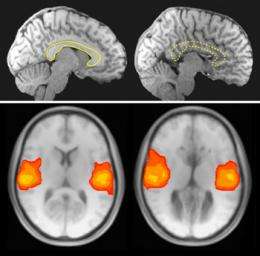
(Top) Magnetic resonance images comparing a healthy subject (left) with an AgCC patient (right). The corpus callosum is the thick, 'c'-shaped structure outlined in the healthy brain and missing from the AgCC brain. (Bottom) Functional magnetic resonance images highlight symmetric patterns of synchronized activity in both healthy (left) and AgCC subjects (right) during rest with eyes closed. More than 15 of this type of network were found to be preserved in AgCC subjects. [Credit: California Institute of Technology]

(Medical Xpress) -- Like a bridge that spans a river to connect two major metropolises, the corpus callosum is the main conduit for information flowing between the left and right hemispheres of our brains. Now, neuroscientists at the California Institute of Technology (Caltech) have found that people who are born without that link—a condition called agenesis of the corpus callosum, or AgCC—still show remarkably normal communication across the gap between the two halves of their brains.

Their findings are outlined in a paper published October 19 in The Journal of Neuroscience.

Our brains are never truly at rest. Even when we daydream, there is a tremendous amount of communication happening between different areas in the . According to J. Michael Tyszka, lead author on the Journal of Neuroscience paper and associate director of the Caltech Brain Imaging Center, many areas of the brain display slowly varying patterns of activity that are similar to one another. The fact that these areas are synchronized has led many scientists to presume that they are all part of an interconnected network called a resting-state network. Much to their surprise, Tyszka and his team found that these resting-state networks look essentially normal in people with AgCC, despite the lack of connectivity.

“This was a real surprise," says Tyszka. "We expected to see a lot less coupling between the left and right brain in this group—after all, they are missing about 200 million connections that would normally be there. How do they manage to have normal communication between the left and right sides of the brain without the ?”

The work used functional magnetic resonance imaging (fMRI) to demonstrate that synchronized activity between the left and right brain survives even this sort of radical rewiring of the nerve connections between the two hemispheres. The presence of symmetric patterns of activity in individuals born without a corpus callosum highlights the brain’s remarkable plasticity and ability to compensate, says coauthor Lynn Paul, research staff member and lecturer in psychology at Caltech. “It develops these fundamental networks even when the left and right hemispheres are structurally disconnected.”

The study that found the robust networks is part of an ongoing research program led by Paul, who has been studying AgCC for several decades. AgCC occurs in approximately one of every 4000 live births. The typical corpus callosum comprises almost 200 million axons—the connections between brain cells—and is the largest fiber bundle in the human brain. In AgCC, those fibers fail to cross the gap between the hemispheres during fetal development, forcing the two halves of the brain to communicate using more indirect and currently unknown means.

“In the 1960s and 1970s, Roger Sperry at Caltech studied 'split-brain' patients in whom the corpus callosum was surgically severed as a treatment for epilepsy," explains Paul. "Our research on AgCC has moved in a different direction and focuses on a naturally occurring brain malformation that occurs before birth. This allows us to examine how, and to what extent, the brain can compensate for the loss of the corpus callosum as a person grows to adulthood.”

According to the team, the findings are especially valuable in light of current theories that link impaired brain connections with clinical conditions including autism and schizophrenia.

“We are now examining AgCC subjects who are also on the autism spectrum, in order to gain insights about the role of brain connectivity in autism, as well as in healthy social interactions," says Tyszka. "About a third of people with AgCC also have autism, and altered connectivity in the corpus callosum has been found in autism. The remarkable compensation in brain functional networks that we found here may thus have important implications also for understanding the function of the brains of people with autism."

More information: "Intact bilateral resting-state networks in the absence of the corpus callosum," The Journal of Neuroscience.

Provided by California Institute of Technology search and more info website

4.8 /5 (9 votes)  

Filter


Move the slider to adjust rank threshold, so that you can hide some of the comments.


Display comments: newest first

Isaacsname
Oct 19, 2011

Rank: not rated yet
Dielectric( insulating ) lipid coatings on the CC, ( myelin ) are what restrict signals between hemispheres, you'd think without the restriction offered by the lipids on the CC there'd be better communication between halves ?
Callippo
Oct 19, 2011

Rank: 5 / 5 (1)
It could open the doors for research of telepathic abilities of human brain.
hush1
Oct 19, 2011

Rank: not rated yet
What is myelination signal restriction? How does myelination signal restriction restrict signals? How do lipid coatings offer restriction and on the CC?

Don't understand either of half of your run on sentence.
Isaacsname
Oct 19, 2011

Rank: not rated yet
" In primates, the speed of nerve transmission depends on its degree of myelination, or lipid coating. This is reflected by the diameter of the nerve axon. In most primates, axonal diameter increases in proportion to brain size to compensate for the increased distance to travel for neural impulse transmission."

http://en.wikiped...callosum

http://en.wikiped...lination

http://en.wikiped...ctrical)

Clear now ?
gmurphy
Oct 20, 2011

Rank: not rated yet
myelination is the process of insulating neural fibers, it makes the signal transmission more efficient by preventing the electrical energy from 'grounding'. http://en.wikiped...i/Myelin .
hush1
Oct 20, 2011

Rank: not rated yet
grounded amplification? No. Not clear.

Myelination occurs to preserve neuronal pathways stimulated from the use of those pathways that aid fetal development and development continuing after birth and throughout the entire human life span.

You know there is knowledge outside Wikipedia, right?

As for the article:
"Intact bilateral resting-state networks in the absence of the corpus callosum"

is like calling bilinguals normal.
The big news for these researchers is that is correct.
Rank 4.8 /5 (9 votes)
Relevant PhysicsForums posts
  • Potential Breakthrough in Seizure Control
    created8 hours ago
  • Popping/Cracked sternum.
    created12 hours ago
  • Which Mental Illness Encompasses This Problem?
    created13 hours ago
  • A question about drug tolerance
    createdMay 23, 2012
  • Poor nutrition leading to overeating?
    createdMay 23, 2012
  • Math and dyslexia?
    createdMay 21, 2012
  • More from Physics Forums - Medical Sciences

More news stories

Of mice and mental models: Neuroscientific implications of risk-optimized behavior in the mouse

(Medical Xpress) -- Regardless of an organism’s biological complexity, every encephalized animal continuously makes under-informed behavioral choices that can have serious consequences. Despite its ubiquity, ...

Neuroscience created May 25, 2012 | popularity not rated yet | comments 0 | with audio podcast feature

Persistent sensory experience is good for aging brain

Despite a long-held scientific belief that much of the wiring of the brain is fixed by the time of adolescence, a new study shows that changes in sensory experience can cause massive rewiring of the brain, even as one ages. ...

Neuroscience created May 24, 2012 | popularity not rated yet | comments 0

Boundary stops molecule right where it needs to be

A molecule responsible for the proper formation of a key portion of the nervous system finds its way to the proper place not because it is actively recruited, but instead because it can't go anywhere else.

Neuroscience created May 24, 2012 | popularity not rated yet | comments 0 | with audio podcast

Locating ground zero: How the brain's emergency workers find the disaster area

Like emergency workers rushing to a disaster scene, cells called microglia speed to places where the brain has been injured, to contain the damage by 'eating up' any cellular debris and dead or dying neurons. ...

Neuroscience created May 24, 2012 | popularity 5 / 5 (2) | comments 0 | with audio podcast

Genetic 'reset switch' enables signaling pathway to induce multiple developmental outcomes for olfactory neurons

Within the nervous system, a handful of signaling pathways modulate development of a cornucopia of different neuronal subtypes. “Even small alterations in neuron differentiation pathways can disrupt subsequent ...

Neuroscience created May 24, 2012 | popularity not rated yet | comments 0


Travel to high altitudes tied to Crohn's, colitis flare-ups

(HealthDay) -- People with inflammatory bowel disease, which includes Crohn's disease and colitis, may be at increased risk for flare-ups when they fly or travel to high altitudes for skiing or mountain climbing, ...

Family history of Alzheimer's affects functional connectivity

(HealthDay) -- Cognitively normal individuals with a family history of late-onset Alzheimer's disease (AD) may display lower resting state functional connectivity in the default mode network (DMN) of the brain, ...

Transvaginal mesh op restores pelvic organ prolapse at price

(HealthDay) -- Transvaginal mesh (TVM) procedures are effective for anatomical restoration of pelvic organ prolapse (POP), but patients report a worsening of sexual function following surgery, according to ...

Skp2 activates cancer-promoting, glucose-processing Akt

HER2 and its epidermal growth factor receptor cousins mobilize a specialized protein to activate a major player in cancer development and sugar metabolism, scientists report in the May 25 issue of Cell.

Tongue analysis software uses ancient Chinese medicine to warn of disease

For 5,000 years, the Chinese have used a system of medicine based on the flow and balance of positive and negative energies in the body. In this system, the appearance of the tongue is one of the measures used to classify ...

Early physical therapist treatment associated with reduced risk of healthcare utilization and reduced overall healthcare

A new study published in Spine shows that early treatment by a physical therapist for low back pain (LBP), as compared to delayed treatment, was associated with reduced risk of subsequent healthcare utilization and lower ...