Neuroscientists pinpoint specific social difficulties in people with autism
October 11, 2011 in Neuroscience
Credit: Caltech/Lance Hayashida
(Medical Xpress) -- People with autism process information in unusual ways and often have difficulties in their social interactions in everyday life. While this can be especially striking in those who are otherwise high functioning, characterizing this difficulty in detail has been challenging. Now, researchers from the California Institute of Technology (Caltech) have isolated a very specific difference in how high-functioning people with autism think about other people, finding thatin actualitythey dont tend to think about what others think of them at all.
This finding, described online this week in the Proceedings of the National Academy of Sciences, sheds light on what researchers call "theory of mind" abilitiesour intuitive skill for figuring out what other people think, intend, and believe. One key aspect of such abilities in terms of social interactions is to be able to figure out what others think of usin other words, to know what our social reputation is. It is well known that social reputation usually has a very powerful influence on our behavior, motivating us to be nice to others.
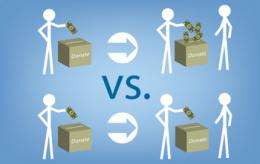
The Caltech team capitalized on this strong effect by asking people to make real money donations to UNICEF under two conditions: alone in a room or while being watched by a researcher.
"What we found in control participantspeople without autismbasically replicated prior work. People donated more when they were being watched by another person, presumably to improve their social reputation," explains Keise Izuma, a postdoctoral scholar at Caltech and first author on the study. "By contrast, participants with autism gave the same amount of money regardless of whether they were being watched or not. The effect was extremely clear."
To be certain that the subjects with autism really were not thinking about their social reputation in the presence of the other personas opposed to simply ignoring that onlookerthe researchers showed that everyone, both controls and people with autism, do better on simple math tasks when being watched than when alone.
"This check was important," says Ralph Adolphs, Bren Professor of Psychology and Neuroscience and professor of biology at Caltech and the principal investigator on the paper, "because it showed us that in people with autism, the presence of another person is indeed registered, and can have general arousal effects. It tells us that what is missing is the specific step of thinking about what another person thinks about us. This is something most of us do all the timesometimes obsessively sobut seems to be completely lacking in individuals with autism."
The findings provide a much more precise picture of how people with autism process social information, says Adolphs, and is important not only for use in diagnostic and interventional therapies, but also for educating the general public about the psychology of autism.
Next up for the team: MRI studies to investigate what occurs in the brain during such social interactions, as well as other investigations into the biology and psychology of autism.
Other authors on the PNAS paper, "Insensitivity to social reputation in autism," are Colin Camerer, Robert Kirby Professor of Behavioral Economics at Caltech and Kenji Matsumoto, a neuroscientist at Tamagawa University in Japan. The work was supported by a Simons Foundation Autism Research Initiative, the National Institute of Mental Health, a fellowship from the Japan Society for the Promotion of Science Fellows, and a Global Centers of Excellence collaborative grant from the Japanese government to Caltech and Tamagawa University.
Provided by
California Institute of Technology
-
Study: Autism affects all brain functions
Aug 16, 2006 |
not rated yet |
0
-
Looking through the broken mirror
Oct 14, 2008 |
not rated yet |
0
-
Brain scans detect autism's signature
Nov 15, 2010 |
not rated yet |
0
-
Researchers discover many genetic keys needed to unlock autism
Jun 08, 2011 |
not rated yet |
0
-
Researchers find further evidence for genetic contribution to autism
Jul 15, 2008 |
not rated yet |
0
-
Motion perception revisited: High Phi effect challenges established motion perception assumptions
Apr 23, 2013 |
3 / 5 (2) |
2
-
Anything you can do I can do better: Neuromolecular foundations of the superiority illusion (Update)
Apr 02, 2013 |
4.5 / 5 (11) |
5
-
The visual system as economist: Neural resource allocation in visual adaptation
Mar 30, 2013 |
5 / 5 (2) |
9
-
Separate lives: Neuronal and organismal lifespans decoupled
Mar 27, 2013 |
4.9 / 5 (8) |
0
-
Sizing things up: The evolutionary neurobiology of scale invariance
Feb 28, 2013 |
4.8 / 5 (10) |
14
-
How can there be a term called "intestinal metaplasia" of stomach
May 21, 2013
-
Pressure-volume curve: Elastic Recoil Pressure don't make sense
May 18, 2013
-
If you became brain-dead, would you want them to pull the plug?
May 17, 2013
-
MRI bill question
May 15, 2013
-
Ratio of Hydrogen of Oxygen in Dessicated Animal Protein
May 13, 2013
-
Alcohol and acetaminophen
May 13, 2013
- More from Physics Forums - Medical Sciences
More news stories
Reducing caloric intake delays nerve cell loss
Activating an enzyme known to play a role in the anti-aging benefits of calorie restriction delays the loss of brain cells and preserves cognitive function in mice, according to a study published in the May ...
Neuroscience
13 hours ago |
5 / 5 (5) |
0
|
B vitamins could delay dementia
(Medical Xpress)—Despite spending billions of dollars on research and development, drug companies have been unable to come up with effective treatments for dementia and Alzheimer's Disease (AD). Now, A. ...
Neuroscience
17 hours ago |
4.9 / 5 (14) |
0
|
Waiting for a sign? Researchers find potential brain 'switch' for new behavior
You're standing near an airport luggage carousel and your bag emerges on the conveyor belt, prompting you to spring into action. How does your brain make the shift from passively waiting to taking action when ...
Neuroscience
17 hours ago |
5 / 5 (1) |
0
|
If you can remember it, you can remember it wrong
(Medical Xpress)—Native peoples in regions where cameras are uncommon sometimes react with caution when their picture is taken. The fear that something must have been stolen from them to create the photo ...
Neuroscience
19 hours ago |
4.2 / 5 (5) |
0
|
Study shows where scene context happens in our brain
In a remote fishing community in Venezuela, a lone fisherman sits on a cliff overlooking the southern Caribbean Sea. This man –– the lookout –– is responsible for directing his comrades on the water, ...
Neuroscience
21 hours ago |
4 / 5 (1) |
0
|
Portland, Ore., rejecting water fluoridation
(AP)—The mayor of Portland, Ore., has conceded defeat in an effort to add fluoride to the city's drinking water.
Study says empathy plays a key role in moral judgments
Is it permissible to harm one to save many? Those who tend to say "yes" when faced with this classic dilemma are likely to be deficient in a specific kind of empathy, according to a report published in the scientific journal ...
Phthalates: Study links chemicals widely found in plastics, processed food to elevated blood pressure in children, teens
Plastic additives known as phthalates (pronounced THAL-ates) are odorless, colorless and just about everywhere: They turn up in flooring, plastic cups, beach balls, plastic wrap, intravenous tubing and—according to the ...
Insight into the dazzling impact of insulin in cells
Australian scientists have charted the path of insulin action in cells in precise detail like never before. This provides a comprehensive blueprint for understanding what goes wrong in diabetes.
New sleeping pill poised to hit US markets
An experimental sleeping pill from US drug company Merck is effective at helping people fall and stay asleep, according to reviewers at the US Food and Drug Administration, which could soon approve the new drug.
Antidepressant reduces stress-induced heart condition
A drug commonly used to treat depression and anxiety may improve a stress-related heart condition in people with stable coronary heart disease, according to researchers at Duke Medicine.
Oct 11, 2011
Rank: 2.3 / 5 (4)
Oct 11, 2011
Rank: 5 / 5 (4)
I wouldn't say empathy " seems to be completely lacking in individuals with autism ", I would say that we logically examine other viewpoints and discard what is unecessary, which just happens to cover a broad span.
You'll find we don't usually wear things like jewelry, makeup, fancy clothes, yet we can know all sorts of things about them due to compulsive autodidactism, it just means we don't see a rational need for them.
If anything, most autistics operate under cold hard logic.
Oct 11, 2011
Rank: 3 / 5 (4)
The psychologist told me I don't have Aspergers or ADD, but I meet that description exactly.
http://en.wikiped...c_memory
http://en.wikiped...esthesia
http://en.wikiped...overload
I also meet these exactly.
I usually don't re-watch movies, because in most cases I have so much of it memorized that I already know what's happening.
The other day I talked about that on an unrelated thread, and I mentioned how I had the Alien:Resurrection movie almost completely memorized, even though I've only seen it all the way through just once.
Two days ago, it so happens that they had the Alien series on television, and I started in on Alien 3.
continued...
Oct 11, 2011
Rank: 2.3 / 5 (3)
I remembered specific details about almost every scene, including the dialogue and inflection of the speaker's voice.
"synesthesia" comes in, because it's actually hard fo rme to seperate the visual and audio compenent memories. Like, if I remember the visual compent, I will remember the audio component. In my memory I "see" the visual component, exactly like the original image, and then I "hear" the audio component in exact tone and inflection, although the visual is much, much easier to remember than the audio.
Like the J.G. Wentworth Commercials with the operas?
I can see and hear most of that running in my head, sometimes on-demand, but over night, it was just like automatic and describe the physical characteristics of most of the people and their clothing.
Oct 11, 2011
Rank: 1 / 5 (2)
The concentration problems this causes are just unfair at times.
I can describe the visual events, not always the dialogue, from movies I have not seen for 5 or more years, accurately and KNOW it's right.
I didn't realize I had this stuff memorized so well, untill a couple nights ago when Alien: Resurrection and Demolition Man unlocked in my mind, and then I could pretty much just "navigate" the videos (not every frame, but most scenes anyway,) and "see" the imagery, and in many cases the dialogue, which in some cases plays back like a tape recorder.
I did not know this wasn't "normal" until a few days ago.
But it's also incredibly distracting at times, because I can't always turn it "off" when it happens, or it may take several days to wind it down in my mind.
Oct 11, 2011
Rank: not rated yet
Synesthesia, I think, is not as rare as people would like to believe. We all have unique methods of memory recall and assigning subject relations, synesthesia should really be explored, especially with teaching.
People do not make the time, or cannot make the time for mental training due to lifestyles/obligations, as a result there is incredible potential lost with many.
Use it or lose it.
Sometimes social difficulties are from even simpler causes, in my case, my eyesight is horrible, but nobody, not even me knew untill I was 12. Nobody thought to have my eyes tested, I thought blurry was normal. I thought it was odd, but also thought everybody's world was blurry so I never said anything about it. This contributed greatly to social difficulties for me, being HFA compounded things.
Oct 11, 2011
Rank: 5 / 5 (1)
Oct 11, 2011
Rank: not rated yet
Oct 11, 2011
Rank: 5 / 5 (3)
Psychoanalysists, psychiatrists and psychologists are all prone to " suffer " the same things they strive to define in other people.
What's that old saying,..It take's one to know one.
O:
Oct 11, 2011
Rank: 3 / 5 (2)
Well, Ralph Adolphs?
All participants were psychologists and psychiatrists.
Or actors trained to mimic what you sought.
Well, here's to thinking about you, Ralph. Or not.
Which is it?
Am I most? Or an individual lacking most of what most have.
Oct 11, 2011
Rank: 5 / 5 (3)
Could it be that people with autism are empathically aware, but choose to operate based on a system of reason instead of crowd-driven behavior?
Isn't this behavior altogether something disgusting in "normal" people, showing how fake they really are and willing to change their behavior (and beliefs) regarding what's right/wrong depending on the crowd their in?
Oct 11, 2011
Rank: 5 / 5 (2)
At the same time, the community is becoming hypersensitive to the smallest [even imagined] hint of racism.
Oct 11, 2011
Rank: 2.3 / 5 (3)
Normal people are "fake" because of peer pressure and hidden motivations, greed, etc.
That doesn't mean that an Aspergers or Autistic would never lie, because some of them can and do.
I would say that I've hardly ever done anything just because of peer pressure. There may have been one or two exceptions, but for the most part, in the past I couldn't care less what other people think of me.
Either they are going to like you for who you are, or they are going to hate you, or somewhere in between. In any case, if you are not true to yourself, then the other person doesn't "really" like you anyway. They like a mask.
Unfortunately, many people are content to like a mask, and content to be liked because of their own mask. I am not.
Oct 11, 2011
Rank: 2.3 / 5 (3)
Doing things out of principle is not a dysfunction.
Autistics are not apathetic out of a "principle".
They have a disability which causes them to have little or no concept or awareness of extroversion or empathy, and they may also have physical impairments as well, such as poor motor control.
Aspergers and Savant Syndrome are not exactly the same thing, but they are classified as "Autism Spectrum Disorders".
Oct 11, 2011
Rank: 2.3 / 5 (3)
In my case, I was introduced to this through cryptography and through J.R.R. Tolkien, and I probably started doing it as mimicking Tolkien.
tolkien and Lewis used to make up words by rotating consonants and vowels, and then applying other rules, such as conjugations from other languages.
I used to do that on my own also, rotate an English word, and then if appropriate, use a conjugation rule from Spanish.
It's an easy way to make up a fictitious language for a novel or a campaign in a game.
Consonants to consonants, vowels to vowels.
for example, this very odd coincidence:
"Human"
becomes
"Genom(e)"
1 left
3 left
1 right
3 right
1 left
add a silent "e"
Genome
Family
1 L
1 L
1 L
1 L
1 L
2 L (Y as a vowel)
Oct 11, 2011
Rank: 2.3 / 5 (3)
If I want to play with the word "Run" in an infinitive form, "To run" then I might apply Rot 1, to make a new base word.
"Run" becomes "Syp".
then I want to apply a standard ending to the word, to put it into a coded infinitive form, but I don't want to use "-ir, er, ar, or," etc, as that would be too obvios, so I make something else up, and maybe add a connecting vowel rule as well.
Now we have "Sypoim".
Which become my infinitive form of "To Run" in my fictitious language. Remember, I'm using english word, rotated right, but applying spanish grammar and syntax, only I coded the spanish part in "nonsense" so the reader wouldn't recognize it.
Now, if I wanted to conjugate "Sypoim" into different tenses, I'd make up a table of unique forms.
Now if I want to do dialogues of characters in their "native" language, I would have a table of all the words I'd need, and their forms as appropriate, and convert the dialogue from english to the language.
Oct 11, 2011
Rank: 5 / 5 (1)
Your last two comments in one word:
Neologism. And it's variations.
Children of all ages do this.
"of all ages" means everyone.
Oct 11, 2011
Rank: 5 / 5 (2)
Use your condition to support the definitions.
This is why self diagnosis is last on anyone's list.
Oct 11, 2011
Rank: 4 / 5 (2)
Oct 12, 2011
Rank: 5 / 5 (1)
No other life form on earth speaks our language.
No other life form can label you autistic.
And no other life form can lie to you.
And you will discover this eventually.
Oct 12, 2011
Rank: 5 / 5 (1)
Oct 12, 2011
Rank: 5 / 5 (1)
Oct 12, 2011
Rank: 5 / 5 (1)
Regards, DH66 (And yes, the raw nerve does feel better. For now)
Oct 12, 2011
Rank: 5 / 5 (1)
Your post highlights something about me as well.
I think I need a second opinion, just to be honest.
I know that when I look at "symptoms" I can't always say "everything" is like me, but I know that there are many similarities.
Hush is saying use conditions to support definitions.
Well, if you don't "know" a definition, all you can do is recognize it when you see it, and say, "yes, I'm a bit like that," or, "I'm a lot like that," or, "that describes me exactly."
People never seem to ask me the right questions, and when I try to describe myself, they get hung up on the wrong words and details, but then, so do I.
Oct 12, 2011
Rank: 5 / 5 (1)
It's true you can't always self diagnose, but damnit the symptom is what it is, whether or not you want to label it with the same classification.
Isn't repetitive behavior a classic sign of Aspergers?
With me, there is always repetitive behavior, especially in things I like, like the obvious video games, but also in other personal interests.
With me, I am absorbed into gaming, because it is obviously highly visual, but also interactive. There is sight, touch, sound, and of course cognition: planning your next move, recall/recognition of events and responding to them, etc.
They talk about video game addiction, and I know that describes me.
I haven't played anything in quite some time, except Chess, though, but I'm still "addicted" because my memory plays the animations and sound effects back all the time.
Oct 12, 2011
Rank: 3 / 5 (2)
I must have played 10,000 games of Starcraft: Broodwar online under different screen names, and I can remember many of them, too many, specifically. The basic openings of the game, the evolution of the game, how I won or lost, what the race matchup was, specific battles within a game including micro-management, in some cases, the names of all or most of the players in the game, even if it was random team in public.
Or back in the 80's, beat "Contra" without losing a life; have the levels memorized maybe up to 80 percent "recall" and the remainder recognition. Have the level names memorized to this day, didn't realize it till I thought about it.
Jungle
Base 1
Waterfall
Base 2
Snowfield
Factory
Hangar
Lair
And can describe how to beat the bosses without getting hit.
It's not about the feat, it's about the issue of "Near Total Recall" visually anyway.
Oct 12, 2011
Rank: 3 / 5 (2)
I modded that game and made campaigns for a while, none of them good enough to publish, it was just a curiosity and an interest.
Well, a few months ago, I accidentally discovered that I have most of the MPQ file archive and it's contents committed to memory, especially the sound effects folder, even though I did not consciously try to do that.
I don't know how to describe this, and I can't exactly control it, but I "navigate" a "semi-visual" file tree interface in my mind, only there are no words, I can't remember the words exactly, because they are not always the same exact as the character or unit name as appears "in game," so my mind doesn't connect it. Can open a "folder" and unlock the sounds of that particular unit, character, or sound effect, which then play back like a *.WAV file or a tape recorder in my mind...
Oct 12, 2011
Rank: 3 / 5 (2)
Well, like I said, I'm trying to describe this, and you know me, I'm going to be thorough, so...
Anyway, I hope the reader can understand how a "train of thought" with me can turn into a very deep, very introverted mode where I experience an involuntary "recycling" of old and new memories in the "background", like if I was cutting grass or working, my mind is still ON all this other stuff, sorting it out, remembering, developing a new strategy or new understanding, etc, and in some cases, even when I'd rather be thinking about something else.
Ok, here's an example.
I would randomly think of a Magic: The Gathering card or card combination even though I haven't played that for many years (very nasty and expensive habit, maybe worse than drugs). Then the thouhts, the color, the game mechanics, memories of specific opponents and specific games begin to play back in my mind.
Oct 12, 2011
Rank: 5 / 5 (1)
In High School I used to worry about what everybody else thought of me, until I figured out that they were all so busy worrying about what everybody thought of *them* that they never gave a thought to me. That epiphany was especially liberating, and something beyond the scope of most non-Aspies.
Oct 12, 2011
Rank: not rated yet
"What is most impressive about you?"
is answered;
"Nothing." -
The meaning of the reply has nothing to do with a label called 'humble'.
When the question:
"What impresses you?"
is answered;
"Nothing." -
The meaning of the reply has nothing to do with a label called 'arrogance'.
There is spoof literature stating:
The ultimate answer is 42 or 47 - or something like that.
The literature goes on to state no one knows the ultimate question.
There is no 'right' question. The best questions are questions that simultaneously provide an answer.
No one knows if those 'best' questions are 'right'.
And no one knows if the answers to those 'best' questions are 'right'.
Best questions are fun. Coming closest to whatever we understand under the label 'learning'.
Oct 12, 2011
Rank: 3 / 5 (2)
No offense, but I would quite disagree when you're conducting an interview in the form of a doctor or some other counsellor or authority.
I was not describing those memories or experiences as being arrogant, sorry I came off that way. What I was describing is that I know NOW that it is not normal, and how it ties into a concentration problem that helps screw up my life.
I was trying to describ this problem, and I guess words fail me. Synesthesia seems to fit it, but whatever. I will list some recent examples, because this is not arrogance, nothing above anyone being good at something, but it's involuntary and often distracting and detrimental to my life.
Oct 12, 2011
Rank: 3 / 5 (2)
Just a while ago, I accidentally dinged two glasses together, and this made a distinctive tone.
This immediately brought back the imagery and sound from the 1980's MacGyver episode where he unlocked a vault with a sound based combination lock, using some wine glasses, stealing diamonds, as I recall, and pouring them down the gutter.
Do you see how an ordinary action or event is immediately tied to an otherwise irrelevant memory, through some sort of spontaneous visual, audio, or word association. The new memory immediately activates an old memory, and the old memory runs to completion.
Do you see how distracting that can be in a work environment, or if I'm supposed to be concentrating or paying attention to a manager giving me instructions, or etc? It's pretty much as if I need a tape recorder to catch the things I miss, because my brain is over-loaded.
I bought a tape recorder, but I don't use it, because it only rarely happens, but then I need it and regret.
Oct 12, 2011
Rank: not rated yet
The meanings of the answers - the two words - to the questions have nothing to do with the meaning of the two words use in reply. The two words most likely to be associated when hearing the answers(the words "nothing") are the words "arrogant" and "humble". A conditioned response.
You are neither arrogant nor humble. I will stop this point.
The discourse becomes too abstract if I continue.
Oct 12, 2011
Rank: not rated yet
Oct 13, 2011
Rank: 5 / 5 (1)
Oct 13, 2011
Rank: 5 / 5 (1)
For making your insight of you and others accessible for all.
Oct 13, 2011
Rank: 5 / 5 (1)
Oct 13, 2011
Rank: 5 / 5 (1)
By the way, the answer to "Life, the universe and everything" is 42. ;) For those who have missed the reference, you need to read: "The hitch-hiker's guide to the galaxy". It's in film too.
@tadchem: You describe me too. & I'm still learning how to fine tune that; hopefully without allowing myself to take on psychopathic traits. That part, although 'easy' (ie ignoring how others might feel) can become tempting & compelling, because it's 'simpler' to feel free to behave that way. But it doesn't make it right & it's not who I want to be. Moderation and balance is the key here. Just my view.DH66
Oct 13, 2011
Rank: 5 / 5 (1)
Oct 13, 2011
Rank: 5 / 5 (1)
Annywayyy... Don't judge Nano too harshly with what he has written. What you are actually seeing is true 'Aspiness' in action. There is a language dysfunction as a part of the condition. An aspect of than is that we tend to interpret the meanings of words in a literal or physical...
Oct 13, 2011
Rank: 5 / 5 (1)
Oct 13, 2011
Rank: 5 / 5 (1)
Oct 13, 2011
Rank: 5 / 5 (1)
My role on this site is the slayer of researchers' obfuscation.
Here is an example of what I do:
http://www.physor...ems.html
"Optimization hardness as transient chaos in an analog approach to constraint satisfaction"
Three words translate the researchers' above worded bullshit.
"Traveling salesman problem."
Now everyone has access to what they are saying.
Almost all researchers write this way. Almost all researchers write this way because they feel insecure. The more obtuse a researcher writes, the more insecure the researcher is.
That's all I do here. I am nothing more than a dragon slayer.
Of insecure words and wording.
Thank you again for privileging us with your ability to convey insight with wording everyone understands.
Oct 14, 2011
Rank: not rated yet
Oct 14, 2011
Rank: not rated yet
Oct 14, 2011
Rank: not rated yet
Oct 14, 2011
Rank: not rated yet
Human thought and conscious are a collection of associations.
The 'markers' for many associations are the reading, writing and speech of the languages you learned and use.
Oct 14, 2011
Rank: not rated yet
Best Regards to All, DH66
Oct 14, 2011
Rank: not rated yet
Oct 14, 2011
Rank: not rated yet
Ultimately, you are defined by the total sum of all associations amassed, stored and catered to within the brain.
All associations have a physical origin. Among all physical states, if there is at least one pathological physical state, an association with that pathological state is formed.
Oct 14, 2011
Rank: not rated yet
That is called your associations. Association is to psychology and psychiatry what the visual is for geometry - it doesn't exist without it.
Oct 14, 2011
Rank: not rated yet
Cheers, DH66
Oct 14, 2011
Rank: not rated yet
If he used his associations to define his condition, then compare his associations with the definitions.
You draw the figure first. And what you see, is what you compare with existing figures.
You don't existing figures and say: "Yep, that's me"
Oct 14, 2011
Rank: not rated yet
Oct 14, 2011
Rank: not rated yet
That statement is kind of at odd with what you said previously about psychology vanishing with total recall. Total recall is REPLETE with associations. You can't have it both ways. Are sure that you aren't over-entangling yourself here? (My association: A cat wrapping itself up in a ball of wool, while attempting to play with it...) ;) :) Hehe DH66
Oct 14, 2011
Rank: not rated yet
All emotions and feelings are all traced back to a physical origins.
The universe is not created by opening up your eyes.
Your eyes and what schines in them is created by the universe.
Oct 14, 2011
Rank: not rated yet
You can look for contradictions or inconsistencies if you like.
Oct 14, 2011
Rank: not rated yet
-As a thought experiment only!-: How would you take it, if I (ie the doctor) labelled you schizophrenic, but refused to tell you what the symptoms were. How much would you be able to appreciate what that implies for you. You would have trouble even relating to the condition and certain would reject the association that the doctor is trying to convince you to accept. Any questions that you might ask, can ONLY be answered in terms of the symptom cluster typical for that condition! Cheers, DH66
Oct 14, 2011
Rank: not rated yet
Hypothetical?? Try this one for size:
http://www.wired....Page=all
and this one:
http://www.youtub...3gjl9x-M
I could probably come up with more, but I think this will do for starters. Btw, I used the keywords: total recall memory.
Enjoy, DH66
Oct 14, 2011
Rank: not rated yet
No human has recalled the gestation period in it's entirety.
Such recall is not possible because first associations are rooted in the physical. A language to describe the physical was not place during gestation, nor was any association harboring the potential to describe the physical occurring in the womb.
Oct 14, 2011
Rank: not rated yet
Btw.(to be taken as a comment on difference on modes of functionning, NOT as a put-down) I too, often have my head in the clouds, but I like to keep my feet firmly planted on the ground. Any argument, no matter how abstract should still be grounded at least to some extent in reality, or else it loses any value or bearing that it might have it. As fun and enjoyable as it might be to explore the abstract; in it's purest form it serves as an exercise for the mind only. The rules governing reality are much stricter than the one's governing the abstract. And the abstract has very few of them. You can make them what you want. Unfortunately, if you then want to use them in an argument, you then need to make sure that the other party knows what they are too. Or they are not going to be able to relate. With what you have been...
Oct 14, 2011
Rank: not rated yet
DH66
Oct 14, 2011
Rank: not rated yet
In this situation, and in all similar situations you seek a second, third, fourth...whatever number it takes...opinion.
The diagnosis has to match the picture you drew of yourself, the picture someone paints of you.
Typical symptom cluster? Typical for that condition?
That's physical prognosis/diagnosis, not psychoanalysis.
Oct 14, 2011
Rank: not rated yet
If you felt the need for debate...stating this is first is the best. I was not debating anything.
Oct 14, 2011
Rank: not rated yet
Oct 14, 2011
Rank: not rated yet
As far as total gestational recall is concerned, I would have thought that we wouldn't have even needed to go there, as the brain is not even remotely developed enought during a good part of that gestation for that to be even possible. I don't believe every last detail that I hear either. Give me some credit! DH66
Oct 14, 2011
Rank: not rated yet
Oct 14, 2011
Rank: not rated yet
Oct 14, 2011
Rank: not rated yet
"not the picture someone drew of you" where did you see write that wording?
-I didn't 'need' a debate. It turned into one, whether you admit it or not.
-A debate doesn't automatically mean that it's an argment.(if that's what you define a debate as) Semantics maybe, but an important distinction.
-Internal mental state. Is that what you thought I was describing?? I was describing a RELATIONSHIP, in physical terms, trying to let you know that I could only make limited sense of your arguments All I wanted, was to be able to converse on the same wavelength as you! What has that got to to with your inner mental state? I don't exact care about that; I was more interested in having an interesting, intellectual and novel conversation. Nothing to do with emotional mirroring back at myself. That's all! But I've you're not interested.... oh well...
DH66
Oct 14, 2011
Rank: not rated yet
http://en.wikiped...urnalism
Oct 14, 2011
Rank: not rated yet
No. You analyze script. And then form a diagnosis. And then a prognosis.
Oct 14, 2011
Rank: not rated yet
If someone could tell how to function outside of those labels, they would be giving me a miracle cure..I can no more function as a neuronormal than what you could function as an autistic person.They constrain me whether I like it or not, whether I even admit to them or not.I can't just 'will my way out of it" It doesn't work that way.It is sometimes said that some people are off the planet, but that an autistic persons lives on their own planet. That is meant to describe the difference in functioning between the two, not for you to have another go at me.I do appreciate your time, but to insist that it be done on your terms alone, is not helpful; you are more able to shift your mode of thinking toward me than what I am to you.I would love to be able to get optimum value.
Oct 14, 2011
Rank: not rated yet
You don't feel I have convey those aspects of our conversation to you. Disappointment is understandable.
Oct 14, 2011
Rank: not rated yet
Oct 14, 2011
Rank: not rated yet
Cheers, DH66
Oct 14, 2011
Rank: not rated yet
That will clear up 90% of any potential misunderstanding arising from thinking of script in any other way.
Your time is the most valuable commodity you have. I end our conservation here at this point with my thanks for your time.
Oct 14, 2011
Rank: not rated yet
Oct 14, 2011
Rank: 3 / 5 (2)
I saw that documentary and I'm familliar with Daniel Tammet.
That's why I KNOW something is similar between me and him, regardless of what the psychologists say. Hell, they were't even familliar with his case, and that should be a modern textbook case of high functioning savant syndrome.
Daniel's memory is better than a camera for God's sake.
He memorized pi to many thousands of digits in just a few days. Can I do anything lik that? Well, not with text and digits, but I can memorize an entire movie or a video game. I wonder how many bytes worth of visual memory I have crammed in my head?
Daniel can identify 4 and 5 digit numbers and tell whether they are prime or not, in his head within about 5 to 10 seconds, etc. Only he claims he wasn't taught to do that, that his mind just instinctively navigates a visual landscape and spits out the answer.
Oct 14, 2011
Rank: 3 / 5 (2)
It was based on peer reviewed science.
http://en.wikiped...l_tammet
Like I said, I can't do most of what he can do, but I can probably do a few things better.
I can actually do prime factors of 4 an 5 digit numbers in my head, and I can find prime numbers of 4 and 5 digits.
I can exponentiation of 2 digit numbers to the 6th and 7th power in my head.
What really freaked me out when I watched this was the doing math in your head, because I've always been like that. If I see a large number, I often instinctively start searching for factors.
Oct 19, 2011
Rank: not rated yet