80 percent of US boys use condoms the first time
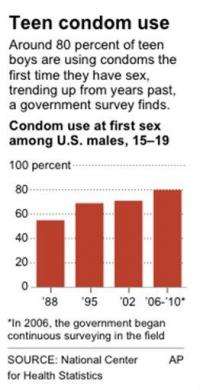
A surprising 80 percent of teenage boys say they are using condoms the first time they have sex, a government survey found in a powerful sign that decades of efforts to change young people's sexual behavior are taking hold.
But another promising trend - a drop since the 1980s in the number of teenagers having sex - has leveled off.
Boys' condom use may mean they are taking more responsibility for contraception or they are protecting themselves from sexually transmitted diseases, experts say. Or, as one young man said, girls may be drawing the line.
"I'm not sure how much of this is guys thinking they need to use a condom or girls insisting they use a condom," said 17-year-old Olivier Vanasse of Princeton, N.J. "I'd be hesitant to give guys credit for coming up with this on their own."
The study, released Wednesday, is based on interviews with about 4,700 teenagers, ages 15 to 19, conducted from 2006 through 2010. It shows the percentage of boys who said they used condoms the first time they had sex climbed from 71 percent in 2002 to 80 percent in the new survey. In 1988, 55 percent of boys said they used a condom during their first sexual intercourse.
"It comes as a general surprise to people that teenagers in general and teen boys in particular can behave responsibly when it comes to making decisions about sex," said Bill Albert, spokesman for the National Campaign to Prevent Teen and Unplanned Pregnancy. "I think it is surprising."
The survey suggests that condom use continues. Asked if they used a condom the last time they had sex in the previous three months, 75 percent said they did, an increase from 71 percent in 2002.
"We don't think it's a stupid thing to do anymore," said Vanasse, a high school senior and staff writer for http://www.sexetc.org , a project of Rutgers University's Answer, a national sex education organization. "It's just accepted as common sense that you should be using a condom if you're going to be having sex."
Overall, about 43 percent of girls and 42 percent of boys report ever having vaginal intercourse, a rate that is statistically unchanged since 2002. The rates had been declining steadily since 1988, when 51 percent of girls and 60 percent of boys reported that they had had sex.
Albert said those findings also explode myths about teen sex.
"There's the notion that all teenagers are doing it, and that's not the case. In fact, less than half said they've had sex," he said. "And there's no gender gap between the teen boys and the teen girls. There's a myth that guys are out on the prowl, and that's not supported by this data."
Less sex and more contraception are driving down teen births, he said. The U.S. teen birth rate in 2009 - 39 births per 1,000 females - was nearly 40 percent lower than the peak in 1991. It's still a dramatically higher birth rate than in Western Europe, where birth control is less expensive and more accessible to teens.
The new study contains more encouraging news. For the first time, there was no racial difference in the percentage of girls reporting they had had sex. In the past, black females were more likely than whites to be sexually experienced.
"That's due to a drop in black females who are sexually experienced," said the study's lead author, Gladys Martinez, a demographer for the government's National Center for Health Statistics.
Other findings:
- Teens were less likely to have had sex if they lived with both parents, if their mothers hadn't been teen moms themselves, or if their mothers were college graduates.
- Most teens - 70 percent of girls and 56 percent of boys - had their first sex with someone with whom they were "going steady."
- A minority - 16 percent of girls and 28 percent of boys - had their first sex with someone they just met or with whom they were "just friends."
Some teenage girls are trying newer contraceptive methods, even the first time they have sex. A small but growing proportion of girls - 6 percent in the new survey, compared with 2 percent in 2002 - reported using long-acting hormonal methods such as injectable birth control, contraceptive patches or the new contraceptive ring.
The finding on teenage boys' condom use heartened proponents of sex education.
"Boys have really stepped up to the plate in the last 20 years. We've included them in the conversation about teen sex and have seen them as able to be responsible actors, and they've done it for us," said Linda Lindberg, a senior research associate for the Guttmacher Institute. "There's been some shift from the double standard of teaching boys not to ask for sex and teaching girls to say no."
She said it was too soon to see any effect from the Obama administration's move away from abstinence-only sex education to programs that teach pregnancy prevention.
More information: Report: http://www.cdc.gov/NCHS/
©2011 The Associated Press. All rights reserved. This material may not be published, broadcast, rewritten or redistributed.


