Pill and pregnancy have biggest effects on ovarian cancer risk
October 26, 2011 in Obstetrics & gynaecology
(Medical Xpress) -- Taking the Pill for 10 years can reduce the risk of ovarian cancer by almost half (45 per cent), new research part-funded by Cancer Research UK shows today.
Overall, women who took the Pill for any length of time had an approximately 15 per cent lower risk of ovarian cancer than those who never took it at all - and the risk reduced further in women taking it for longer.
The study, published in the British Journal of Cancer, looked at how various reproductive factors affected the risk of ovarian cancer.
Taking the Pill for more than 10 years had the biggest impact on reducing the risk of the disease, followed by getting pregnant and having more than one child.
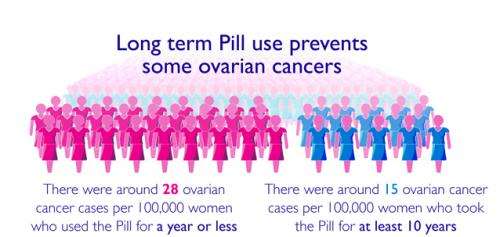
Among women who used the pill for a year or less, the risk of developing ovarian cancer was around 28 per 100,000 per year. For women who took the pill for at least 10 years, this risk fell by about half to around 15 per 100,000 per year.
Women who had ever been through a full-term pregnancy had a 29 per cent lower ovarian cancer risk compared with women who had never been pregnant.
Among women who had never been pregnant, the risk of developing ovarian cancer was 34 per 100,000 per year. For women who had at least one full-term pregnancy, this risk fell to around 24 per 100,000 per year.
And the bigger the family, the greater the benefit among women who have children, each additional child lowered the risk of ovarian cancer by a further eight per cent.
The research is part of ongoing work by the European Prospective Investigation of Cancer (EPIC) a Cancer Research UK co-funded study and one of the largest studies into the links between diet, lifestyle and cancer.
Naomi Allen, a Cancer Research UK epidemiologist, based at the University of Oxford who works on the EPIC study, said: Ovarian cancer is difficult to detect and so prevention is key to saving women suffering from this disease. These results are important because most women dont know that taking the Pill or getting pregnant can help reduce their risk of ovarian cancer later on in life.
Research has not yet established how factors like the Pill and pregnancy reduce ovarian cancer risk. One theory is that taking the Pill or getting pregnant changes the level of hormones that can affect a womans risk of the disease.
While the Pill has a protective effect against ovarian cancer, women taking the Pill have an increased risk of breast cancer while using it, but which disappears after use has stopped.
Ovarian cancer is the fifth most common cancer in women in the UK with over 6,500 cases diagnosed each year.
The link between ovarian cancer and pregnancy and using oral contraceptives is already well established - this study adds weight to the evidence.
Dr Richard Edmondson, a Cancer Research UK women's cancer expert based at the University of Newcastle, said: "Women may be reassured to know that the oral contraceptive is not only an effective contraceptive but can have the added benefit of reducing their risk of ovarian cancer.
This is however balanced against a slightly increased risk of developing breast cancer. To put this in context, it is estimated that if 100,000 women use the pill for ten years or more there will be 50 more breast cancers than would have otherwise occurred, but 12 fewer ovarian cancers.
This may be particularly important for women with an increased risk of ovarian cancer in their family.
Sara Hiom, director of health information at Cancer Research UK, said: These days it is not uncommon for women to have fewer children or none at all. Women tend to be unaware that these reproductive factors have a protective effect on their risk of ovarian cancer.
Nobody can expect women to start living like their Victorian counterparts to reduce their risk of the disease. But there are other things that can be done to lower the risk of ovarian cancer like stopping smoking and maintaining a healthy weight.
As with most cancers, the risk of developing ovarian cancer increases with age - most cases are in women who are past their menopause. Inherited faulty genes can also play a significant role, and women who think they may have a family history should discuss this with their doctor.
Treatment for ovarian cancer is better if the disease is caught as early as possible. So all women should be aware of the signs of ovarian cancer like pain in the lower tummy, bloating, increased tummy size, difficulty eating or feeling full. If these symptoms are new and happen on most days then its worth getting checked out by your doctor without delay.
More information: Konstantinos K Tsilidis et al, Oral Contraceptive Use and Reproductive Factors and Risk of Ovarian Cancer in European Prospective Investigation into Cancer Nutrition British Journal of Cancer (2011) DOI:10.1038/bjc.2011.371
Provided by Cancer Research UK
-
Study links obesity to elevated risk of ovarian cancer
Jan 05, 2009 |
not rated yet |
0
-
Scientists discover new genetic marker of ovarian cancer risk
Jul 20, 2010 |
not rated yet |
0
-
Fertility drugs do not increase risk of ovarian cancer
Feb 06, 2009 |
not rated yet |
0
-
Faulty gene connected to ovarian cancer risk
Aug 09, 2011 |
not rated yet |
0
-
Only women with Western Swedish breast cancer gene run higher risk of ovarian cancer
Apr 05, 2010 |
not rated yet |
0
-
Of mice and mental models: Neuroscientific implications of risk-optimized behavior in the mouse
May 25, 2012 |
not rated yet |
0
-
Limits to growth: Scientists identify key metastasis-enabling enzyme
May 22, 2012 |
5 / 5 (4) |
0
-
Seeing is as seeing does: Spatially-structured retinal input in early development of cortical maps
Apr 26, 2012 |
5 / 5 (4) |
1
-
Dreamless nights: Brain activity during nonrapid eye movement sleep
Apr 09, 2012 |
4.4 / 5 (12) |
0
-
Take your time: Neurobiology sheds light on the superiority of spaced vs. massed learning
Mar 28, 2012 |
4.5 / 5 (21) |
3
-
Force in a magnetic coupling
4 hours ago
-
Sign of scalar product in electric potential integral?
11 hours ago
-
Heat engines: how can we yield work?
12 hours ago
-
What capacitors to use in a Tesla coil...?
22 hours ago
-
Work done by us on the spring
23 hours ago
-
Surface current density
May 25, 2012
- More from Physics Forums - Classical Physics
More news stories
Phone contact with nurses linked with better outcomes for women with gestational diabetes
Among women with gestational diabetes mellitus, referral to a telephone-based nurse management program was associated with lower risk of high baby birth weight and increased postpartum glucose testing, according to Kaiser ...
Obstetrics & gynaecology
May 25, 2012 |
not rated yet |
0
Progestin treatment for polycystic ovarian syndrome may reduce pregnancy chances
(Medical Xpress) -- The hormone progestin, often given as a first step in infertility treatment for polycystic ovary syndrome (PCOS), appears to decrease the odds of conception and of giving birth, according to a study by ...
Obstetrics & gynaecology
May 25, 2012 |
not rated yet |
0
|
Women trying to have babies face different clock problem
A new Northwestern University study shows that the biological clock is not the only clock women trying to conceive should consider. The circadian clock needs attention, too.
Obstetrics & gynaecology
May 23, 2012 |
not rated yet |
0
|
UK may allow IVF for older women, same-sex couples
(AP) -- A powerful health advisory agency says Britain should extend free fertility treatments to women up to age 42 as well as same-sex couples, recommendations likely to be followed by many of the U.K.'s medical centers.
Obstetrics & gynaecology
May 22, 2012 |
not rated yet |
0
The Women's Health Initiative study and hormone therapy -- what have we learned 10 years on?
In July 2002 the publication of the first Women's Health Initiative (WHI) report caused a dramatic drop in Menopausal Hormone Therapy (HT ) use throughout the world. Now a major reappraisal by international experts, published ...
Obstetrics & gynaecology
May 22, 2012 |
not rated yet |
0
Travel to high altitudes tied to Crohn's, colitis flare-ups
(HealthDay) -- People with inflammatory bowel disease, which includes Crohn's disease and colitis, may be at increased risk for flare-ups when they fly or travel to high altitudes for skiing or mountain climbing, ...
Family history of Alzheimer's affects functional connectivity
(HealthDay) -- Cognitively normal individuals with a family history of late-onset Alzheimer's disease (AD) may display lower resting state functional connectivity in the default mode network (DMN) of the brain, ...
Transvaginal mesh op restores pelvic organ prolapse at price
(HealthDay) -- Transvaginal mesh (TVM) procedures are effective for anatomical restoration of pelvic organ prolapse (POP), but patients report a worsening of sexual function following surgery, according to ...
Tongue analysis software uses ancient Chinese medicine to warn of disease
For 5,000 years, the Chinese have used a system of medicine based on the flow and balance of positive and negative energies in the body. In this system, the appearance of the tongue is one of the measures used to classify ...
Skp2 activates cancer-promoting, glucose-processing Akt
HER2 and its epidermal growth factor receptor cousins mobilize a specialized protein to activate a major player in cancer development and sugar metabolism, scientists report in the May 25 issue of Cell.
Early physical therapist treatment associated with reduced risk of healthcare utilization and reduced overall healthcare
A new study published in Spine shows that early treatment by a physical therapist for low back pain (LBP), as compared to delayed treatment, was associated with reduced risk of subsequent healthcare utilization and lower ...