Almac devises test to detect likelihood of colon cancer recurring
November 8, 2011 in Cancer
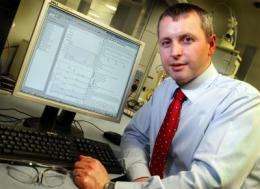
Professor Paul Harkin, President and Managing Director of Almac’s Diagnostic business unit which has devised a new test to detect likelihood of colon cancer recurring. Credit: Almac
The findings of Almac scientists' research have been published in the online version of the Journal of Clinical Oncology (JCO) ahead of the print edition of the journal. The JCO is the peer-reviewed publication of the American Society of Clinical Oncology (ASCO), the world's leading professional society representing physicians who treat people with cancer.
Colon cancer is the third most common cancer in the US. Over 100,000 patients are diagnosed each year and around one quarter of these patients are diagnosed with stage 2 of the disease.
Stage 2 colon cancer has a relatively good prognosis with around 80% of patients cured by surgery but the disease will recur in the remaining 20% within five years.
Although the 20% of patients in which the cancer recurs may benefit from chemotherapy there is currently no test which doctors can use to help identify them.
The JCO report gives detail on the development and validation of a prognostic test designed by Almac, ColDX, specifically developed to identify high risk patients who may benefit from additional therapy.
Professor Paul Harkin, President and Managing Director of Almac's Diagnostic business and Professor of Molecular Oncology at Queen's University Belfast said:
"We have used complex technologies designed in Craigavon, Northern Ireland, to examine tumour samples from around the world to identify a genetic signature which tell us the likelihood of stage 2 colon cancer recurring. This technology will make it much more straightforward for doctors to identify high risk patients who may benefit from chemotherapy.
"Our highly novel test represents a significant breakthrough in how colon cancer can be managed. We believe it has the potential to change clinical practice and save the lives of some cancer patients. "Almac is committed to research which improves the health of people around the world and this is just one example of how we are working to achieve that."
Almac scientists including, Professor Richard Kennedy, Dr Max Bylesjo, Dr Peter Kerr, Dr Timothy Davison and Dr Vitali Proutski were involved in the research.
The test was developed using Almac's proprietary discovery technology and using clinical patient samples from around 14 clinical sites across the world including Queen's University Belfast.
Professor Patrick Johnston, Dean, School of Medicine, Dentistry and Biomedical Sciences at Queen's, said:
"We are pleased to have been able to play a role in helping Almac to develop this groundbreaking technology which we hope could save many lives in the future. Both Queen's and Almac are working tirelessly in advancing cancer research and treatments."
Following further external validation and commercialisation the test could be available to UK patients within a couple of years and potentially even sooner in the US.
More information: The full title of the article published in the Journal of Clinical Oncology is entitled: "Development and Independent Validation of a Prognostic Assay for Stage II Colon Cancer Using Formalin-Fixed Paraffin-Embedded Tissue". http://jco.ascopub … 498.full.pdf
Provided by JPR
-
Scientists discover a way to kill off tumors in cancer treatment breakthrough
Apr 05, 2011 |
not rated yet |
0
-
Molecular profiling can accurately predict survival in colon cancer patients
Sep 25, 2007 |
not rated yet |
0
-
Test may help predict colon cancer recurrence risk
May 14, 2009 |
not rated yet |
0
-
Researchers identify gene set that shows which patients benefit from chemo after surgery
Sep 07, 2010 |
not rated yet |
0
-
Gene signature may improve colon cancer treatment
Feb 26, 2010 |
not rated yet |
0
-
Of mice and mental models: Neuroscientific implications of risk-optimized behavior in the mouse
May 25, 2012 |
not rated yet |
0
-
Limits to growth: Scientists identify key metastasis-enabling enzyme
May 22, 2012 |
5 / 5 (4) |
0
-
Seeing is as seeing does: Spatially-structured retinal input in early development of cortical maps
Apr 26, 2012 |
5 / 5 (4) |
1
-
Dreamless nights: Brain activity during nonrapid eye movement sleep
Apr 09, 2012 |
4.4 / 5 (12) |
0
-
Take your time: Neurobiology sheds light on the superiority of spaced vs. massed learning
Mar 28, 2012 |
4.5 / 5 (21) |
3
-
Potential Breakthrough in Seizure Control
8 hours ago
-
Popping/Cracked sternum.
13 hours ago
-
Which Mental Illness Encompasses This Problem?
13 hours ago
-
A question about drug tolerance
May 23, 2012
-
Poor nutrition leading to overeating?
May 23, 2012
-
Math and dyslexia?
May 21, 2012
- More from Physics Forums - Medical Sciences
More news stories
Skp2 activates cancer-promoting, glucose-processing Akt
HER2 and its epidermal growth factor receptor cousins mobilize a specialized protein to activate a major player in cancer development and sugar metabolism, scientists report in the May 25 issue of Cell.
Cancer
21 hours ago |
not rated yet |
0
|
Pancreatectomy OK without downstaging from therapy
(HealthDay) -- Pancreatectomy improves median survival in pancreatic cancer patients even when presurgical neoadjuvant therapy does not lead to radiographic downstaging of tumors, according to a study published ...
Cancer
22 hours ago |
not rated yet |
0
Common therapies for basal cell carcinoma offer similar survival
(HealthDay) -- For patients with superficial basal cell carcinoma (sBCC), treatment with imiquimod or photodynamic therapy (PDT) results in similar long-term tumor-free survival, according to a review published ...
Cancer
23 hours ago |
not rated yet |
0
Cancer may require simpler genetic mutations than previously thought
Chromosomal deletions in DNA often involve just one of two gene copies inherited from either parent. But scientists haven't known how a deletion in one gene from one parent, called a "hemizygous" deletion, can contribute ...
Cancer
May 25, 2012 |
not rated yet |
0
|
New prostate cancer screening guidelines face a tough sell, study suggests
(Medical Xpress) -- Recent recommendations from the U.S. Preventive Services Task Force (USPSTF) advising elimination of routine prostate-specific antigen (PSA) screening for prostate cancer in healthy men are likely to encounter ...
Cancer
May 25, 2012 |
not rated yet |
1
Travel to high altitudes tied to Crohn's, colitis flare-ups
(HealthDay) -- People with inflammatory bowel disease, which includes Crohn's disease and colitis, may be at increased risk for flare-ups when they fly or travel to high altitudes for skiing or mountain climbing, ...
Family history of Alzheimer's affects functional connectivity
(HealthDay) -- Cognitively normal individuals with a family history of late-onset Alzheimer's disease (AD) may display lower resting state functional connectivity in the default mode network (DMN) of the brain, ...
Transvaginal mesh op restores pelvic organ prolapse at price
(HealthDay) -- Transvaginal mesh (TVM) procedures are effective for anatomical restoration of pelvic organ prolapse (POP), but patients report a worsening of sexual function following surgery, according to ...
Tongue analysis software uses ancient Chinese medicine to warn of disease
For 5,000 years, the Chinese have used a system of medicine based on the flow and balance of positive and negative energies in the body. In this system, the appearance of the tongue is one of the measures used to classify ...
Early physical therapist treatment associated with reduced risk of healthcare utilization and reduced overall healthcare
A new study published in Spine shows that early treatment by a physical therapist for low back pain (LBP), as compared to delayed treatment, was associated with reduced risk of subsequent healthcare utilization and lower ...
New device allows pacemaker patients to safely undergo MRIs
For many, it's a medical conundrum: The very pacemaker keeping their heart in rhythm prevents them from undergoing an MRI to diagnose other ailments, because interaction between the two devices could prove deadly.