Biologists deliver neutralizing antibodies that protect against HIV infection in mice
Over the past year, researchers at the California Institute of Technology, and around the world, have been studying a group of potent antibodies that have the ability to neutralize HIV in the lab; their hope is that they may learn how to create a vaccine that makes antibodies with similar properties. Now, biologists at Caltech led by Nobel Laureate David Baltimore, president emeritus and Robert Andrews Millikan Professor of Biology, have taken one step closer to that goal: they have developed a way to deliver these antibodies to mice and, in so doing, have effectively protected them from HIV infection.
This new approach to HIV prevention -- called Vectored ImmunoProphylaxis, or VIP -- is outlined in the November 30 advance online publication of the journal Nature.
Traditional efforts to develop a vaccine against HIV have been centered on designing substances that provoke an effective immune response -- either in the form of antibodies to block infection or T cells that attack infected cells. With VIP, protective antibodies are being provided up front.
"VIP has a similar effect to a vaccine, but without ever calling on the immune system to do any of the work," says Alejandro Balazs, lead author of the study and a postdoctoral scholar in Baltimore's lab. "Normally, you put an antigen or killed bacteria or something into the body, and the immune system figures out how to make an antibody against it. We've taken that whole part out of the equation."
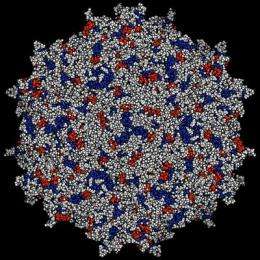
Because mice are not sensitive to HIV, the researchers used specialized mice carrying human immune cells that are able to grow HIV. They utilized an adeno-associated virus (AAV) -- a small, harmless virus that has been useful in gene-therapy trials -- as a carrier to deliver genes that are able to specify antibody production. The AAV was injected into the leg muscle of mice, and the muscle cells then put broadly neutralizing antibodies into the animals' circulatory systems. After just a single AAV injection, the mice produced high concentrations of these antibodies for the rest of their lives, as shown by intermittent sampling of their blood. Remarkably, these antibodies protected the mice from infection when the researchers exposed them to HIV intravenously.
The team points out that the leap from mice to humans is large -- the fact that the approach works in mice does not necessarily mean it will be successful in humans. Still, the researchers believe that the large amounts of antibodies that the mice were able to produce -- coupled with the finding that a relatively small amount of antibody has proved protective in the mice -- may translate into human protection against HIV infection.
"We're not promising that we've actually solved the human problem," says Baltimore. "But the evidence for prevention in these mice is very clear."
The paper also notes that in the mouse model, VIP worked even in the face of increased exposure to HIV. To test the efficacy of the antibody, the researchers started with a virus dose of one nanogram, which was enough to infect the majority of the mice who received it. When they saw that the mice given VIP could withstand that dose, they continued to bump it up until they were challenging them with 125 nanograms of virus.
"We expected that at some dose, the antibodies would fail to protect the mice, but it never did -- even when we gave mice 100 times more HIV than would be needed to infect 7 out of 8 mice," says Balazs. "All of the exposures in this work were significantly larger than a human being would be likely to encounter."
He points out that this outcome likely had more to do with the properties of the antibody that was tested than the method, but adds that VIP is what enabled the large amount of this powerful antibody to circulate through the mice and fight the virus. Furthermore, VIP is a platform technique, meaning that as more potent neutralizing antibodies are isolated or developed for HIV or other infectious organisms, they can also be delivered using this method.
"If humans are like mice, then we have devised a way to protect against the transmission of HIV from person to person," says Baltimore. "But that is a huge if, and so the next step is to try to find out whether humans behave like mice."
He says the team is currently in the process of developing a plan to test their method in human clinical trials. The initial tests will ask whether the AAV vector can program the muscle of humans to make levels of antibody that would be expected to be protective against HIV.
"In typical vaccine studies, those inoculated usually mount an immune response -- you just don't know if it's going to work to fight the virus," explains Balazs. "In this case, because we already know that the antibodies work, my opinion is that if we can induce production of sufficient antibody in people, then the odds that VIP will be successful are actually pretty high."
More information: "Antibody-based Protection Against HIV Infection by Vectored ImmunoProphylaxis," Nature, 2011.


