Breakthrough in the battle against malaria
November 29, 2011 in Medical research
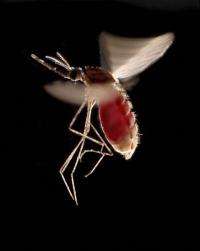
A mosquito in flight with its abdomen full of blood. This species, Anopheles stephensi, is the insect that transmits malaria in India and Pakistan. Credit: Hugh Sturrock/Wellcome Images
An international team of scientists has announced a breakthrough in the fight against malaria, paving the way for the development of new drugs to treat the deadly disease.
According to the World Health Organisation malaria currently infects more then 225 million people worldwide and accounts for nearly 800,000 deaths per year. Most deaths occur among children living in Africa where a child dies every 45 seconds of malaria and the disease accounts for approximately 20% of all childhood deaths. The disease is caused by the malaria parasite, Plasmodium, that is injected into the human host through the bite of the female Anopheles mosquito.
Now researchers have discovered new ways in which the malarial parasite survives in the bloodstream of its victims.
The advance is the result of a collaboration between medical scientists at the University of Leicester in the UK and a team from the French Institut National de la Santé et de la Recherche Médicale (Inserm) working at the Wellcome Trust Centre for Molecular Parasitology in Glasgow and the Ecole Polytechnique Fédérale de Lausanne (EPFL, Switzerland), now relocating to Monash University in Melbourne (Australia).
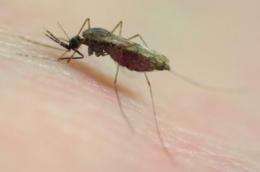
This is a specimen of Anopheles gambiae. Credit: Copyright Inserm/E.Begouen
The breakthrough was made by the teams led by Professor Andrew Tobin at the University of Leicester and Professor Christian Doerig, now at Monash University, and is published in the prestigious scientific journal Nature Communications and was funded by The Wellcome Trust, the European Commission, Inserm and EPFL.Professor Tobin, of the Department of Cell Physiology and Pharmacology, said: "I am proud to be involved in a collaboration that has made such an impact on malaria research. Our study opens new avenues for researchers to look for new drugs that treat malaria."
Professor Doerig explained "We have shown that a crucial element that is required by malaria parasites to survive in the human blood stream is a group of enzymes called protein kinases. If we stop these proteins kinases from working then we kill the malaria parasites. We are now looking for drugs that do exactly that stop the protein kinases from working. If we find these drugs then we will have a new way of killing the malaria parasite."
Professor Tobin added: "It seems perfectly realistic to us that we can now develop novel anti-malaria drugs based on the findings that we have made it certainly is a big moment in our fight against this terrible disease that mainly affects the world's poorest people."
Tobin and Doerig also warn: "The parasite is very clever at adapting to drug treatments and in so doing becoming resistant to drugs. In fact, there is already evidence that the parasite is developing resistance to the most recent front line treatment for malaria.
"To avoid the catastrophic affects of widespread resistance to anti-malarial treatments we need a continued pipeline of new anti-malaria drugs. Our discovery provides one avenue towards populating such a pipeline."
Provided by
University of Leicester
-
Discovery of key malaria proteins could mean sticky end for parasite
Jul 09, 2008 |
not rated yet |
0
-
Malaria's weakest link
Mar 08, 2011 |
not rated yet |
0
-
Breakthrough in malaria research looks to body's immune cells
Nov 25, 2011 |
not rated yet |
0
-
Scientists demonstrate feasibility of preventing malaria parasite from becoming sexually mature
Jun 02, 2008 |
not rated yet |
0
-
Protein plays key role in transmitting deadly malaria parasite
May 28, 2008 |
not rated yet |
0
-
Of mice and mental models: Neuroscientific implications of risk-optimized behavior in the mouse
May 25, 2012 |
not rated yet |
0
-
Limits to growth: Scientists identify key metastasis-enabling enzyme
May 22, 2012 |
5 / 5 (4) |
0
-
Seeing is as seeing does: Spatially-structured retinal input in early development of cortical maps
Apr 26, 2012 |
5 / 5 (4) |
1
-
Dreamless nights: Brain activity during nonrapid eye movement sleep
Apr 09, 2012 |
4.4 / 5 (12) |
0
-
Take your time: Neurobiology sheds light on the superiority of spaced vs. massed learning
Mar 28, 2012 |
4.5 / 5 (21) |
3
-
Potential Breakthrough in Seizure Control
9 hours ago
-
Popping/Cracked sternum.
14 hours ago
-
Which Mental Illness Encompasses This Problem?
14 hours ago
-
A question about drug tolerance
May 23, 2012
-
Poor nutrition leading to overeating?
May 23, 2012
-
Math and dyslexia?
May 21, 2012
- More from Physics Forums - Medical Sciences
More news stories
Implantable pain disk may help those with cancer
An estimated 3.5 million cancer patients around the globe are in severe pain from their disease, but many get no relief.
Medical research
May 25, 2012 |
not rated yet |
0
|
Energy levels link sleep control mechanisms
Sleep, or lack of it, can determine level of cognitive performance which is linked with accidents as well as increased risk of serious health problems. Links between cell energy levels, gene transcription ...
Medical research
May 25, 2012 |
not rated yet |
0
Researchers identify key brain cell in antidepressant action
(Medical Xpress) -- Antidepressant medications such as Prozac have helped improve mood and lessen anxiety in millions of people with major depression. But scientists know surprisingly little about how these drugs work.
Medical research
May 25, 2012 |
4.7 / 5 (3) |
0
|
Rockefeller scientists pioneer new method to determine mechanisms of drug action
(Medical Xpress) -- Knowing that a drug works is great. Knowing how it works is a luxury. And until now, determining a drugs mechanism of action has been a tedious and difficult process for scientists.
Medical research
May 25, 2012 |
not rated yet |
0
|
Like curry? New biological role identified for compound used in ancient medicine
Scientists have just identified a new reason why some curry dishes, made with spices humans have used for thousands of years, might be good for you.
Medical research
May 25, 2012 |
4.5 / 5 (12) |
2
|
Travel to high altitudes tied to Crohn's, colitis flare-ups
(HealthDay) -- People with inflammatory bowel disease, which includes Crohn's disease and colitis, may be at increased risk for flare-ups when they fly or travel to high altitudes for skiing or mountain climbing, ...
Family history of Alzheimer's affects functional connectivity
(HealthDay) -- Cognitively normal individuals with a family history of late-onset Alzheimer's disease (AD) may display lower resting state functional connectivity in the default mode network (DMN) of the brain, ...
Transvaginal mesh op restores pelvic organ prolapse at price
(HealthDay) -- Transvaginal mesh (TVM) procedures are effective for anatomical restoration of pelvic organ prolapse (POP), but patients report a worsening of sexual function following surgery, according to ...
Tongue analysis software uses ancient Chinese medicine to warn of disease
For 5,000 years, the Chinese have used a system of medicine based on the flow and balance of positive and negative energies in the body. In this system, the appearance of the tongue is one of the measures used to classify ...
Skp2 activates cancer-promoting, glucose-processing Akt
HER2 and its epidermal growth factor receptor cousins mobilize a specialized protein to activate a major player in cancer development and sugar metabolism, scientists report in the May 25 issue of Cell.
Early physical therapist treatment associated with reduced risk of healthcare utilization and reduced overall healthcare
A new study published in Spine shows that early treatment by a physical therapist for low back pain (LBP), as compared to delayed treatment, was associated with reduced risk of subsequent healthcare utilization and lower ...

Nov 29, 2011
Rank: 3.5 / 5 (2)
Nov 29, 2011
Rank: not rated yet
Dec 01, 2011
Rank: not rated yet
If the genetic alteration spreads to all species no harm done. The swarms/spread are localized, the food chain uninterrupted, and eradication of carriers simplified. Any re-occurance is localized. The much harder task of creating sterile males genetically was already undertaken without success.